
The word warped gets used for this constantly, and it points people at the wrong explanation. Here is what is really happening.
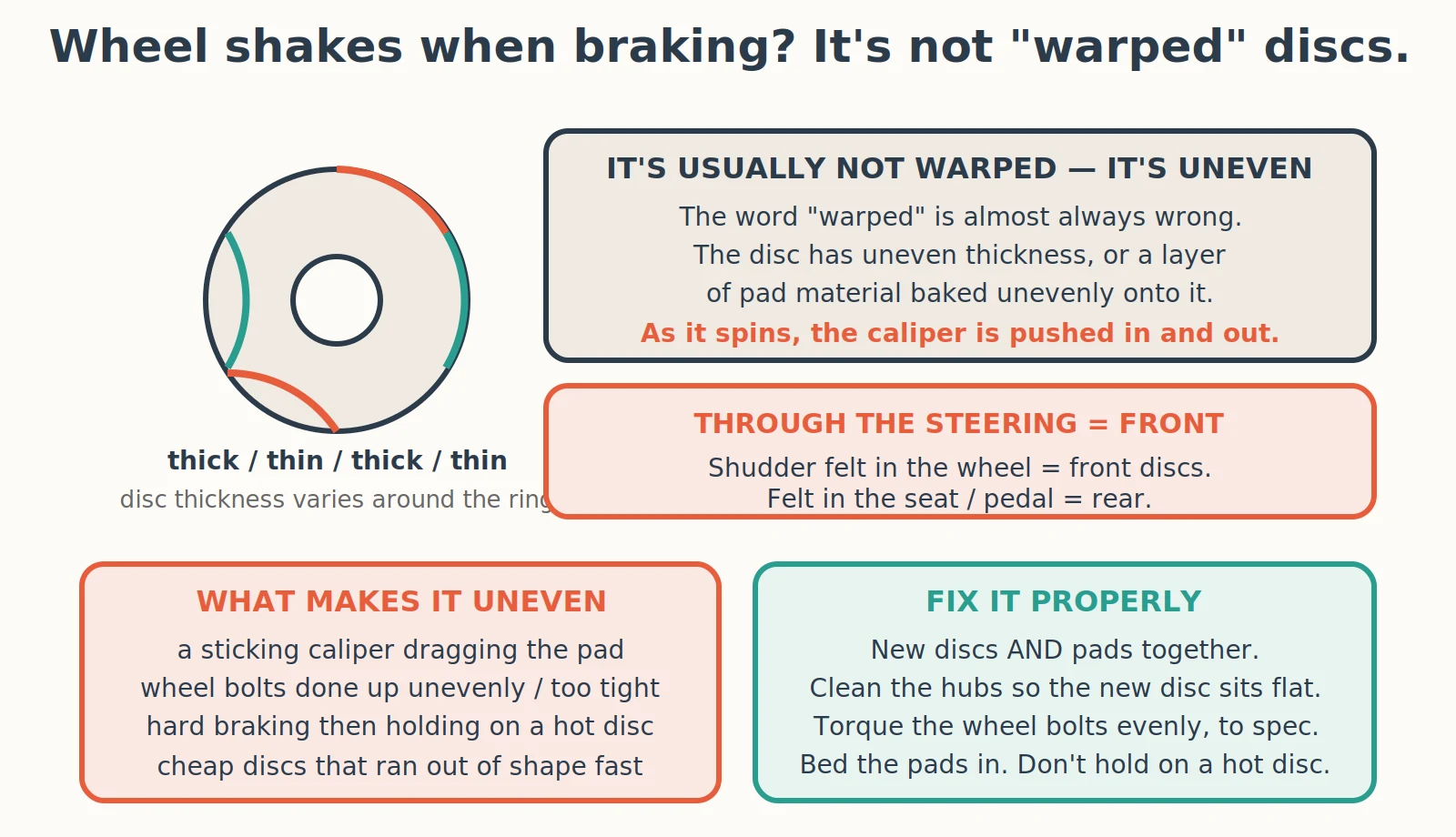
The disc thickness varies around the ring. As it spins, the caliper is pushed in and out — that is the shudder.
Are the discs really warped?
Usually not, in the sense people mean. A truly bent disc is rare. What actually causes almost all brake shudder is uneven disc thickness, which the trade calls thickness variation, or an uneven layer of pad material transferred onto the disc surface.
Both come to the same thing. As the disc spins, the thick parts and thin parts pass through the caliper, and the caliper is pushed in and out with every rotation. That is felt as a pulsing or shuddering, and it gets stronger the harder or faster you brake.
Calling it warped suggests heat bent the metal, and that then sends people towards the wrong causes and the wrong fixes. It is more useful to think of it as the disc no longer being a perfectly even thickness all the way around.
How do I tell if it is the front or rear discs?
By where you feel it. Vibration that comes up through the steering wheel is the front discs, because the front brakes and the steering are on the same axle. Vibration felt through the seat, the floor or the brake pedal, without much in the steering, is usually the rear discs.
This one clue saves money, because it tells you which end to work on rather than doing all four corners on a guess.
What makes a disc become uneven?
A sticking caliper is a leading cause. If the caliper does not release cleanly, the pad drags on the disc, creating a hot spot that wears unevenly or bakes pad material onto that patch. Sticky slide pins or a seized piston both do this.
Uneven wheel torque is another, and it is underrated. Wheel bolts done up unevenly, or over-tightened with an air gun instead of to the correct torque, distort the disc slightly. Over thousands of heat cycles that distortion becomes permanent thickness variation.
Holding the car stationary on the brake pedal right after hard braking, while the disc is very hot, presses the pads against one spot and can transfer material there. On a long descent followed by a stop at a light, this is easy to do without realising.
And cheap discs simply run out of shape faster. A poor quality disc with an uneven casting or soft metal develops thickness variation much sooner than a good one.
Why did the shudder come back soon after new discs?
Two usual reasons, and both are fitting rather than the discs themselves.
The hub was not cleaned. If there is rust or debris between the hub face and the new disc, the disc sits very slightly out of true from the moment it is bolted on. Even a small amount causes thickness variation to develop quickly. The hub face must be cleaned back to bare metal.
The underlying cause was never fixed. If a sticking caliper caused the first set to go uneven, fitting new discs onto that same caliper just repeats the process. The caliper has to be freed off or replaced at the same time, or the new discs go the same way.
Uneven wheel torque afterwards, or skipping the bedding-in procedure, will also bring it back.
Can uneven discs be machined instead of replaced?
Sometimes, if the disc has enough thickness left to be skimmed within its minimum specification. Machining removes the high spots and restores an even surface.
Whether it is worth doing depends on the disc. Many modern discs are quite thin to begin with and do not have enough material to machine safely, so replacement is the sensible route. And machining does nothing about the cause, so if a sticking caliper made the disc uneven, the caliper still needs sorting.
Is it safe to drive with brake shudder?
The brakes still work, so the car stops, but braking performance is compromised because the pads are not in constant even contact. In an emergency stop that matters.
It also tends to get worse, and it puts extra stress on the suspension and steering components through the constant vibration. It is not a fault to leave for months, both for safety and because the longer it runs the more likely it takes other parts with it.
Common questions
Why does my car only shudder when braking from high speed? Thickness variation produces a pulse once per wheel rotation, so the faster the wheel spins the stronger and more noticeable the shudder. It often shows up first at motorway speeds.
Can wheel balancing fix brake shudder? No. A wheel balance problem causes vibration that is there all the time at a given speed, whether or not you are braking. Brake shudder appears specifically when you brake. They are different faults.
Should I replace discs and pads together? For a shudder repair, yes. Fitting new discs against old, unevenly worn pads gives poor contact and can bring the problem back. Do them as a pair.
Does the shudder mean my discs are dangerous? Not immediately, but braking is less effective and it worsens over time. Treat it as a repair to do soon rather than an emergency, unless braking feels genuinely compromised.
Can a sticking caliper cause it? Yes, it is one of the most common underlying causes. A dragging pad creates the hot spot that makes the disc uneven. Free or replace the caliper or the new discs will not last.
Need brake parts?
I supply brake discs, pads, calipers, wheel hubs and ABS sensors out of China. Matched to your VIN, with the fitting hardware, with warranty. Small or mixed orders welcome. Send me the VIN on WhatsApp and I will price it the same day.