
The first thing to establish is which system your car has, because the two fail for completely different reasons and the cheap causes are different.
How do I know if my car has hydraulic or electric power steering?
Open the bonnet and look for a power steering fluid reservoir, usually a small tank with a cap marked with a steering wheel symbol. If it is there, you have hydraulic steering, and there will be a belt-driven pump on the engine.
If there is no fluid reservoir at all, you have electric power steering, usually called EPS or EPAS. Instead of a pump and fluid, an electric motor assists the steering, controlled by a torque sensor and a control module.
Most cars built in the last fifteen years or so use electric power steering. It is more efficient, because the motor only draws power when you actually turn the wheel.
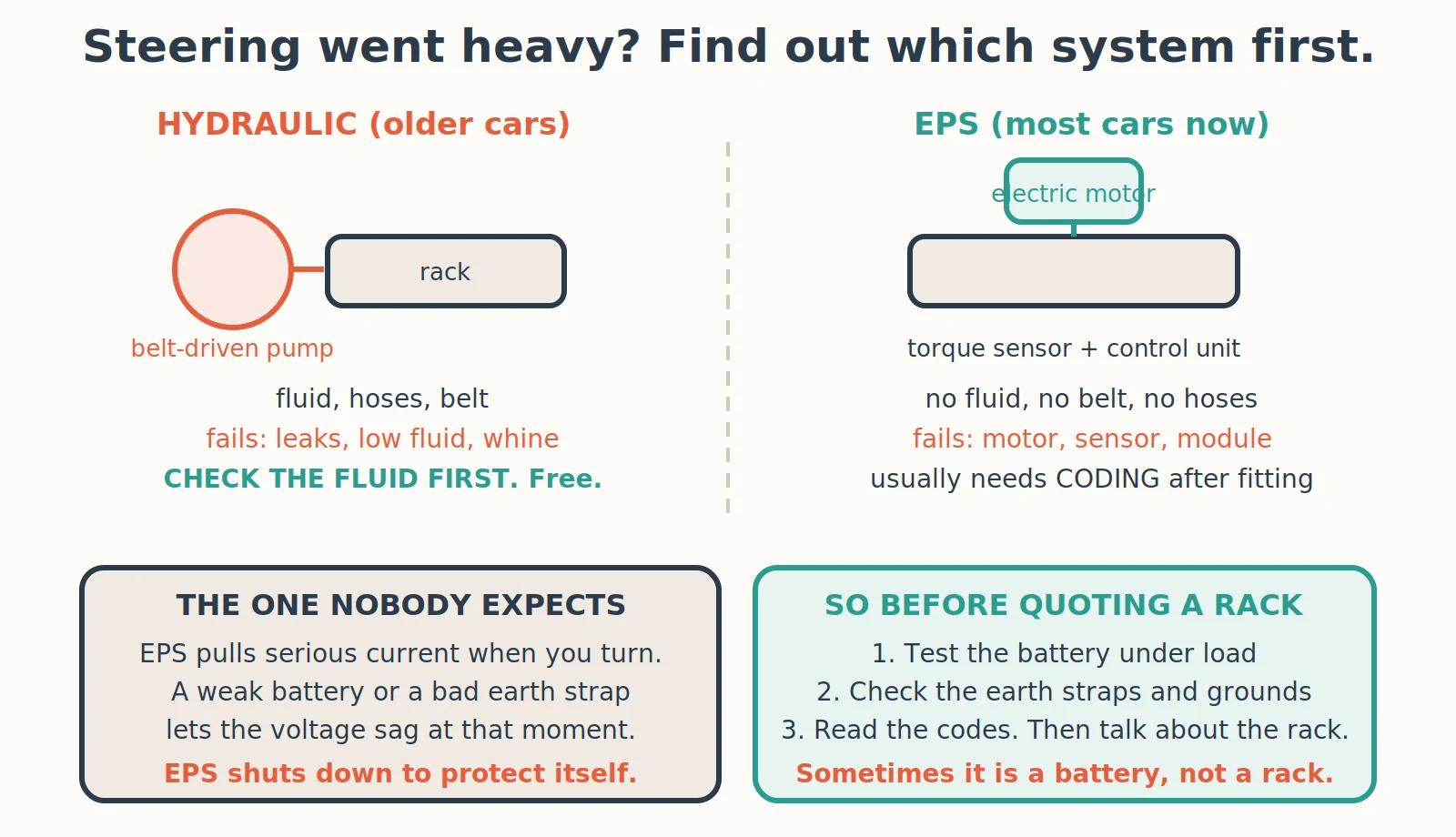
Two completely different systems. The cheap causes are different, so identify which one you have before anyone quotes a rack.
What causes heavy steering on a hydraulic system?
Check the fluid level first, because it is free and it is the most common cause. Low fluid means the pump draws air, and air does not push. If the level is low, there is a leak somewhere, so look at the hoses, the rack seals and the pump shaft.
A slipping or broken drive belt is the next thing to check. If the belt that drives the pump is glazed, loose or snapped, the pump stops working. On many cars that same belt also drives the alternator and the water pump, so you would usually have other warnings at the same time.
A failed pump is the more expensive answer, and it usually announces itself with a whine that rises with engine speed and is loudest at full lock. A whine plus heavy steering plus correct fluid level points at the pump.
One more that catches people: a hydraulic system that is heavy only when cold and improves as it warms up often has thickened, contaminated fluid or an ageing pump that cannot build pressure until everything is warm.
What causes heavy steering on an electric power steering system?
Here is the one that surprises people, and it is worth checking before anything else. Electric power steering draws a large amount of current at the exact moment you turn the wheel, particularly at low speed or when parking.
If the battery is weak, or an earth strap is corroded, the system voltage sags at that moment. The EPS control module sees the voltage drop, decides conditions are unsafe, and shuts the assistance down to protect itself. You get heavy steering and often a warning light, and the steering rack is in perfect health.
So the sequence that saves money is: test the battery under load, inspect and clean the earth straps and main grounds, then read the fault codes. Only after that should anyone start talking about a new rack or column.
The genuine EPS failures are the motor itself, the torque sensor that measures how hard you are turning, and the control module. These are real and they do happen, particularly on higher mileage cars, but they are not where you start.
Is it safe to drive with heavy steering?
Mechanically the steering still works. There is a direct mechanical connection from the wheel to the road wheels in both systems, so the car is steerable without assistance.
The practical problem is effort. Parking and low speed manoeuvres become very hard work, and in an emergency avoidance situation that extra effort matters. If the assistance has failed intermittently rather than completely, that is worse, because the steering effort changes without warning. Treat intermittent loss of assistance as urgent.
Why does the steering only go heavy sometimes?
Intermittent loss of assistance almost always points at something electrical or thermal rather than mechanical.
On EPS systems, look at connections and voltage. A poor earth or a marginal battery gives you a fault that appears when the electrical load is highest and disappears afterwards. Overheating is another cause, because the EPS module reduces assistance if the motor gets too hot after prolonged low speed manoeuvring, and that is normal protective behaviour rather than a fault.
On hydraulic systems, intermittent heaviness usually means fluid level or aeration. Air in the system comes and goes with temperature and with how the fluid is sloshing about.
Does an electric steering rack need coding after replacement?
On most cars, yes. The new unit generally needs to be coded or programmed to the vehicle, and the steering angle sensor usually needs calibrating afterwards.
This catches people out constantly. A perfectly good rack is fitted, nothing is coded, the car drives badly or throws faults, and the new part gets blamed. If you are ordering an EPS rack or column, confirm the coding requirement before the car is taken apart, not after.
Common questions
Can a bad battery cause a power steering fault? On an electric power steering system, yes, and it is one of the most common causes of an EPS warning with heavy steering. Test the battery before condemning the rack.
Why is my steering heavy only when parking? Low speed is when the assistance has to work hardest. A weak hydraulic pump or a marginal electrical supply shows up there first, before it shows up at road speed.
What does an EPS warning light look like? Usually a steering wheel symbol, sometimes with an exclamation mark, in yellow or red. Red generally means assistance has been lost, yellow that the system has a fault but may still be working.
Can you top up power steering fluid yourself? On a hydraulic system yes, using the fluid specified for that car. But a low level means a leak, so topping it up is a temporary measure while you find where it went, not a repair.
Need steering or suspension parts?
I supply electric power steering racks and columns, hydraulic pumps, steering angle sensors, control arms and suspension parts out of China. Matched to your VIN, coding requirements confirmed before shipping, with warranty. Send me the VIN on WhatsApp and I will price it the same day.