
If a workshop has quoted you for a new sensor or an ABS module straight after an alignment, this is worth reading before you spend anything.
What does the steering angle sensor do?
It tells the stability control system where you are pointing the steering wheel. That sounds trivial, but it is one half of the most important comparison the car makes.
The stability control system, called ESP, ESC, DSC or VSC depending on the brand, constantly compares two things. Where the driver is pointing, which comes from the steering angle sensor. And where the car is actually going, which comes from the yaw rate sensor and the wheel speed sensors.
When those two disagree, the car is sliding, and the system brakes an individual wheel to bring it back in line. That is the whole principle.
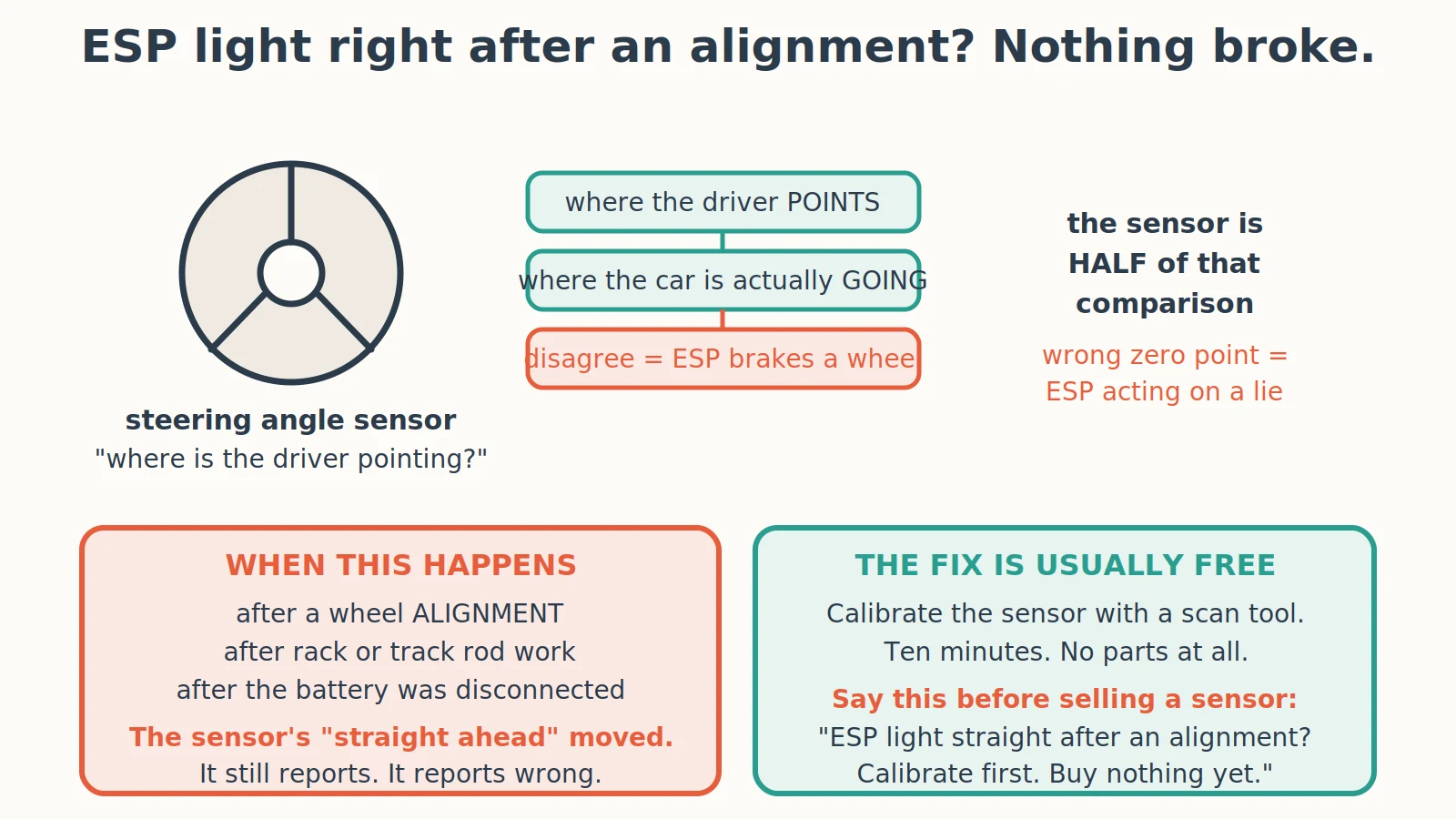
The sensor supplies one half of the comparison. If its zero point is wrong, the whole calculation is wrong.
Why does an alignment upset it?
Because an alignment adjusts the track rods to change the wheel angles, and that moves the steering wheel position relative to the road wheels.
The sensor's idea of straight ahead was learned before the alignment. Afterwards, the wheels are straight but the sensor may believe the steering is turned slightly. So the car is told the driver is steering left while the wheel speeds and yaw sensor say the vehicle is going perfectly straight.
The system sees a permanent disagreement that it cannot explain. Since acting on bad data could mean braking a wheel for no reason at speed, it does the safe thing and switches itself off, with a warning light.
Nothing is broken. The reference point moved and nobody told the sensor.
When else does this happen?
The same fault appears after any work that changes the steering or the electrical reference. Steering rack replacement. Track rod ends. Clock spring or steering column work. Suspension work that alters geometry.
It also appears after the battery has been disconnected or gone completely flat on some vehicles, because the stored calibration is lost. That one confuses people badly, since there is no obvious connection between a flat battery and a stability control warning.
How is the steering angle sensor calibrated?
With a diagnostic tool, following the procedure for that specific vehicle. Broadly, the car is placed with the wheels genuinely straight, and the tool tells the sensor that this position is now zero.
Some vehicles have a simpler relearn that happens by driving in a straight line at a set speed, or by turning lock to lock a specified number of times. Others require the full tool procedure. It depends on the model.
The important part is that a proper alignment should include this calibration as part of the job. If a workshop returns a car with an ESP light on after an alignment, the job is not finished.
Do I need a new steering angle sensor?
Usually not, and this is where money gets wasted. If the light came on immediately after alignment or steering work, calibration is the first thing to try, and it costs nothing in parts.
A genuinely failed sensor is a different pattern. It tends to throw an implausible signal fault, or produce a light that appears at random rather than immediately after work, or refuse to calibrate at all. If the calibration procedure will not complete, then the sensor or its wiring becomes a real suspect.
So the order is simple. Calibrate first. If it will not calibrate, then investigate the sensor.
Is it safe to drive with the ESP light on?
The normal brakes and steering still work, so the car is drivable. What you have lost is stability control and usually traction control.
That matters most in exactly the conditions where you would want them, which is wet roads, loose surfaces, and emergency avoidance. On a dry road at moderate speed you are unlikely to notice anything. In heavy rain you might notice a great deal. It is not a light to leave on for months.
Common questions
Can a wheel alignment cause a traction control light? Yes, indirectly, if the steering angle sensor is not recalibrated afterwards. It is one of the most common reasons the light appears after an alignment.
Will the ESP light clear itself? Sometimes, on vehicles that use a driving relearn procedure. Often it will not, and it needs a tool.
Should the alignment shop fix it free? Recalibration is generally considered part of doing an alignment on a car with stability control. It is reasonable to take the car back.
Can a wheel speed sensor cause the same light? Yes. ESP uses wheel speed data too, so a failed ABS sensor gives ABS and ESP lights together. The clue is timing. Straight after an alignment points at calibration. Appearing on its own while driving points at a wheel speed sensor or its wiring.
Does the steering angle sensor affect lane keeping or adaptive cruise? On cars with driver assistance systems it can, because those systems also use steering angle data. A miscalibrated sensor can produce assistance faults that look unrelated.
Need steering or ABS sensors?
I supply steering angle sensors, ABS wheel speed sensors, yaw sensors and chassis electronics out of China. Matched to your VIN, tested, with warranty. Small or mixed orders welcome and these parts fly cheap. Send me the part number or the VIN on WhatsApp and I will price it the same day.