
This is one of the most common ways a straightforward rear brake job turns expensive, so it is worth understanding before starting.
What is different about an electronic parking brake caliper?
On a traditional rear caliper with a cable handbrake, the piston has a screw mechanism inside that you wind back with a cube tool or wind-back tool. The handbrake cable pulls a lever on the outside. Everything is mechanical.
On an electronic parking brake, the cable and lever are replaced by an electric actuator motor bolted to the back of the caliper. When you press the parking brake switch, that motor drives a screw forward into the piston to clamp the pads. To release, the motor drives the screw back.
So the piston is not just held by hydraulic pressure. It is being physically held by a motor-driven screw, and that screw does not care how hard you push against it with a hand tool.
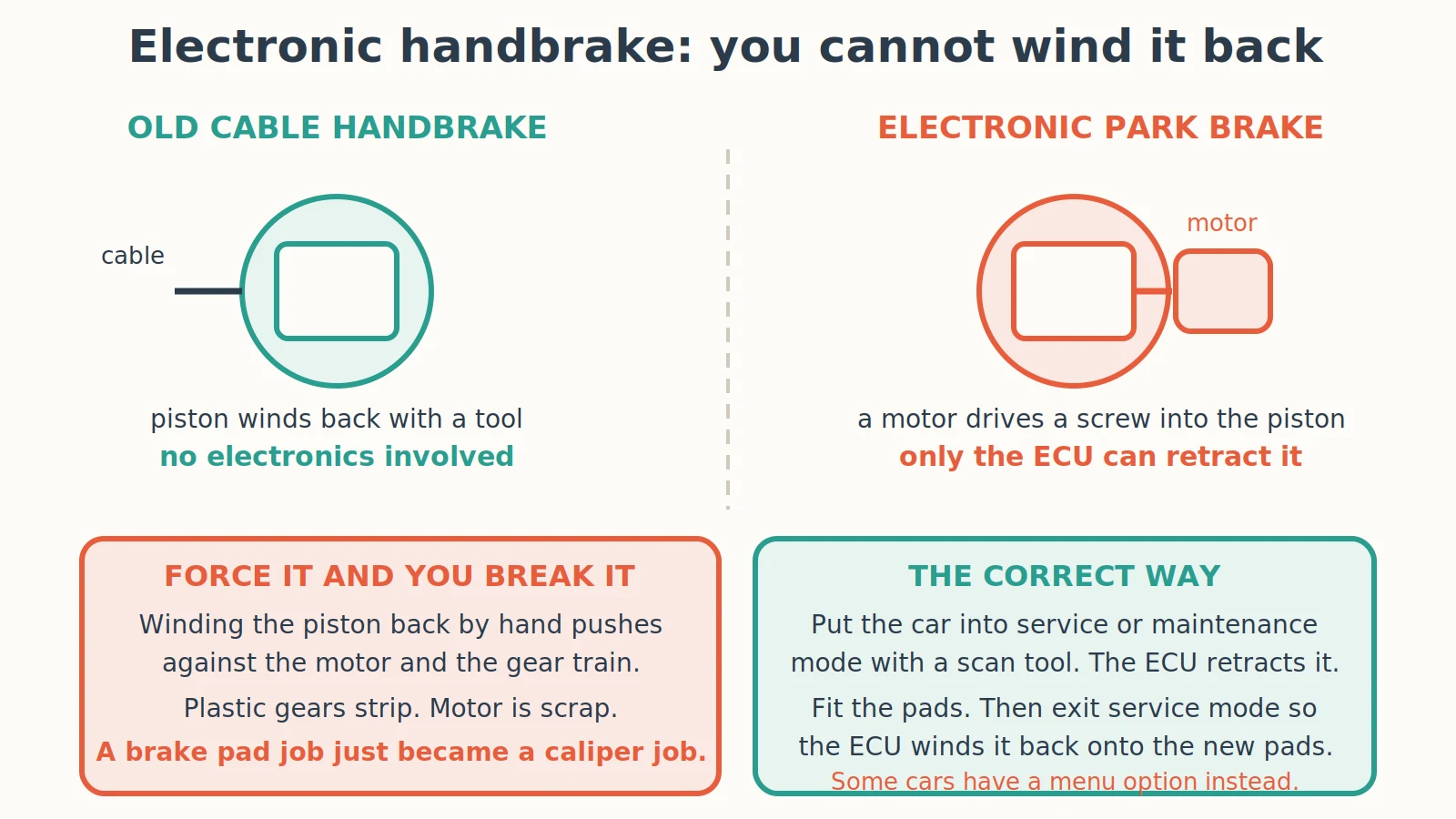
A motor and gear train drive the screw. Push against it with a wind-back tool and the gears are what give way.
What happens if you force the piston back?
The force goes back through the screw into the gear train and the motor. Those gears are often plastic or small metal gears not designed to be driven backwards under load, and they can strip.
Once the gears are damaged, the motor spins and nothing moves. The parking brake will not apply or release properly on that corner, you get a fault light, and the fix is usually a new actuator motor or a complete caliper.
So the job that was going to be a set of pads becomes pads plus a caliper or actuator, plus the diagnostic time to sort the fault out afterwards. All to save ten minutes.
What is service mode and how does it work?
Service mode, sometimes called maintenance mode or brake pad replacement mode, is a function in the car's control unit that fully retracts the parking brake actuators and keeps them retracted while you work.
The general sequence is: put the car into service mode, which winds the actuators fully back. Change the pads and discs. Then exit service mode, which winds the actuators back onto the new pads and re-establishes the correct position.
That second half matters just as much as the first. Exiting service mode properly is how the system learns where the new, thicker pads sit. Skip it and the parking brake may hold poorly or throw a fault.
Can you do it without a diagnostic tool?
It depends on the vehicle. Some cars have a service mode option in the dashboard menu or a specific button and pedal sequence that puts the system into maintenance mode. Others require a tool.
Disconnecting the actuator's electrical plug and hoping the piston can then be wound back is not a substitute. The screw is still mechanically in position and the gears are still in the way.
If you cannot confirm a documented procedure for your exact model, the safe answer is to use a tool or have a workshop do it. The cost of the diagnostic time is far below the cost of a caliper.
Why is my electronic parking brake not releasing?
Several causes, roughly in order of how often they turn up. A weak battery, because the actuators draw significant current and low voltage can prevent operation. Corrosion or seizure in the caliper or actuator, which is common in wet and salty climates. A failed actuator motor, often with stripped gears. Damaged wiring to the actuator, which flexes with suspension movement. Or a control module fault.
Before condemning parts, test the battery and inspect the wiring at the caliper. Those are the cheap causes and they are genuinely common.
Do electronic parking brake calipers seize more often?
They are vulnerable in a specific way. The actuator is an electric motor with a gearbox sitting in the wheel arch, exposed to water, salt and road grime for years. Moisture ingress leads to corrosion, and a corroded mechanism binds.
Vehicles in coastal or salted-road climates suffer noticeably more. Where a cable handbrake would just seize a cable, an electronic system seizes a motor assembly that costs considerably more.
There is also a maintenance angle. Applying and releasing the parking brake regularly, and servicing the caliper slides and guide pins when the pads are changed, both reduce the chance of a seized mechanism.
Common questions
Can you change rear pads without a scan tool on an electronic handbrake? Only if that specific vehicle has a documented manual service mode procedure. Many do not. Do not assume.
Why did the parking brake light come on after a brake job? Usually because service mode was never exited properly, or the system needs to relearn the new pad position. Sometimes the actuator was damaged during the job.
Is an electronic parking brake actuator sold separately from the caliper? On many vehicles yes, which is much cheaper than a whole caliper. Confirm by VIN before assuming you need the complete unit.
Does the electronic parking brake work if the battery is flat? Generally no, because the actuators need power. That is also why a car with a flat battery may be stuck with the parking brake applied.
Do I need to bleed the brakes after changing pads on an electronic system? Not routinely for a pad change alone, but follow the correct procedure for the vehicle if the hydraulic system was opened.
Need brake and chassis parts?
I supply electronic parking brake actuators, calipers, ABS sensors, wheel hubs and chassis parts out of China. Matched to your VIN, with warranty. Small or mixed orders welcome. Send me the VIN on WhatsApp and I will price it the same day.