
So the useful question is not what is wrong with the new turbo. It is what killed the old one, and whether anybody dealt with it.
How does a turbocharger actually get lubricated?
There is no ball race carrying the load in the traditional sense on most turbos. The shaft rides on a film of pressurised engine oil in a plain bearing. That film is the only thing keeping metal off metal at extremely high speed and temperature.
Oil comes in through a small feed pipe from the engine's oil galleries, passes through the centre housing, and drains back down to the sump through a larger drain pipe. Both directions matter, and they fail differently.
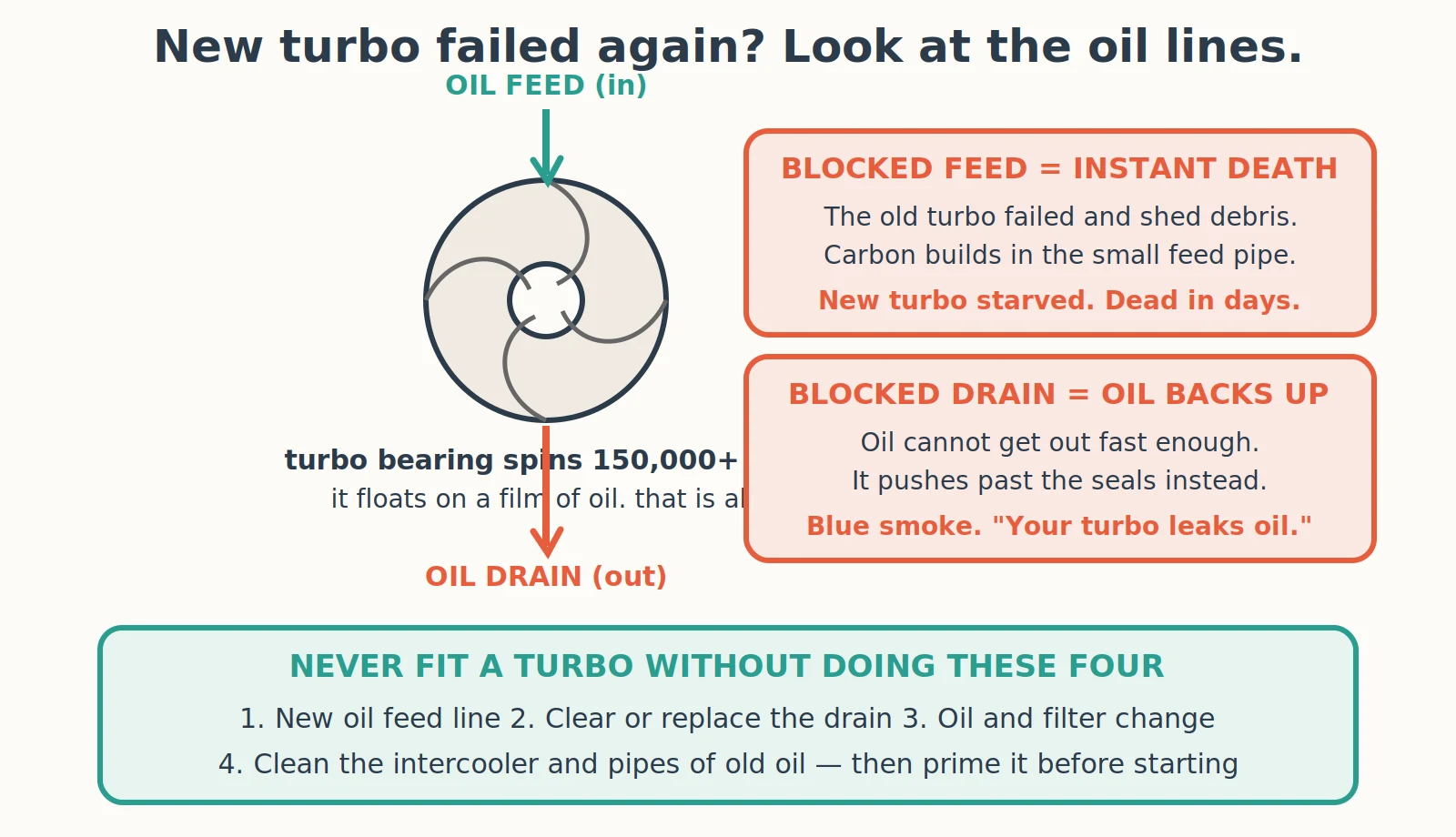
Feed in, drain out. Restrict either one and the new turbo is finished, for two completely different reasons.
What happens if the oil feed line is blocked?
The turbo is starved. Without a continuous supply of clean oil at pressure, the bearing surfaces touch, generate heat, and the shaft picks up damage within minutes of running. A badly restricted feed can destroy a brand new turbo on the first drive.
The feed pipe is small in diameter and it runs through a very hot area, so it is exactly where carbon deposits build up. When a turbo fails, it often also throws metal debris into the oil, and that debris lodges in the same narrow pipe.
This is why fitting a new turbo to the old feed line is a gamble. The pipe that helped kill the last one is still there.
What happens if the oil drain is blocked?
The opposite problem, and it produces a very misleading symptom. Oil goes into the turbo faster than it can escape, so pressure builds in the centre housing and forces oil past the seals into the compressor or turbine side.
Now you get blue smoke and oil consumption, and everybody concludes the new turbo has a leaking seal. The seal is fine. It is being overwhelmed.
Drain restrictions come from carbon in the drain pipe, a blocked or damaged pipe, or excessive crankcase pressure pushing back up the drain. That last one matters, because it points at a different fault entirely.
Can crankcase pressure cause a turbo to leak oil?
Yes, and it is one of the most missed causes. The turbo drain relies on gravity and on the crankcase not being pressurised. If the engine has high blow-by from worn rings, or the breather system is blocked, the crankcase pressure pushes back against the drain.
Oil cannot leave the turbo properly, so it leaves past the seals instead. Fit a third turbo and it will do the same thing.
So on any engine that has eaten more than one turbo, check the crankcase breather system and consider whether the engine's condition is the real cause. That is an uncomfortable conversation, but it is cheaper than a third turbo.
What should always be done when fitting a replacement turbo?
Replace the oil feed line rather than cleaning it. It is a relatively cheap part and cleaning a small carboned pipe reliably is difficult to verify.
Clear or replace the oil drain, and confirm it is not restricted or kinked.
Change the engine oil and filter, using the correct specification. The old oil contains debris from the failure.
Clean the intercooler and the charge pipes. A failed turbo pushes oil into them, and that oil then gets drawn back into the engine and can cause serious problems on a diesel.
Prime the new turbo with clean oil before starting, and let the engine idle rather than revving it immediately.
Check the air filter and the intake for debris, because a foreign object entering the compressor is another cause of sudden failure.
How do I know if the turbo is really the problem?
Before condemning a turbo, check the simple things, because several cheaper faults produce the same symptoms. A boost leak from a split hose or loose clamp gives low boost. A faulty boost pressure sensor reports low boost that is not actually low. A sticking or failed actuator gives no boost with a perfectly healthy turbo.
The order that saves the most money is: sensor, then boost leaks, then actuator, then the turbo itself. Most people start at the turbo, which is the most expensive item on the list.
Common questions
How long should a turbocharger last? On a well maintained engine with clean oil, often the life of the engine. Turbos rarely die of old age alone. They die of oil starvation, contamination, or foreign objects.
Does letting the engine idle before switching off help? Yes, particularly after hard driving. It lets oil keep circulating while the turbo cools, which reduces the carbon build-up that eventually blocks the feed pipe.
Can I fit a used turbo? You can, but you inherit unknown bearing condition and you still have to do all the oil system work. The saving is often smaller than it looks once the labour is counted.
Why is there oil in my intercooler? Usually a failed turbo seal, or excessive crankcase pressure pushing oil through the breather into the intake. On a diesel, oil pooling in the intake is worth taking seriously because it can be drawn into the engine.
Do turbo failures always show a fault code? No. Mechanical wear and gradual boost loss often produce driveability symptoms before any code appears.
Need turbo and diesel parts?
I supply turbochargers, turbo actuators, oil feed and drain lines, boost sensors and diesel engine parts out of China. Matched to your VIN, tested, with warranty. Small or mixed orders welcome. Send me the VIN on WhatsApp and I will price the turbo with the oil lines together.