
The single most useful thing to understand is that limp mode is the car doing its job, not the car breaking. Here is what triggers it and how to work through it.
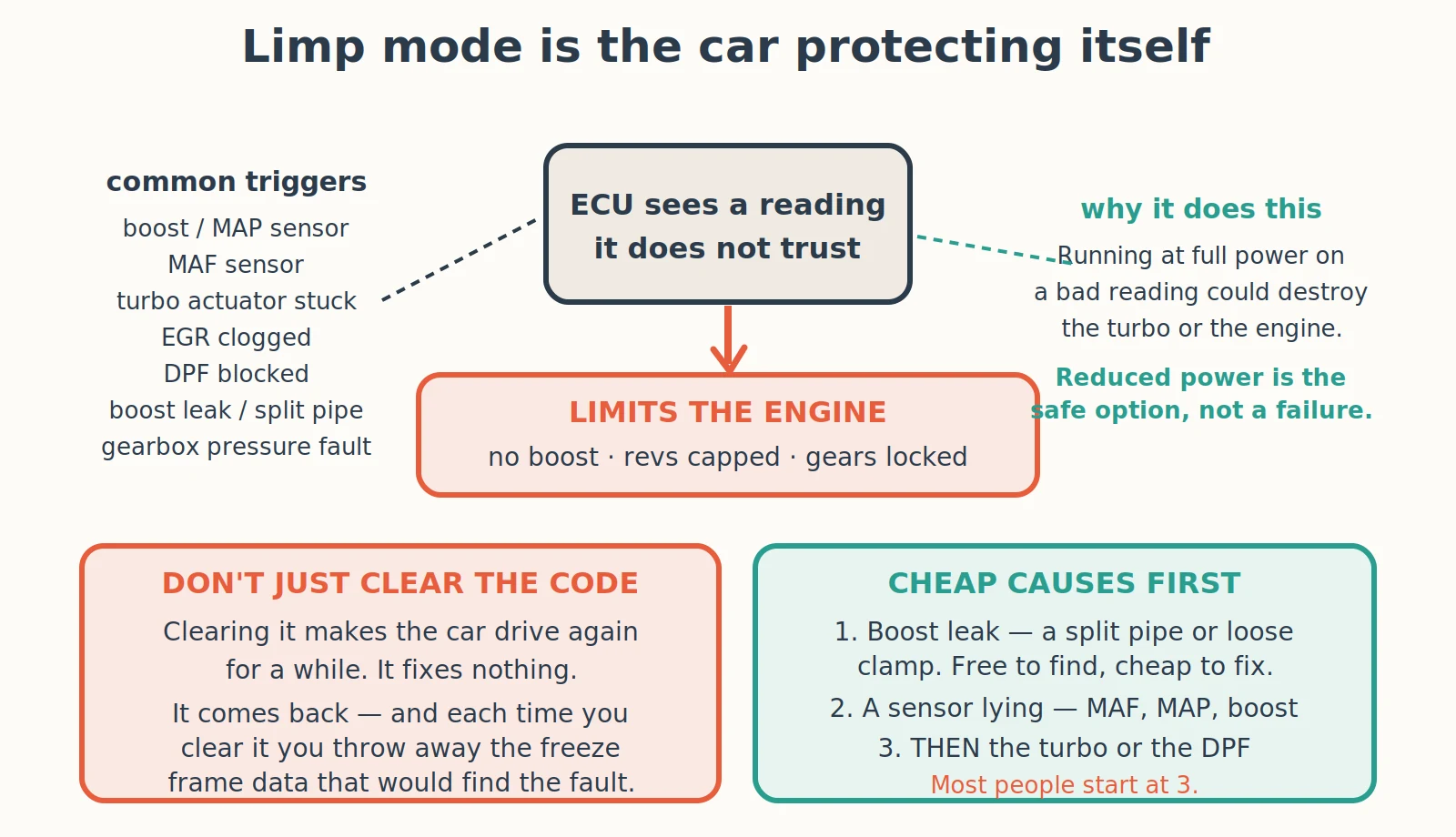
The ECU sees a reading it cannot trust and limits the engine rather than risk damage at full power.
What is limp mode actually doing?
When the engine computer detects a fault serious enough that running at full power could cause damage, it restricts the engine to a safe state. Typically that means no turbo boost, a capped rev limit, and on an automatic, the gearbox locked into one gear.
The car feels gutless and often will not go much beyond a modest speed, but it will usually still drive, which is the point. Limp home means exactly that: enough performance to get somewhere safely rather than leaving you stranded.
So the reduced power is not the fault. It is the protection. Something else caused it, and that is what needs finding.
What are the most common causes on a diesel?
Boost-related problems are the biggest single group. A split intercooler pipe, a loose or slipped clamp, or a perished hose lets boost escape, so the engine cannot reach the pressure the computer expects. Seeing a large gap between requested and actual boost, the computer assumes something is wrong and pulls back.
Sensor faults are the next group, and they are frequently misdiagnosed. A boost or MAP sensor, or a mass air flow sensor, reporting an implausible value will trigger limp mode even though the mechanical parts are all fine. These sensors are cheap compared with what they get blamed on.
A turbo actuator that is sticking, so the turbo cannot control boost properly, is common on higher mileage diesels. A clogged EGR valve upsets running and can trigger it. And a diesel particulate filter that has become too blocked to regenerate will put the car into limp mode to prevent further damage.
On vehicles with automatic gearboxes, a transmission fault such as a pressure or solenoid problem can also cause a limp condition, which is why the codes matter rather than assuming it is always the engine.
Why should I not just clear the code?
Clearing the fault code usually makes the car drive normally again, for a while. That feels like a fix, which is exactly why it is such a common mistake.
Nothing has been repaired. The condition that triggered limp mode is still there, so it comes back, often quickly. And in the meantime the engine may be running with a genuine fault that is doing damage, which is the situation limp mode existed to prevent.
There is a second cost that people do not think about. Stored with the fault code is freeze-frame data, a snapshot of the engine conditions at the moment the fault occurred. That data is often the most useful clue for finding an intermittent fault. Clearing the code throws it away. So repeatedly clearing codes makes the eventual diagnosis harder, not easier.
What order should the causes be checked in?
Read the codes first, including freeze-frame data, and treat them as a starting point rather than an answer. A code names a circuit or a condition, not necessarily the failed part.
Then check for boost leaks, because they are cheap to find and cheap to fix. A visual inspection of the intercooler pipes, clamps and hoses catches a surprising number of limp mode cases. A split in a boost pipe is far more common than a failed turbo, and vastly cheaper.
Then look at the sensors involved, particularly the boost or MAP sensor and the MAF sensor, checking their live readings for plausibility rather than just whether they have a code.
Only after those should attention move to the expensive items: the turbo and its actuator, the EGR system, and the DPF. Most people start there, which is why so much money gets spent on limp mode faults that were a split hose or a twenty dollar sensor.
Is it safe to drive in limp mode?
Limp mode is designed so you can get the car somewhere safely rather than being stranded, so short journeys to home or to a workshop are the intended use.
It is not designed to be driven in indefinitely. The performance limitation itself creates risk in traffic, since the car may not accelerate to merge or overtake normally. And whatever caused it may be actively damaging something, so continuing to drive extends the problem.
Treat it as get the car somewhere and get it diagnosed, not as a temporary inconvenience to live with.
Why does limp mode come and go?
An intermittent limp mode usually means an intermittent fault, and the most common culprits are electrical connections and boost leaks that only open up under high load.
A boost pipe that seals fine at idle can pop or leak under full boost, so the fault appears only under hard acceleration and clears when you restart. A sensor connector with corrosion may work most of the time and fail when the wiring flexes or heats up. A sticking turbo actuator may bind only when hot.
This is exactly where freeze-frame data earns its keep, because it records whether the fault happened under load, hot, cold or at speed, which points at which of these it is.
Common questions
Will limp mode clear itself? Some faults clear after restarting if the condition no longer applies, which is why the car sometimes seems fine the next morning. That does not mean it is fixed.
Can a blocked DPF cause limp mode? Yes. If the filter is too blocked to regenerate normally, the car limits power to prevent damage. Catching it before that stage, with regular longer runs at temperature, is far cheaper.
Is limp mode always an engine problem? No. On automatics, a gearbox fault can cause it too. That is why reading the codes matters before assuming which system is at fault.
Can a cheap sensor really cause limp mode? Yes, routinely. A boost, MAP or MAF sensor reporting a bad value triggers protection even though every mechanical part is healthy. This is why sensors should be checked before the turbo.
Does limp mode damage the engine? No, it exists to prevent damage. The underlying fault may be doing damage, which is the reason not to keep driving in it.
Need diesel and turbo parts?
I supply turbochargers, turbo actuators, boost and MAP sensors, MAF sensors, EGR valves, intercooler pipes and DPF pressure sensors out of China. Matched to your VIN, tested, with warranty. Small or mixed orders welcome. Send me the VIN and the fault code on WhatsApp and I will help narrow it down before you buy anything.