
This is a question where the mechanical answer and the legal answer are different, so it is worth being clear on both.
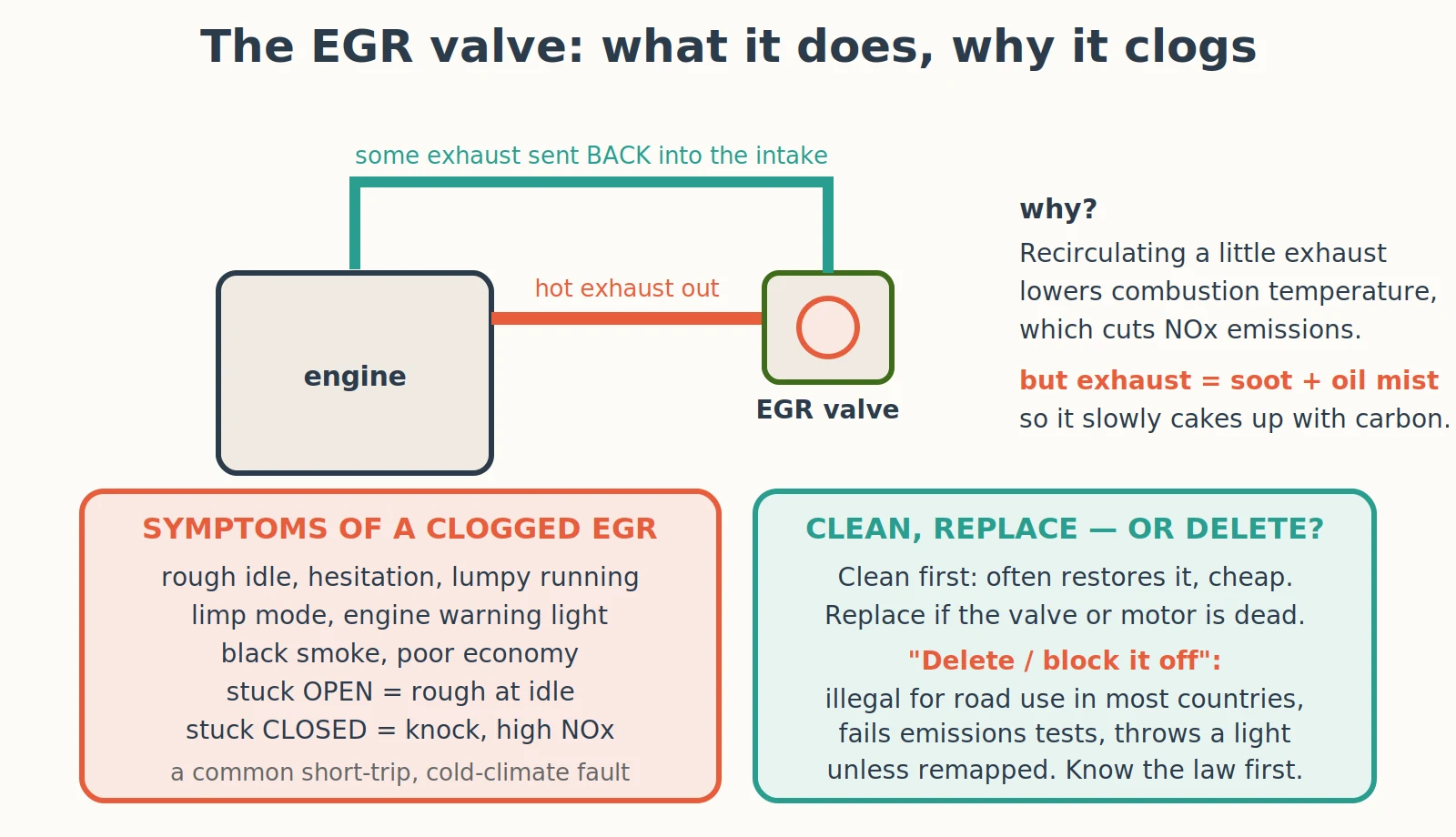
The EGR sends a little exhaust back into the intake to cut emissions. Exhaust carries soot, so it slowly clogs.
What does the EGR valve actually do?
EGR stands for exhaust gas recirculation. The valve takes a small amount of exhaust gas and feeds it back into the engine's intake to be burned again.
The reason is emissions. Recirculating some exhaust lowers the peak temperature of combustion, and lower combustion temperatures produce less of a pollutant called NOx, nitrogen oxides. So the EGR valve is fundamentally an emissions control device, and that is the key to understanding why removing it has consequences beyond the engine.
The catch is that exhaust gas carries soot and oil mist, so over time the valve and its passages cake up with carbon. That is why EGR problems are so common, particularly on diesels and on cars that do a lot of short, cold trips where the deposits never get burned off.
What are the symptoms of a faulty EGR valve?
A clogged or stuck EGR valve gives a fairly recognisable set of symptoms: a rough or lumpy idle, hesitation, poor throttle response, reduced economy, and often a warning light or even limp mode.
Whether it sticks open or closed changes the picture. Stuck open, it lets exhaust into the engine when it should not, which typically causes a rough idle and stalling, because the engine is trying to idle on partly inert gas. Stuck closed, it stops recirculation altogether, which can cause higher combustion temperatures, knocking, and raised NOx that shows up on an emissions test.
Because these symptoms overlap with other faults, it is worth confirming the EGR is the cause with diagnostics rather than assuming, before cleaning or replacing anything.
How is an EGR valve cleaned?
The valve is removed and the carbon deposits cleaned off with a suitable carbon cleaner and some careful work, taking care not to damage the valve or any electronic parts. On many vehicles this restores normal operation and is far cheaper than replacement.
There are also cleaning products designed to be used through the intake without removing the valve, and their results vary. They can help with light deposits but are unlikely to rescue a heavily caked valve, which really needs to come off to be cleaned properly.
Cleaning is the right first move when the valve mechanism and its motor are still sound and the problem is simply carbon. It buys back normal running at low cost.
When does the EGR valve need replacing instead?
When the valve itself has failed rather than just being dirty. If the electric motor or the position sensor inside it has failed, if the valve is physically seized and will not move even after cleaning, or if it is so worn it no longer seals, then cleaning will not fix it and a new valve is needed.
It is worth diagnosing which situation you are in before spending, because replacing a valve that only needed cleaning wastes money, and cleaning a valve whose motor has died wastes time. The fault codes and a proper test of the valve's movement tell you which.
Is it legal to delete or blank off the EGR?
On a vehicle used on public roads, in most countries, no. The EGR is part of the emissions system, and removing or disabling it is generally illegal for road use. It will cause the vehicle to fail an emissions test where one is required, and tampering with emissions equipment can have legal penalties.
Mechanically, blanking it off also tends to trigger a warning light, because the engine computer monitors the valve and notices when it stops responding. To suppress that, people remap the engine to ignore the EGR, which is a further modification with its own legal and insurance implications.
There are limited legitimate contexts, such as off-road, competition or certain non-road applications, where emissions rules differ. But for a normal road car the honest position is that deleting the EGR is not a legal repair, and I would not present it as one. The legal route is to clean it or replace it so the system works as intended. What is permitted varies by country and changes over time, so anyone considering it should check the current rules where the vehicle is registered.
How do I stop the EGR clogging again?
The deposits build up worst on engines that do a lot of short, low-speed, cold trips, because the system never gets hot enough for long enough to burn deposits off. Regular longer runs at operating temperature help keep it cleaner.
Good quality fuel and oil, and keeping the oil changes up to date, also reduce the soot and oil mist that feed the deposits. And on a diesel, a healthy EGR is connected to a healthy diesel particulate filter and intake, so keeping the whole system in good order matters more than treating the valve in isolation.
Common questions
Will cleaning the EGR valve fix limp mode? If the limp mode was caused by a stuck or clogged EGR, cleaning can fix it. If it was caused by a failed motor or another fault, it will not. Confirm the cause first.
Does blanking the EGR improve performance? Any change is usually small and comes with legal, testing and warning-light consequences on a road car. It is not a legal performance modification for road use in most places.
Why does my EGR keep clogging? Short cold trips are the main cause, because deposits never burn off. Longer runs at temperature, good fuel and regular oil changes all slow it down.
Can a blocked EGR cause a DPF problem? On a diesel the intake, EGR and DPF are all connected, and a poorly running engine from a bad EGR can contribute to DPF issues. They are worth looking at together.
Is an EGR cooler the same as the valve? No. Many diesels also have an EGR cooler, which lowers the temperature of the recirculated gas, and it can leak or block separately from the valve. A leaking EGR cooler is a known cause of coolant loss on some engines.
Need EGR and emissions parts?
I supply EGR valves, EGR coolers, intake parts and diesel emissions components out of China. Matched to your VIN, tested, with warranty. Small or mixed orders welcome. Send me the VIN on WhatsApp and I will price it the same day.