
Fuel consumption is worth working through in cost order, because the cheap causes are far more common than the expensive ones.
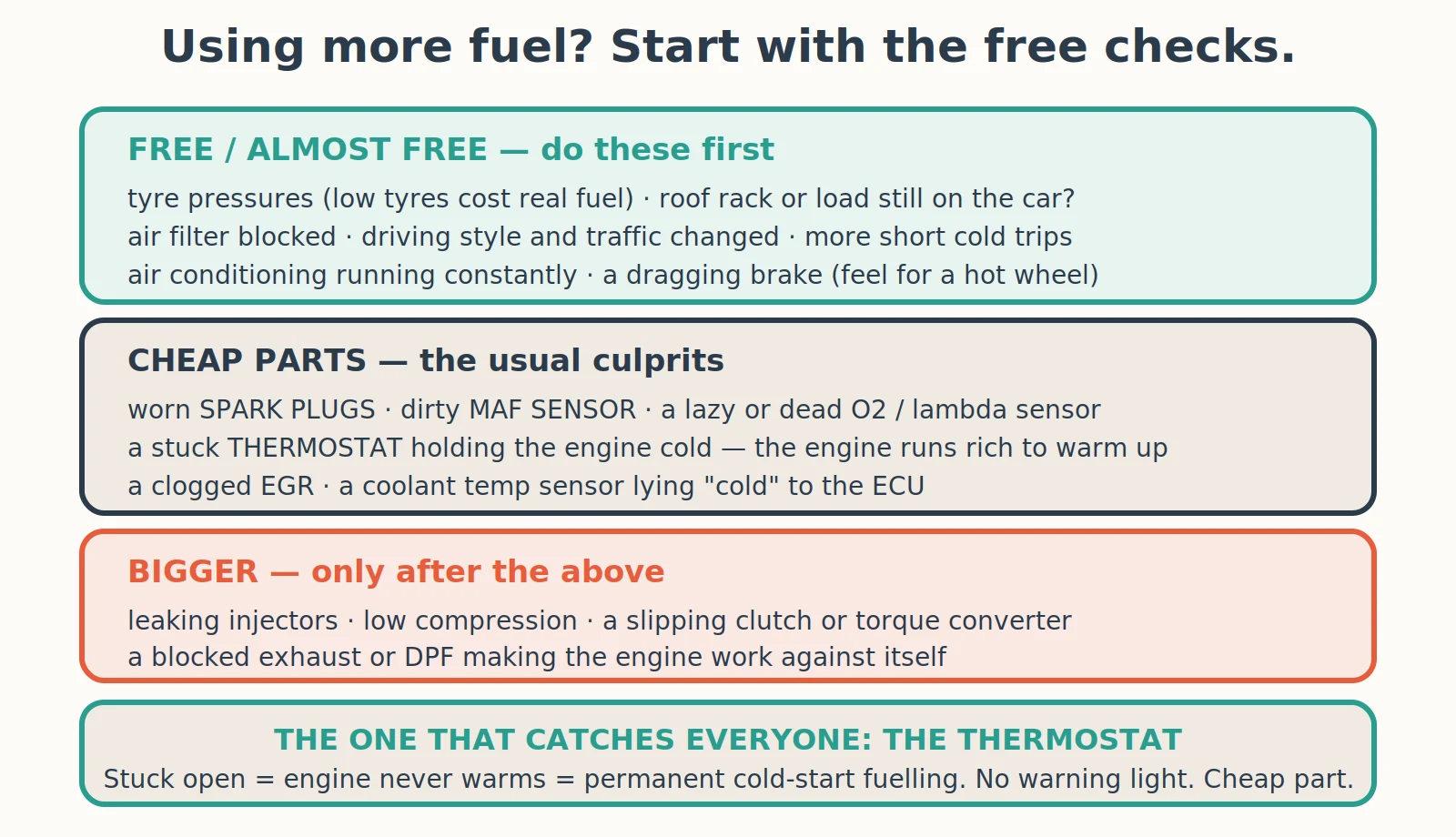
Work down the list in cost order. Most sudden consumption increases are solved in the top two boxes.
What are the free things to check first?
Tyre pressures are the most commonly overlooked. Underinflated tyres increase rolling resistance and cost real fuel, and they also wear faster and handle worse. Checking them costs nothing and it is worth doing regularly rather than only when consumption climbs.
Anything adding weight or drag matters. A roof rack, roof box, or a load left in the boot after a trip all cost fuel, and a roof box in particular has a large effect at speed because of aerodynamic drag.
Driving pattern changes are the other big one, and they are easy to miss because they do not feel like a fault. More short journeys, more traffic, a different commute, or colder weather all raise consumption without anything being wrong with the car. An engine uses noticeably more fuel while it is warming up, so a pattern of short trips is expensive even on a perfectly healthy car.
A dragging brake is worth checking too. A sticking caliper means the car is constantly braking slightly, which costs fuel and creates heat. After a drive, a wheel that is far hotter than the others points straight at it.
Which cheap parts commonly cause it?
Worn spark plugs make combustion less efficient, so more fuel is needed for the same result. If they are overdue, that alone can explain a drop in economy.
A dirty mass air flow sensor misreports how much air is entering the engine, so the computer adds the wrong amount of fuel. This is a very common cause and the sensor is not expensive.
An oxygen or lambda sensor that has become lazy is a classic. These sensors tell the computer whether the mixture is right, and as they age they respond more slowly. A slow sensor causes the computer to run the engine richer than necessary, and it often does this without setting a fault code, because the sensor is still working, just not well.
A blocked air filter restricts airflow, which affects the mixture and makes the engine work harder. It is cheap and quick to replace and often badly clogged in dusty climates.
Why does a stuck thermostat cost so much fuel?
This is the one that catches people, so it is worth explaining properly.
A cold engine needs a richer fuel mixture to run. As it warms to operating temperature, the computer leans the mixture out to the efficient setting. That is normal and it is why a car uses more fuel in the first few minutes.
If the thermostat sticks open, coolant circulates through the radiator constantly and the engine never reaches full operating temperature. The computer sees a cold engine, so it keeps applying warm-up fuelling permanently. The car runs rich all the time, consumption climbs noticeably, and the heater may also be weak.
The reason it is so commonly missed is that it often triggers no warning light at all. The only clues are higher fuel use, a temperature gauge that sits lower than usual or takes a very long time to rise, and poor cabin heat. The thermostat itself is a cheap part.
A coolant temperature sensor reporting the wrong value causes exactly the same rich-running behaviour, and is equally cheap, so the two are worth checking together.
When is it something bigger?
Only after the above have been ruled out is it worth looking at the more expensive causes.
Leaking or poorly atomising injectors put in more fuel than intended. Low compression means the engine is less efficient and has to work harder. A slipping clutch or a slipping torque converter wastes engine power that never reaches the wheels, which shows up as consumption as well as poor performance.
A blocked exhaust or a heavily loaded diesel particulate filter makes the engine work against a restriction, which costs both power and fuel. On a diesel, a filter attempting frequent regenerations also burns extra fuel by design, so a car doing lots of short trips with a struggling filter can use noticeably more.
The order matters because these are all far more expensive than a thermostat or an air filter, and they are far less common as the cause of a sudden change.
How do I measure consumption properly?
The trip computer is convenient but it is an estimate and can drift. To know what is really happening, fill the tank completely, reset the trip meter, drive normally, then fill completely again at the same pump and divide the fuel used by the distance covered.
Doing that over two or three tanks gives a reliable figure and a trend, which is far more useful than an impression that the car feels thirsty. It also tells you whether a repair actually worked, rather than guessing.
Common questions
Does air conditioning use much fuel? It does add load, most noticeably at low speeds. In hot climates it is often unavoidable, but constant use is a genuine part of the consumption picture.
Can bad fuel cause higher consumption? Poor quality or contaminated fuel can affect combustion and, over time, foul injectors and plugs. It is worth considering in markets where fuel quality varies.
Why is my consumption worse in winter? Longer warm-up times, denser cold air, more electrical load and winter tyres all contribute. Cold weather genuinely costs fuel even on a healthy car.
Do fuel additives improve economy? Cleaning products can help if injectors are genuinely dirty, but they do not fix a stuck thermostat, a lazy sensor or worn plugs. Diagnose first rather than pouring in a bottle and hoping.
Should the engine light be on if fuel consumption is bad? Not necessarily. Lazy oxygen sensors and stuck-open thermostats routinely cause higher consumption with no light at all, which is why consumption is worth investigating even without a warning.
Need sensors and service parts?
I supply oxygen and lambda sensors, MAF sensors, thermostats, coolant temperature sensors, spark plugs, air filters and fuel filters out of China. Matched to your VIN, tested, with warranty. These are all small, light parts that fly cheaply and are easy to stock. Send me the VIN on WhatsApp and I will price a set the same day.