
Bearing noise is one of the easier faults to identify once you know the test, and it is worth identifying because it does not stay minor.
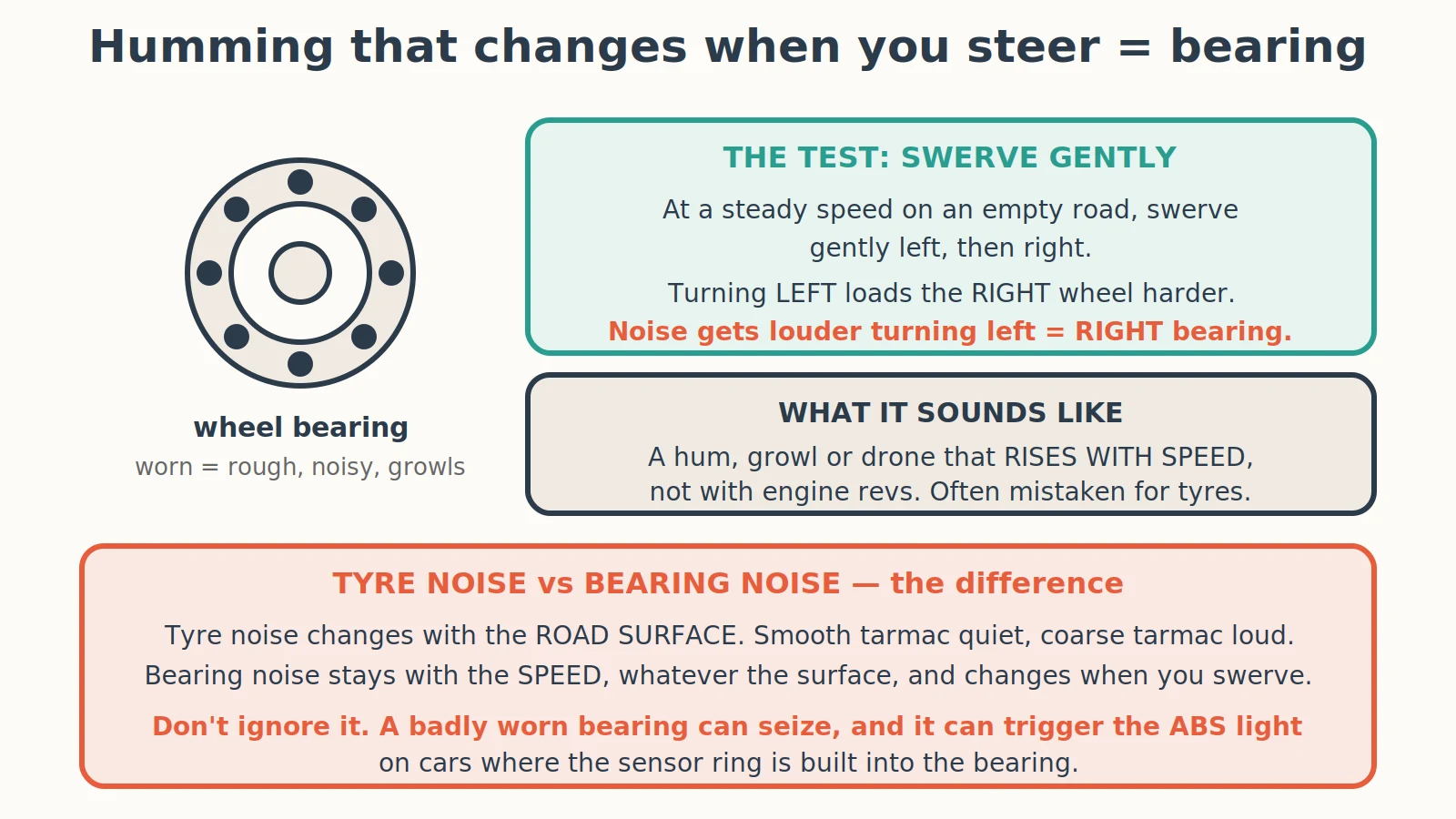
Swerve gently and listen. Loading the bad bearing makes it louder, which tells you which corner it is.
What does the noise actually sound like?
Most people describe it as a hum, a drone or a growl. It starts quietly, often only noticeable above a certain speed, and gets louder and rougher as the bearing wears. In a badly worn bearing it becomes a distinct grinding or rumbling.
The defining characteristic is that it tracks road speed, not engine speed. If you are coasting in neutral at fifty kilometres per hour and the noise is the same as it was under power at fifty, that points at something turning with the wheels rather than with the engine. Noise that changes when you rev the engine at a standstill is not a bearing.
Because the noise is a constant drone rather than a knock or a click, it often creeps up so gradually that drivers stop noticing it, and only realise how loud it had become after it is fixed.
How do I tell it apart from tyre noise?
This is the most common confusion, because worn or unevenly worn tyres also hum. Two things separate them.
Road surface. Tyre noise changes noticeably with the surface: quiet on smooth new tarmac, loud on coarse chip surfaces. Bearing noise stays much the same regardless of the surface, because it is coming from the car, not the road.
The swerve test. On a clear, empty road at a steady speed, swerve gently to the left, then gently to the right, and listen. Turning left shifts weight onto the right-hand wheels, loading the right bearing more heavily, so a worn right bearing gets louder. Turning right does the same to the left bearing. A noise that clearly changes with these gentle direction changes is very likely a bearing, and it also tells you which side.
Do this at a moderate speed with plenty of space and no traffic. It is a gentle weight-transfer test, not an aggressive manoeuvre.
What makes wheel bearings fail?
Age and mileage are the main ones, since a bearing does an enormous number of revolutions over its life. Beyond that, water and contamination are the biggest killers. Once the seal is compromised, water and grit get in, the grease is ruined, and the bearing surfaces start to pit and roughen.
Impact damage from potholes and kerbs shortens bearing life, sometimes dramatically. Driving through deep water while the bearing is hot can draw water past the seals. Heavy loads and towing add stress. And on some vehicles, incorrect fitting, particularly overtightening or using the wrong technique on a press-fit bearing, causes early failure of a new part.
In coastal and salted-road climates bearings fail noticeably sooner, because salt attacks the seals and accelerates corrosion.
Is it dangerous to drive with a noisy wheel bearing?
A bearing that has just started to hum is not an emergency, but it does not improve and it can deteriorate faster than people expect.
As it wears further it develops play, which affects handling and tyre wear, and in a badly neglected case a bearing can seize or the wheel assembly can be damaged. That is a serious failure at speed. There is also the heat: a failing bearing generates significant heat, which can damage surrounding components.
A practical check is to feel the wheel centre after a drive. A bearing that is much hotter than the others is working hard and is worth attending to promptly rather than leaving for months.
Can a wheel bearing cause an ABS light?
Yes, on many modern vehicles, and this connection catches people out.
On a lot of cars the ABS sensor reads a magnetic ring that is built into the wheel bearing itself. If that ring is damaged, or if the bearing develops enough play to change the gap between the sensor and the ring, the ABS signal becomes unreliable and the system switches off with a warning light.
So an ABS light on the same corner as a humming noise is a strong clue that the bearing is the cause of both. Replacing the sensor in that situation will not fix it, because the sensor is fine and the ring it reads is the problem.
Common questions
Should wheel bearings be replaced in pairs? Not necessarily, unlike brakes. It is normal to replace only the failed one. That said, if both are of similar age and mileage and one has gone, the other may not be far behind.
How long can I drive on a noisy wheel bearing? There is no safe number, because it depends on how far gone it is. A faint hum gives you time to book it in; a loud growl or any play should be dealt with promptly.
Can a wheel bearing cause vibration? A badly worn one can, though vibration is more often a wheel balance, tyre or brake issue. Bearing noise is the more typical symptom.
Does a new bearing need any special fitting? Many are press-fit or hub assemblies with specific torque procedures, and incorrect fitting causes early failure. It is worth having it done properly rather than improvised.
Why is my new wheel bearing noisy already? Common causes are incorrect fitting, a low quality bearing, or the noise actually coming from a different corner than assumed. The swerve test is worth repeating to confirm which side is really noisy.
Need wheel bearings and hubs?
I supply wheel bearings, complete hub assemblies with integrated ABS rings, and ABS sensors out of China. Matched to your VIN and the correct corner, with warranty. Send me the VIN on WhatsApp and I will confirm whether your vehicle takes a bearing or a full hub assembly before you order.