
The distinction between losing ABS and losing brakes is the key thing, and a lot of people get it the wrong way round in both directions.
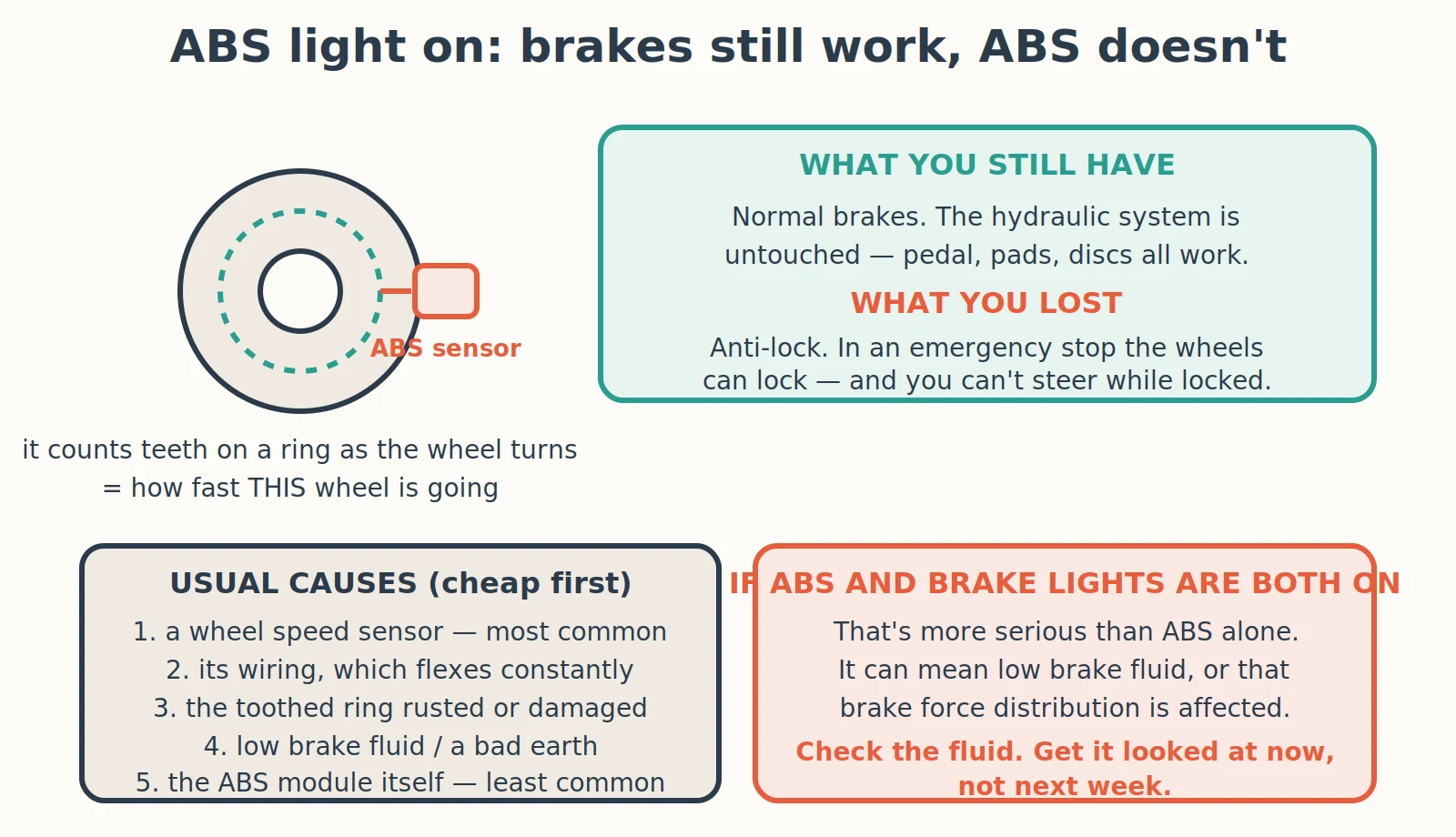
The sensor counts teeth on a ring to measure that wheel's speed. Lose the signal and ABS switches itself off.
What does ABS actually do?
Anti-lock braking stops the wheels from locking under heavy braking. It does this by monitoring each wheel's speed and, if it sees a wheel about to lock, rapidly releasing and reapplying the brake on that wheel many times a second.
The benefit is not usually a shorter stopping distance, which is a common misunderstanding. The benefit is that a rolling wheel can still steer, while a locked, sliding wheel cannot. ABS is what lets you brake hard and steer around an obstacle at the same time.
Each wheel has a speed sensor that reads a toothed ring turning with the wheel, and the ABS module compares all four. If one sensor stops reporting sensibly, the module can no longer trust its picture of what the wheels are doing, so it shuts the system off and turns on the warning light rather than acting on bad data.
What usually causes the ABS light?
A wheel speed sensor is the most common cause. They sit at the wheel, exposed to water, salt, heat and road debris for years, so they fail with age and corrosion. In coastal and salted-road climates they fail noticeably more often.
The wiring to the sensor is the next most common, and it is often overlooked. The cable runs down to the wheel and flexes constantly with suspension movement and steering, so it chafes and breaks internally. A broken wire produces exactly the same symptom as a failed sensor, so it is worth checking the wiring before replacing the sensor.
The toothed ring itself can rust, get damaged, or become packed with debris so the sensor cannot read it cleanly. This is common on older vehicles in wet climates.
Low brake fluid, a bad earth connection, or a blown fuse can also trigger the light. And the ABS module itself can fail, but that is the least common cause and the most expensive, so it should be the last thing suspected, not the first.
How do I know which wheel it is?
A diagnostic scan will normally name the specific wheel sensor circuit that has the fault, which narrows the job to one corner of the car straight away. That makes ABS faults one of the easier things to diagnose accurately.
What the code does not tell you is whether the sensor, the wiring or the ring is at fault, only that the signal from that corner is wrong. So the code points you to the wheel, and inspection and testing at that wheel tell you which part to replace. Replacing a sensor when the wire was broken is a common and avoidable waste.
Why are the ABS light and traction control light both on?
Because stability and traction control use the same wheel speed sensors as ABS. If a wheel speed signal is lost, ABS, traction control and stability control all lose the information they need, so they all switch off together.
So seeing ABS, traction control and stability lights come on at the same time does not usually mean three faults. It usually means one wheel speed sensor has failed and taken all three systems with it. That is good news, because it points at one cheap part rather than three systems.
When does the ABS light mean something more serious?
If the red brake warning light is on at the same time as the ABS light, treat that as urgent. That combination can indicate low brake fluid, which is a genuine braking safety issue, or that the system that distributes braking force between the front and rear has been affected.
In that situation, check the brake fluid level straight away. Low fluid means either wear or a leak, and a leak in the braking system is serious. If both lights are on, the car should be checked immediately rather than driven on for days.
The ABS light alone, with normal pedal feel and normal braking, is a much less urgent situation, though it should still be fixed.
How urgent is it really?
It depends on your conditions. On dry roads at moderate speeds, most drivers will never notice ABS is missing. In heavy rain, on gravel, or in an emergency where you need to brake hard and steer at once, it matters a great deal.
There is also a practical point in many places: a car with an ABS fault will typically fail a roadworthiness or safety inspection, so it has to be fixed eventually anyway.
Given the most common cause is an inexpensive sensor, and it is usually pinpointed to one wheel by a scan, this is a fault worth fixing promptly rather than living with.
Common questions
Will my brakes still work with the ABS light on? Yes. The hydraulic braking system is separate and unaffected. You lose the anti-lock function, not the brakes.
Can a wheel bearing cause an ABS light? It can, on vehicles where the sensor ring is built into the bearing, or where excessive bearing play upsets the sensor gap. A noisy bearing plus an ABS light on the same corner is a strong clue.
Why did the ABS light come on after new brakes or a wheel change? Often a sensor or its wiring was disturbed, or a sensor was not seated properly. It is worth checking that corner before assuming a part has failed.
Does the ABS light affect the handbrake or parking brake? Not directly, but on cars with an electronic parking brake the systems share modules and wiring, so faults can appear together.
Can I clear the ABS light myself? Clearing the code without fixing the cause just means it returns as soon as the system runs its self-check. Fix the fault, then clear it.
Need ABS and brake parts?
I supply ABS wheel speed sensors, wheel hubs with integrated rings, brake discs, pads and calipers out of China. Matched to your VIN and to the specific corner, with warranty. These sensors are small, cheap to fly and easy to stock in a range. Send me the VIN and the fault code on WhatsApp and I will confirm the right one before you buy.