
This matters because getting it wrong is one of the most expensive mistakes on a modern engine. Here is how to be sure.
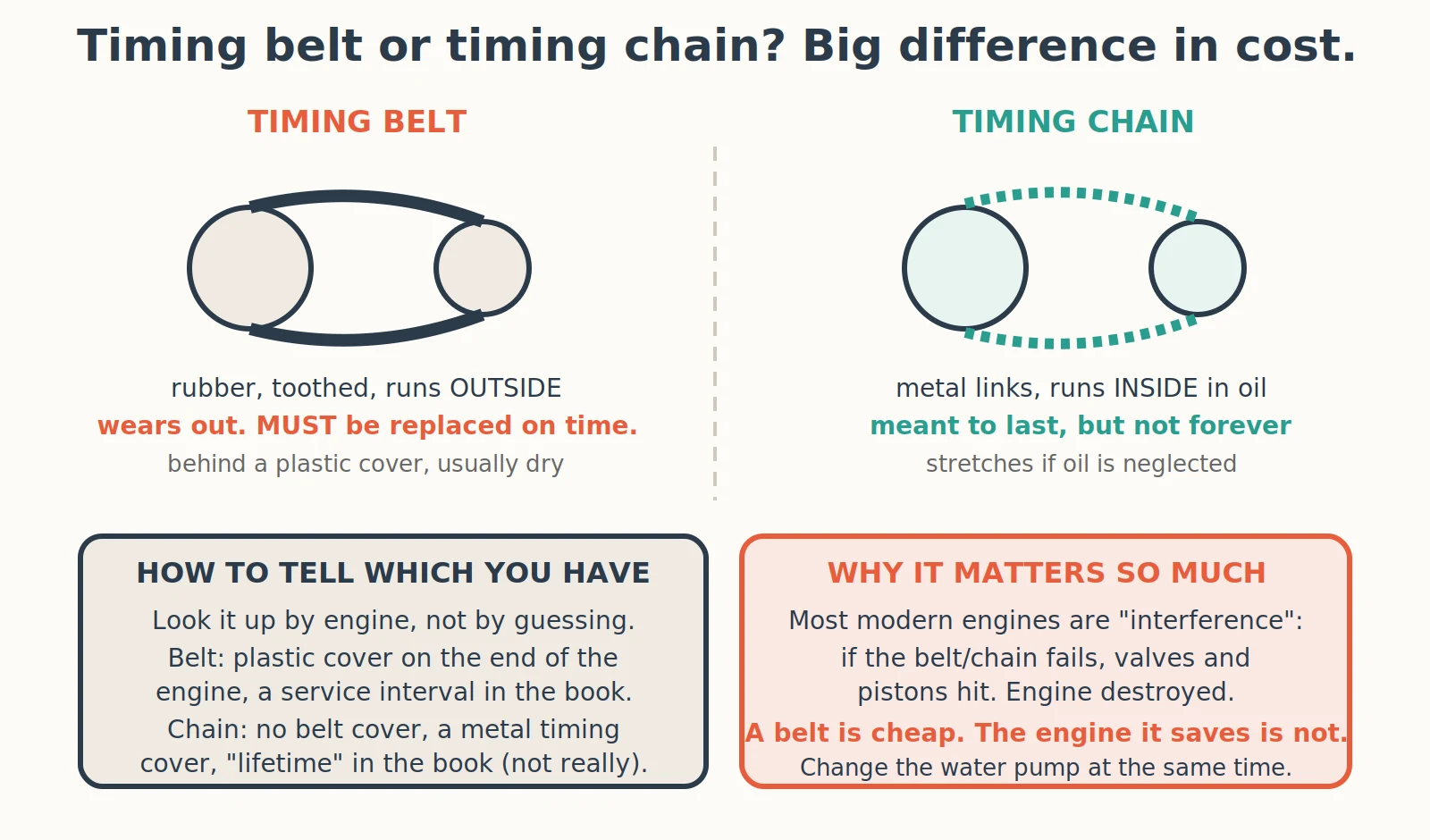
Belt: rubber, outside, dry, replaced on time. Chain: metal, inside, runs in oil, lasts longer but not forever.
What is the difference between a timing belt and a timing chain?
Both do the same job. They keep the crankshaft and the camshafts turning in time with each other, so the valves open and close at exactly the right moment relative to the pistons. If that timing is lost, the engine cannot run, and on most engines the valves and pistons collide.
A timing belt is made of reinforced rubber with teeth on the inside. It runs on the outside of the engine, behind a plastic cover, and it is usually dry. Being rubber, it ages, cracks and eventually fails, so it has a defined replacement interval.
A timing chain is a metal chain, much like a heavy-duty bicycle chain, and it runs inside the engine bathed in oil. Metal lasts far longer than rubber, so chains are designed to go the life of the engine in principle. In practice they stretch over time, especially if the oil is poor or neglected, so lifetime is not quite the promise it sounds.
How can I tell which one my engine has?
The dependable answer is to look it up by your exact engine code, not just the model. Many cars were sold with a belt in one engine and a chain in another, and sometimes the same model changed from one to the other partway through production. So a general answer about the model is not safe. The engine code is.
Physically, there are clues. A belt engine has a plastic timing cover, usually on one end of the engine, and the service book lists a timing belt replacement interval. A chain engine has a metal timing cover and no belt replacement interval, though it may mention the chain as lifetime.
If you are buying parts or planning maintenance, confirm by the engine code before spending anything. This is exactly the kind of detail worth checking against the specific vehicle rather than assuming.
When does a timing belt need replacing?
At the interval specified for that engine, which is given as a distance or a time, whichever comes first. The time limit matters as much as the distance, because rubber ages even on a car that does very little mileage. A belt that has done hardly any kilometres but is many years old is still a risk, because the rubber has hardened.
Heat and dust age a belt faster, so in a hot climate the conservative approach is to treat the interval as a maximum and not stretch it. The cost of a belt is small. The cost of the engine it protects is not.
There is one more thing that should always be done at the same time. The water pump on many belt-driven engines is turned by the timing belt, and it is buried behind the same covers. Since the labour to get in there is the whole cost of the job, the water pump, tensioner and idler pulleys should be replaced together with the belt. Doing the belt and leaving an old water pump means paying that labour twice when the pump fails a year later, and a pump that fails can take the new belt with it.
Do timing chains ever need replacing?
Yes, despite the lifetime label. A chain stretches as it wears, and the tensioner and guides that keep it tight also wear. On some engines this is rare and the chain genuinely lasts. On others it is a known weak point that stretches early, particularly if oil changes were neglected or the wrong oil was used.
The warning signs are a rattle from the timing end of the engine, especially on cold start-up, and in more advanced cases a timing-related fault code as the camshaft position drifts out of specification relative to the crankshaft. A cold-start rattle that lasts a couple of seconds before the oil pressure builds is a classic early symptom of a stretched chain or a worn tensioner.
Because a chain runs in oil and depends on oil pressure to keep its tensioner firm, chain life is closely tied to oil condition. This is one of the strongest reasons not to stretch oil changes on a chain engine.
What happens if a timing belt or chain fails?
On most modern engines, which are what is called interference designs, failure is catastrophic. When the belt or chain breaks or jumps, the camshafts stop but the pistons keep moving, and the valves and pistons occupy the same space at the same time. They collide, bending valves and sometimes damaging pistons and the cylinder head.
The result is a very expensive repair, often approaching the cost of a replacement engine, from a part that was cheap to replace on schedule. This is the entire reason timing maintenance is treated so seriously.
A small number of engines are non-interference designs, where a failure simply stops the engine without the valves and pistons meeting. But you should never assume yours is one of those without confirming it, because the great majority are not.
Common questions
How much does a timing belt change cost compared to the engine? The belt job is a fraction of the cost of the engine damage a failure causes. That gap is the whole argument for doing it on time.
Can I just change the timing belt without the water pump? You can, but if the pump is belt-driven it is a false economy, because the labour is the main cost and it has to be repeated when the pump fails. Do them together.
Is a rattle on cold start a timing chain problem? It can be a stretched chain or a worn tensioner, especially if it lasts a second or two on start-up. It is worth investigating early, because a chain that jumps causes the same damage as a snapped belt.
Does a car with a timing chain need less maintenance? It has no scheduled belt change, but the chain depends entirely on good oil and regular changes. Neglect the oil and the chain becomes the weak point instead.
How do I find my engine code? It is in the vehicle documents, on a sticker or stamped on the engine, and it can be identified from the VIN. Confirming parts by VIN or engine code avoids buying the wrong timing kit.
Need timing parts?
I supply timing belt kits, timing chain kits, tensioners, guides and water pumps out of China. Matched to your VIN and engine code so you get the right kit the first time, with warranty. Send me the VIN on WhatsApp and I will confirm belt or chain and price the full kit the same day.