
This is the quickest diagnosis available on any engine, and it costs nothing. Here is how to read it properly.
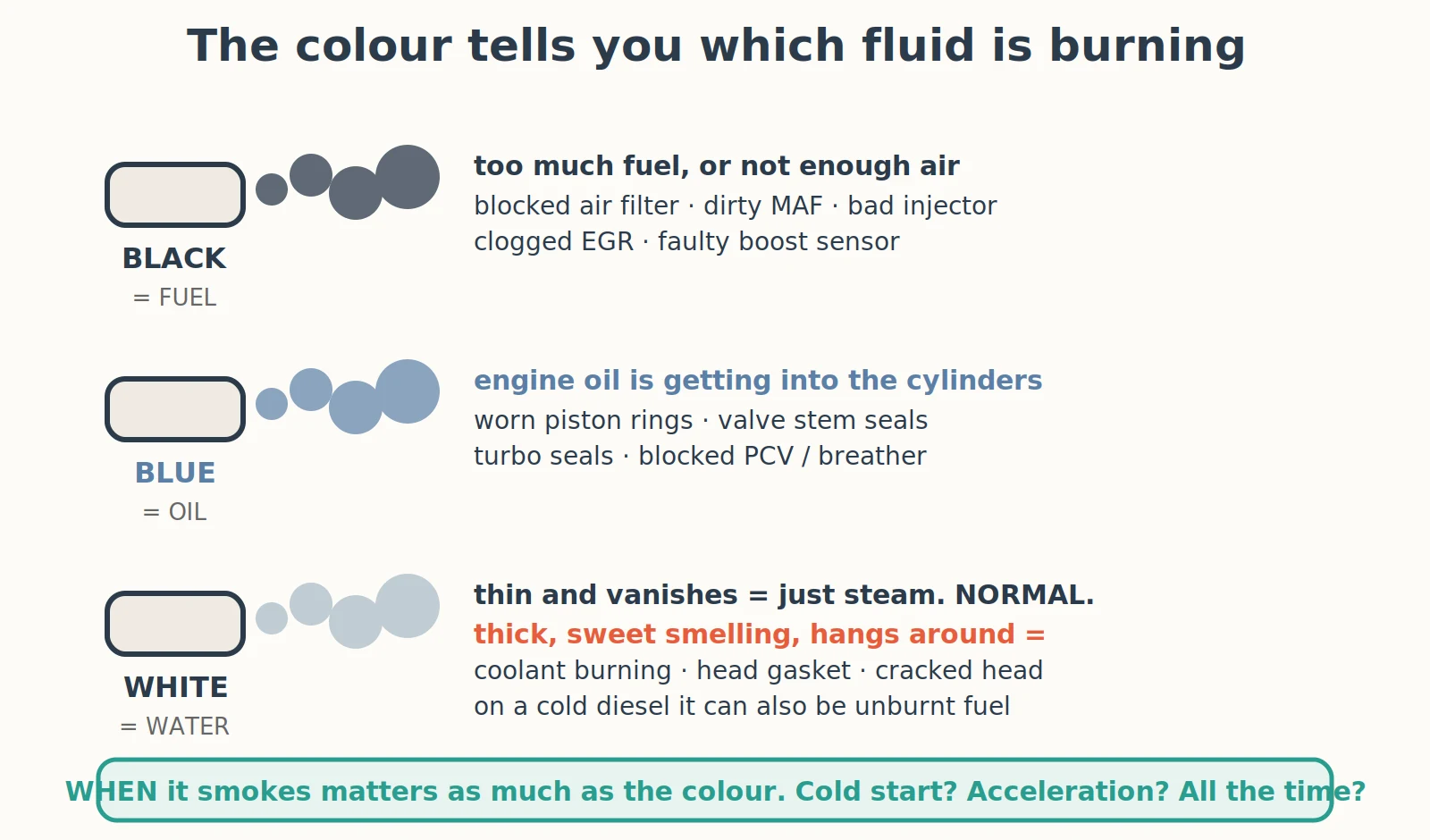
Black is fuel. Blue is oil. Thick white is coolant. Thin white that vanishes is just steam.
What causes black smoke from the exhaust?
Black smoke is unburnt fuel, which means the mixture is too rich. Either too much fuel is going in, or not enough air is.
On the air side: a blocked air filter, a dirty or failing mass air flow sensor reading low, a boost leak on a turbo engine, a carboned-up intake or a clogged EGR system. On a diesel, a heavily sooted intake manifold is extremely common and it strangles airflow.
On the fuel side: a leaking or badly atomising injector, incorrect injection timing, or a faulty sensor causing the computer to add more fuel than the engine needs. A boost pressure sensor reading low will make a diesel's computer behave oddly, because it is trying to correct for a shortfall that does not exist.
A little black smoke under hard acceleration on an older diesel is fairly normal. Continuous black smoke, or smoke at idle, is not.
What causes blue smoke from the exhaust?
Blue smoke means engine oil is being burned in the combustion chamber. There are four common routes it takes to get there, and when the smoke appears tells you which one.
Blue smoke only on start-up, then it clears: valve stem seals. Oil seeps past the hardened seals down the valve stems overnight and burns off in the first few seconds. Classic and very identifiable.
Blue smoke under load and generally all the time: worn or stuck piston rings, letting oil past into the cylinder. This one usually comes with reduced compression and higher oil consumption.
Blue smoke on overrun, when you lift off at speed: often turbocharger seals. Oil is drawn through the turbo when there is high vacuum in the intake.
And the one people forget: a blocked crankcase breather or PCV system. When crankcase pressure cannot escape properly, it pushes oil past seals and rings that were not actually worn out. Check this first, because it is cheap and it can cause the appearance of all the others.
Is white smoke always a head gasket?
No, and this is where people panic unnecessarily.
Thin white vapour on a cold morning that disappears within a few seconds and does not linger is condensation in the exhaust. Completely normal, especially in cold or humid weather.
Thick white smoke that hangs in the air, smells slightly sweet, and continues after the engine is warm is coolant being burned. That points at a head gasket, a cracked cylinder head, or on some engines a failed oil cooler. Check whether the coolant level is dropping with no visible leak, and whether there is any mayonnaise-like residue under the oil filler cap.
On a diesel there is a third possibility. White or grey-white smoke on a cold start that clears as the engine warms can be unburnt fuel rather than coolant, often caused by faulty glow plugs, low compression or injector problems. Cold, white, and clears with warmth on a diesel is more likely a glow plug or injector issue than a head gasket.
How do I tell coolant loss from a head gasket apart from a smaller leak?
Look for the combination of symptoms rather than one on its own. A head gasket failure usually gives you several at once: white smoke, coolant loss with no external puddle, overheating, bubbles in the expansion tank, and sometimes oil and coolant mixing.
Coolant disappearing with no smoke and no overheating is much more likely to be a pressure cap, a cracked expansion tank, or an internal leak somewhere less dramatic such as an oil cooler or a housing gasket. Those are far cheaper repairs, and they get misdiagnosed as head gaskets regularly.
A cooling system pressure test carried out cold, plus a combustion gas test on the coolant, will separate the two properly without anyone guessing.
Can smoke damage the catalytic converter or DPF?
Yes, and this is why smoke should be treated as urgent on a modern car.
Unburnt fuel and oil passing into the exhaust contaminate a catalytic converter and clog a diesel particulate filter. So a fault that starts as a cheap sensor or a set of valve stem seals ends up destroying a very expensive exhaust component.
On a diesel with a DPF, continuous smoke is effectively filling the filter faster than it can burn off. Fixing the smoke early is far cheaper than replacing the filter afterwards.
Common questions
Is a little smoke on a cold start normal? Thin white vapour that clears quickly, yes. A puff of blue smoke that clears, no, that points at valve stem seals. Black smoke at any time on a modern engine is not normal.
Why does my diesel smoke only when accelerating hard? Usually an air supply restriction or a fuelling issue. Check the air filter, the intake for soot, the MAF sensor and for boost leaks before assuming injectors.
Can bad fuel cause black smoke? Poor quality or contaminated fuel can affect combustion and injector condition, so yes, indirectly. It is worth considering in markets where fuel quality varies.
Does blue smoke always mean the engine is worn out? No. Valve stem seals, turbo seals and a blocked breather all produce blue smoke on an engine that is mechanically sound otherwise. Diagnose before assuming a rebuild.
Should I use an oil additive to stop blue smoke? Thicker oil or additives may reduce visible smoke temporarily by masking the symptom. They do not repair worn seals or rings, and heavier oil can cause its own problems on engines with variable valve timing that depend on specific oil viscosity.
Need engine or diesel parts?
I supply injectors, glow plugs, turbochargers, MAF sensors, EGR valves, valve stem seal kits and gaskets out of China. Matched to your VIN, tested, with warranty. Small or mixed orders welcome. Send me the VIN on WhatsApp and I will price it the same day.