
This is a genuinely debated topic, so it is worth explaining what the interval is really based on and where it falls short.
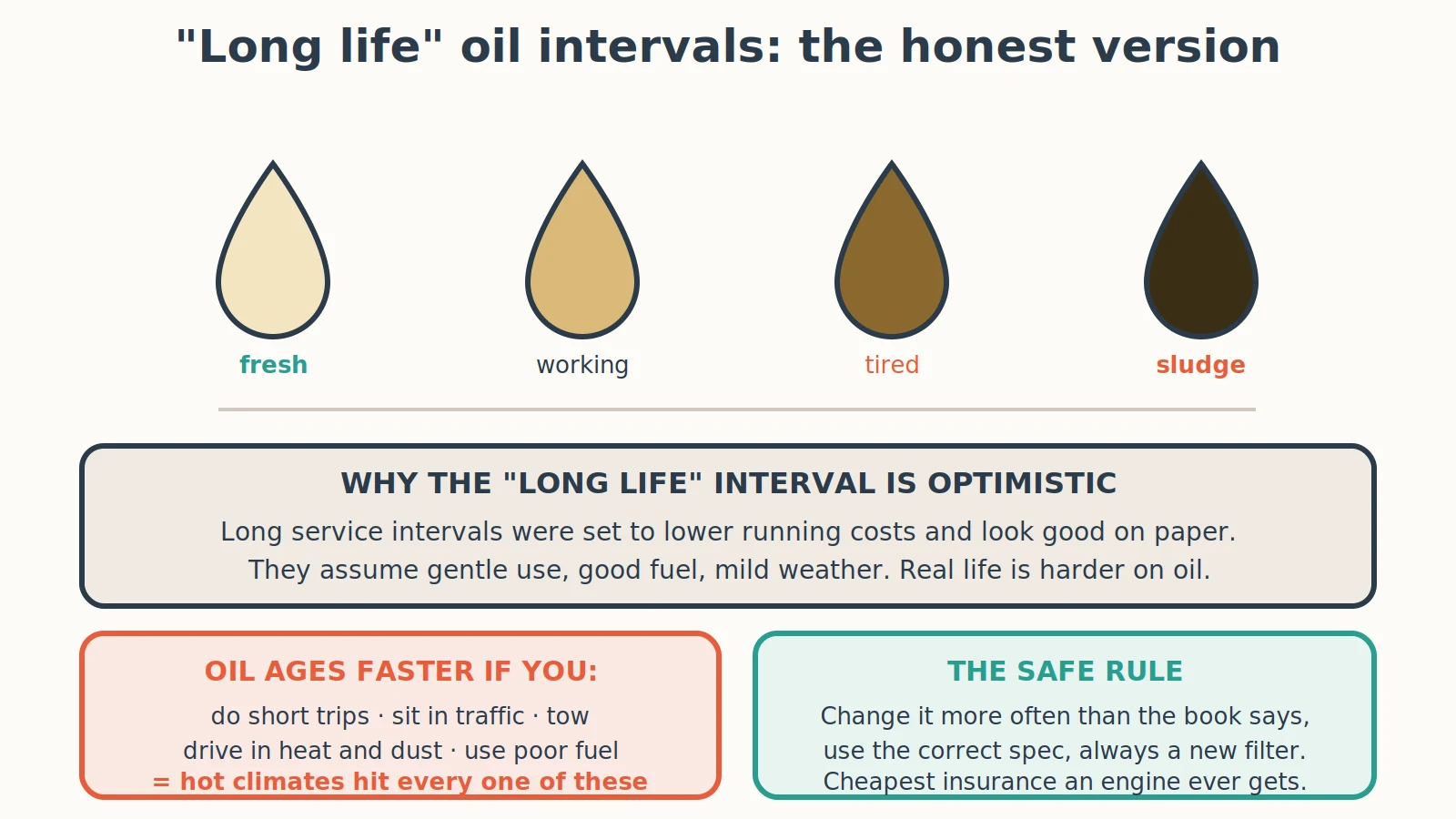
Oil goes from fresh to sludge as it works. Long-life intervals assume ideal conditions that most driving does not meet.
Why are modern service intervals so long?
Modern oils genuinely are better than older ones, and engines are built to tighter tolerances, so some of the longer interval is real progress. But the intervals are also a commercial figure. Lower advertised running costs make a car more attractive, and longer intervals mean fewer services over a warranty period, which looks good to a fleet buyer.
The interval is calculated for a set of assumptions: reasonable mileage made up of longer journeys, good quality fuel, moderate temperatures, and the engine reaching full operating temperature regularly. When the real conditions match those assumptions, the long interval can be fine.
The problem is that a lot of real-world driving does not match those assumptions at all, and the oil ages faster than the interval expects.
What makes oil wear out faster?
Short trips are one of the hardest things on oil. An engine that never fully warms up allows fuel and moisture to collect in the oil, which dilutes it and forms sludge. A car used only for short school runs and shopping trips is working its oil far harder than the mileage suggests.
Sitting in traffic ages oil through heat and running time without much distance covered. Towing or carrying heavy loads raises temperatures and stress. Dust and poor air filtration let abrasive particles into the engine. And poor quality or contaminated fuel, which is a real issue in some markets, puts more combustion by-products into the oil.
Heat runs through all of these. Oil ages faster the hotter it runs, so a hot climate is hard on oil by itself, and it also tends to come with the traffic and dust that make things worse. In hot conditions, the long-life interval is at its most optimistic.
What happens if I leave the oil too long?
As oil ages it loses its ability to protect. It thickens, forms sludge and deposits, and stops flowing freely to where it is needed. The additives that neutralise acids and hold contaminants in suspension get used up, and after that the oil starts to work against the engine rather than for it.
The consequences build quietly. Sludge blocks narrow oil passages and can stick the piston oil control rings, which then causes oil consumption. On an engine with a timing chain, degraded oil accelerates chain and tensioner wear. On a turbocharged engine, tired oil coking in the turbo's oil feed is a classic cause of turbo failure. None of these announce themselves early, which is exactly why stretching oil changes is so risky. By the time there is a symptom, the wear is done.
Does the type of oil matter as much as the interval?
Yes, and using the wrong specification can cause problems even on a correct interval. Modern engines are designed around a specific oil specification, not just a viscosity like a number on the bottle. The specification covers the additive package, which matters for emissions equipment, timing systems that use oil pressure to adjust valve timing, and diesel particulate filters.
Using an oil that meets the manufacturer's specification is not marketing. The wrong additive package can damage a particulate filter or cause variable valve timing faults. So the correct answer is always the specified oil, changed on a sensible interval, with a new filter each time. A cheap oil of the wrong specification is a false economy even if it is changed often.
So how often should I actually change it?
For a car used in tough conditions, which includes hot climates, dusty roads, short trips and heavy traffic, changing more frequently than the long-life interval is the conservative and sensible choice. Many experienced owners and independent workshops treat the long-life figure as a maximum for ideal conditions and change well before it in real ones.
The exact figure depends on the engine and the conditions, so this is guidance rather than a single number. But the principle is simple: when in doubt, change it sooner. The cost of an oil and filter change is trivial next to the cost of the engine wear that stretching it causes. Of every maintenance decision on a car, this is the one where erring on the cautious side is cheapest.
Always change the filter with the oil. A new filter with old-interval oil, or fresh oil through a clogged filter, both defeat the point.
Common questions
Is it bad to change oil too often? No real harm comes from changing it early, only a little extra cost. The risk is all on the other side, leaving it too long.
Does a car that does low mileage still need regular oil changes? Yes, on a time basis. Oil degrades with age and with short-trip use even if the distance is small, so a low-mileage car still needs changes by time.
Can I use any oil of the right thickness? No. The manufacturer specification matters as much as the viscosity, because of emissions equipment and timing systems. Match the specification, not just the grade number.
Why does my car use more oil since a long service interval? Extended intervals can stick the piston oil control rings with deposits, which causes consumption. Shorter intervals with the correct oil can sometimes slow or reduce it.
Does synthetic oil last longer between changes? It resists ageing better than mineral oil, but it still degrades with heat, short trips and contamination. It raises the ceiling; it does not remove the need to change on a sensible interval.
Need filters and service parts?
I supply oil filters, air filters, cabin filters, fuel filters and full service kits out of China. Matched to your VIN so the filters and specification are right, with warranty. These are light, cheap to ship and easy to stock. Send me the VIN on WhatsApp and I will price a full service kit the same day.