
Some oil consumption is normal on any engine. What matters is how much, and whether it is getting worse.
How much oil consumption is actually normal?
Manufacturers generally accept some consumption, and the acceptable figure varies enormously between engines. Some are specified as tolerating up to around a litre per thousand kilometres, which surprises people, while others should use almost none between services.
The practical test is not the absolute figure, it is the trend. An engine that has always used half a litre between services and still does is behaving normally for that engine. An engine that used none for years and now needs topping up monthly has developed a fault. Track it rather than comparing yourself against someone else's car.
What is never acceptable is running the level low. Low oil starves bearings and turbochargers, and that turns a consumption problem into a mechanical failure.
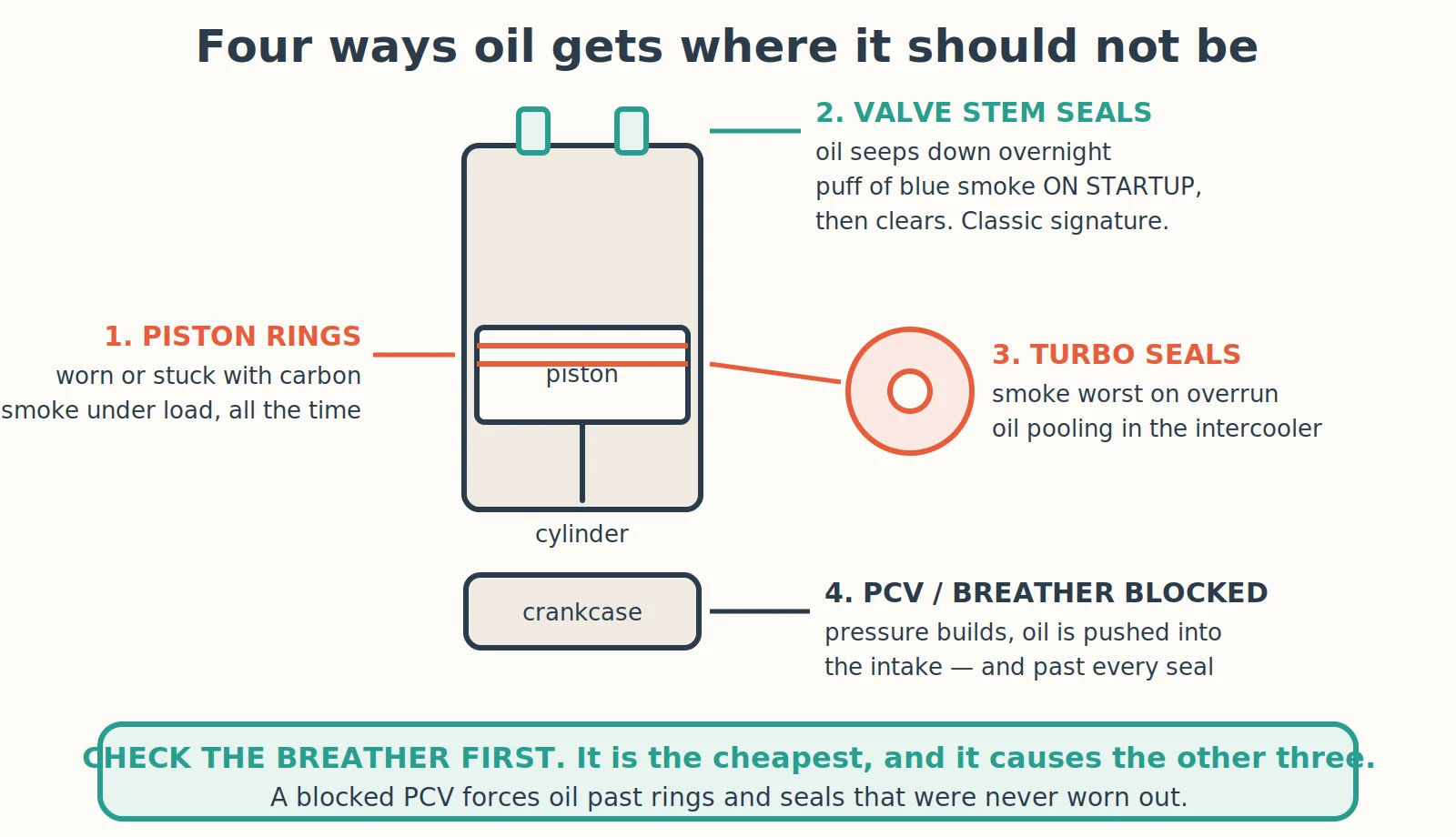
Four routes into the combustion chamber. The breather is the cheapest to check and it causes the others.
How do I tell which cause it is?
Use the timing of the smoke, because each route has a signature.
Blue smoke on start-up that clears after a few seconds, then nothing for the rest of the day, points at valve stem seals. Oil drains down the valve stems while the engine is parked and burns off on the first firing.
Smoke under load and steady consumption all the time points at piston rings. This usually comes with reduced compression, and on a turbocharged engine it often comes with higher crankcase pressure as well.
Smoke on overrun, when you lift off at speed, and oil found in the intercooler or charge pipes, points at turbocharger seals.
Consumption with little or no visible smoke, oil in the intake, and a rough idle points at the crankcase breather or PCV system pushing oil into the intake.
Why does a blocked breather cause oil consumption?
Every engine produces blow-by, which is combustion pressure escaping past the piston rings into the crankcase. The crankcase ventilation system removes that pressure and returns the gases to the intake to be burned.
When that system blocks with sludge, or the PCV valve fails, pressure builds inside the engine. That pressure has to go somewhere, so it pushes oil past seals and gaskets, up the turbo drain, and past piston rings that were doing their job perfectly well.
So a blocked breather does not just cause oil consumption. It creates the symptoms of worn rings, leaking turbo seals and failing crankshaft seals, on an engine that has none of those problems. Plenty of engines have been rebuilt for a fault that was a blocked breather.
This is why it belongs at the top of the list. It is cheap, it is common, and getting it wrong is expensive in the most avoidable way.
Can the wrong oil cause consumption?
It can contribute more than people expect. Oil that is too thin for the engine passes more easily past rings and seals, particularly in a hot climate or under heavy load. Oil that does not meet the manufacturer's specification may also cope poorly with the temperatures inside a modern turbocharged engine.
Extended oil change intervals are the other half of this. Degraded oil forms deposits that stick the piston oil control rings in their grooves. Once those rings are stuck, they stop scraping oil off the cylinder walls, and consumption climbs. On some engines this is the single most common cause of high oil use, and it is caused by maintenance history rather than by design.
In hot climates in particular, using the correct grade and changing it on time matters more than in temperate conditions, because oil ages faster with heat.
Can stuck piston rings be freed without stripping the engine?
Sometimes, and it is worth attempting before committing to major work when the diagnosis points at deposits rather than physical wear.
The approach is to run shorter oil change intervals with a good quality oil of the correct specification, which gradually cleans deposits. Some workshops use engine cleaning treatments or a soak procedure on the piston crowns. Results vary a great deal, and it works on stuck rings, not on worn ones.
The honest position is that this is worth trying when the evidence points at carbon, and it is a waste of time when compression testing shows genuine mechanical wear. Test first, then decide.
What damage does high oil consumption cause?
Beyond the cost of the oil, it contaminates the exhaust system. Oil ash poisons a catalytic converter and clogs a diesel particulate filter, so the consumption fault eventually creates a second, much larger bill.
Oil in the intake also builds deposits on the back of the intake valves, which is a particular problem on direct injection engines where there is no fuel washing over them to keep them clean.
And the obvious risk: an engine that uses oil quietly between long service intervals can run dangerously low without the driver noticing. Check the level regularly on any engine that is known to consume.
Common questions
Is burning oil the same as leaking oil? No. A leak leaves marks under the car and on the engine. Burning oil leaves nothing outside but the level drops. Check for external leaks first, because they are easier and cheaper to fix.
Will thicker oil stop oil consumption? It may reduce it temporarily by masking the problem, but it does not fix worn seals or stuck rings. On engines with variable valve timing, using oil outside the specified viscosity can cause timing faults, so it is not a free experiment.
Can a turbo cause oil consumption without smoke? Yes, particularly if the oil is passing into the exhaust side or accumulating in the intercooler rather than burning immediately. Check the intercooler and charge pipes for oil.
Does an oil consumption test prove anything? It gives you a measured figure over a known distance, which is far more useful than an impression. If you are pursuing a warranty claim, a documented consumption test is usually required.
Why do modern engines burn more oil than older ones? Lower tension piston rings and thinner oils are used to reduce friction and improve economy, and turbocharged engines run hotter with higher cylinder pressures. Some consumption is a design consequence rather than a fault.
Need engine parts?
I supply valve cover and PCV assemblies, valve stem seal kits, turbochargers, gaskets and engine parts for BMW, Mercedes, Audi, Land Rover and Toyota out of China. Matched to your VIN, with warranty. Small or mixed orders welcome. Send me the VIN on WhatsApp and I will price it the same day.