
That is the honest version. Plenty of people do the conversion and are happy with it, and there are situations where it is the right call. Here is how to tell which situation you are in.
What does a dual mass flywheel actually do?
A dual mass flywheel, usually shortened to DMF, is two flywheel halves with a spring and damper system between them. One half bolts to the crankshaft. The other half carries the clutch. They are connected through springs rather than being one solid piece.
The reason it exists comes down to how a diesel engine makes power. High compression, high torque, low revs. Every firing stroke is effectively a hammer blow on the crankshaft, and between those blows the crank slows slightly. That is called torsional vibration, and modern diesels produce a lot of it.
Without something to absorb those pulses, they travel straight into the gearbox. The springs in a DMF soak them up before they get there.
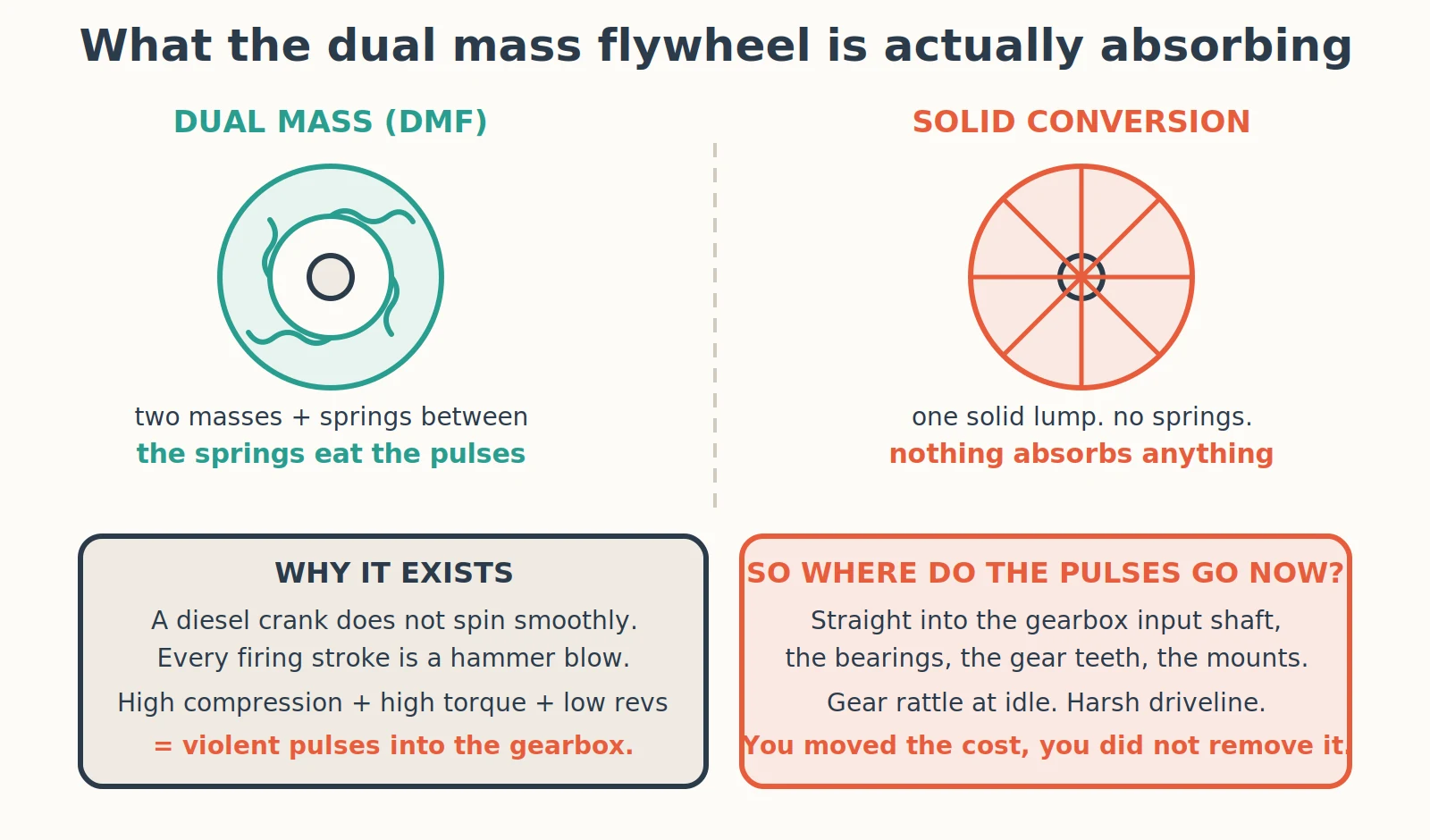
The springs between the two masses absorb the firing pulses. A solid flywheel has nothing to absorb them with.
What are the symptoms of a failing dual mass flywheel?
A rattle at idle with the clutch pedal up, which goes quiet when you press the clutch down, is the classic one. It comes from the springs and the free play between the two masses as they wear.
Vibration through the floor or the pedals at low revs. Judder when pulling away, particularly from cold. Rattle when you switch the engine off, as it shakes to a stop. And in a badly worn case, a knocking or clonking that gets worse under load.
One useful distinction: a release bearing noise happens when the clutch pedal is pressed down. A dual mass flywheel rattle usually happens with the pedal up and disappears when you press it. That single check separates two very different repair bills.
Why do people convert to a solid flywheel?
Cost and durability, in that order. A dual mass flywheel is expensive, and it is a wear item that can fail again in another hundred thousand kilometres. A solid flywheel conversion kit is often cheaper and there is nothing inside it to wear out.
For some vehicles, particularly hard-worked commercial ones, that argument holds up. If a van does high mileage and the owner accepts a harsher driveline in exchange for never doing this job again, that is a rational trade.
The mistake is thinking the conversion is free of consequences. It is not. It is a trade, and the person selling the kit does not always explain what is on the other side of it.
What actually goes wrong after a solid flywheel conversion?
Gear rattle at idle in neutral is the most common complaint, and it is not a fault with the kit. It is the sound of the gearbox internals being shaken by pulses the flywheel used to absorb. On a quiet cabin it can be genuinely annoying.
A harsher take-up and more vibration at low revs is normal afterwards. Some drivers barely notice, others hate it.
The serious concern is long term wear. Those pulses now load the gearbox input shaft, its bearings and the gear teeth directly. On some engine and gearbox combinations this is tolerated for years. On others it shortens gearbox life. There is no single answer that covers every vehicle, which is exactly why the advice online is so contradictory.
One more practical point: engine mounts and driveline components also absorb more after the conversion, so mount wear can accelerate.
When is a solid flywheel conversion a reasonable choice?
It stacks up better on older, high mileage commercial vehicles where the owner cares about cost per kilometre and accepts noise. It stacks up better on engines where the conversion has a long track record on that specific model rather than being a generic kit.
It stacks up badly on refined passenger cars, on anything under warranty, on cars the owner intends to sell soon, and on vehicles where the gearbox is expensive or known to be marginal.
If you are unsure, look for evidence on your exact engine and gearbox combination, not on conversions in general. This is a question where the answer genuinely differs between vehicles.
Should the clutch and release bearing be replaced at the same time?
Yes, always. The gearbox has to come out either way, and the labour is the entire cost of this job. Replacing a flywheel and leaving an old clutch means paying that labour twice within a year or two.
The same applies in reverse. If you are doing a clutch on a car with a dual mass flywheel at high mileage, inspect the flywheel properly while it is out. A worn DMF will destroy a new clutch, and then the new clutch gets blamed.
Common questions
How long does a dual mass flywheel last? Very roughly, many last somewhere between one hundred and two hundred thousand kilometres, but driving style matters enormously. Labouring the engine at low revs in a high gear is what kills them fastest.
Can a dual mass flywheel be repaired or refurbished? Some specialists rebuild them. Quality varies a great deal, so it depends entirely on who does it. It is not a job for a general workshop.
Will a solid flywheel conversion fail an inspection or void warranty? It can affect warranty on a newer vehicle, and it changes how the driveline behaves. Check before doing it on anything still covered.
Does a solid flywheel damage the gearbox? On some engine and gearbox combinations it accelerates wear, on others it appears to be tolerated for a long time. There is no universal answer, which is why you should research your specific vehicle rather than trusting general advice.
Why does my new clutch judder after fitting? A worn dual mass flywheel that was not replaced is one of the most common causes. So is oil contamination from a leaking crankshaft or gearbox seal that was not addressed while everything was apart.
Need clutch and driveline parts?
I supply dual mass flywheels, clutch kits, release bearings and driveline parts out of China. Matched to your VIN, with warranty. Small or mixed orders welcome. Send me the VIN on WhatsApp and I will price the complete kit the same day.