
Some low-speed hesitation is in the nature of these gearboxes, so the first thing to establish is whether yours is behaving normally or genuinely developing a fault.
How does a dual-clutch gearbox actually work?
It is essentially two manual gearboxes in one case, each with its own clutch. One clutch handles the odd gears, one, three and five. The other handles the even gears, two, four and six.
The clever part is that while you are driving in one gear, the next gear is already selected on the other clutch, waiting. Changing gear is just a handover from one clutch to the other, which is why a healthy DSG changes so fast and so smoothly. There is no pause to select the next gear because it is already engaged.
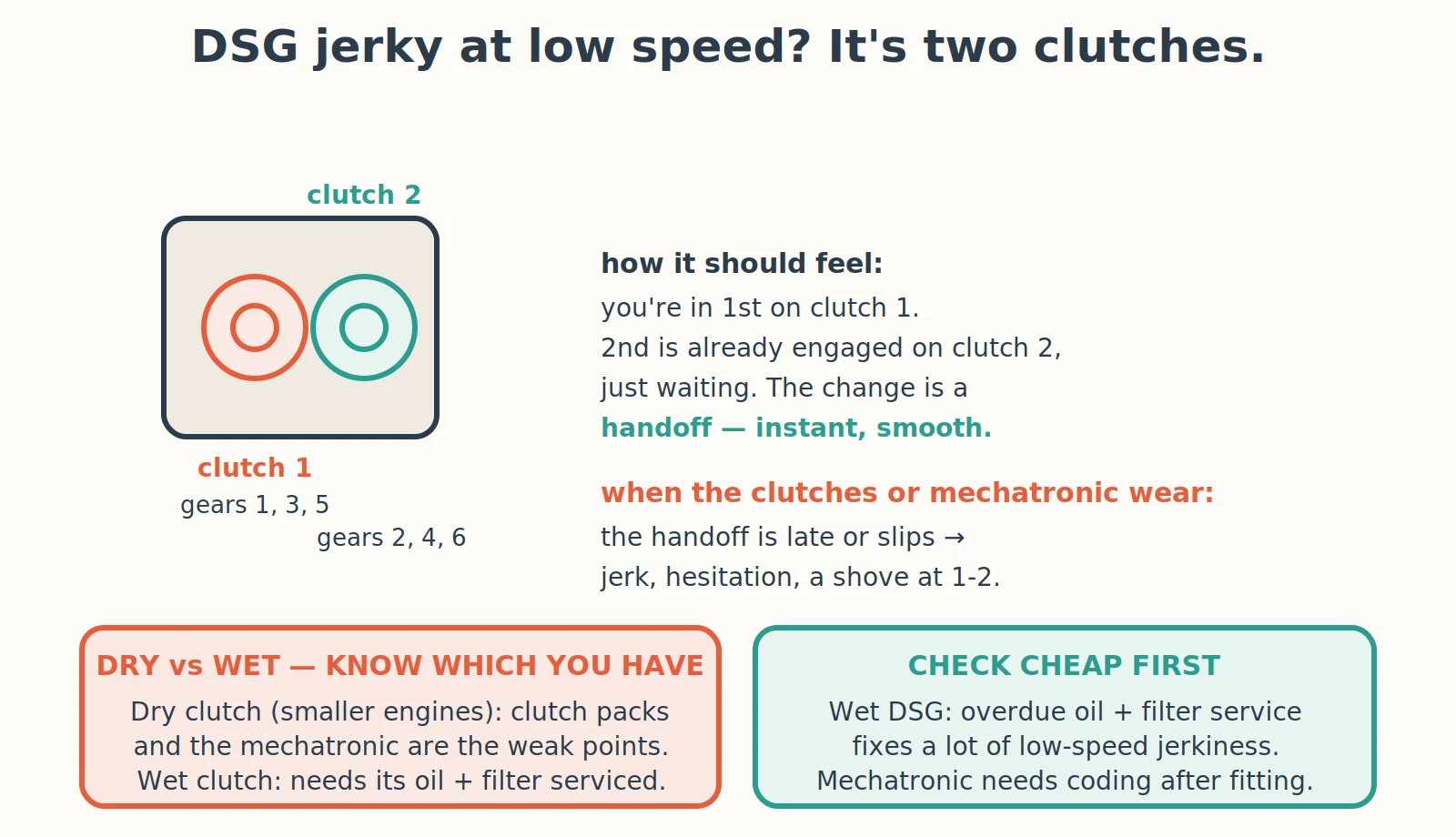
Two clutches, pre-selecting the next gear. When the handover slips or comes late, you feel it as a jerk.
Why is it jerky pulling away and at low speed?
Low speed is the hardest work a dual-clutch gearbox does. Pulling away from a standstill, crawling in traffic, and manoeuvring all involve the clutch slipping in a controlled way, because there is no torque converter to smooth things out like a traditional automatic.
When the clutches or the control system are healthy, that slip is managed so well you barely notice it. As they wear, the control becomes less precise. You get a jerk as the clutch engages, a hesitation as it works out what to do, or a shudder as it slips more than it should.
The one-to-two change is where it shows up most, because that is the handover happening at low speed under load. A shudder or shove there is the classic early symptom.
Do I have a wet-clutch or dry-clutch DSG, and why does it matter?
It matters a great deal, because they fail differently and they are serviced differently.
A dry-clutch DSG, generally used on smaller, lower-torque engines, runs its clutches dry like a manual. The clutch packs and the mechatronic unit are the usual weak points, and they do not have gearbox oil bathing the clutches to service.
A wet-clutch DSG, used on higher-torque engines, runs its clutches in oil. That oil needs changing, along with its filter, and this is the single most important maintenance item on the gearbox.
The reason this matters for a jerky gearbox is that on a wet-clutch DSG, a great deal of low-speed jerkiness comes from old, degraded oil, and a proper service often improves it markedly. On a dry-clutch DSG there is no such easy win, and the fault is more likely to be genuine clutch or mechatronic wear.
Can a service really fix a jerky DSG?
On a wet-clutch DSG that is overdue, often yes, at least partially. The oil carries away wear particles and provides the precise hydraulic control the clutches and mechatronic rely on. As it ages it loses those properties, and the gearbox becomes less precise, which shows up as jerkiness.
A correct oil and filter service, using the exact specified fluid and the right quantity, can restore a lot of that smoothness. It is not guaranteed to cure a badly worn gearbox, but it is the cheapest thing to try and it is maintenance the gearbox needed anyway.
The specified service interval is worth respecting rather than treating the gearbox as sealed for life, because running old fluid is what causes a lot of the wear in the first place.
What is the mechatronic unit and how does it fail?
The mechatronic unit is the gearbox's brain and hydraulic control combined, controlling the clutches and gear selection. It contains solenoids, valves and electronics, and on many DSGs it sits inside the gearbox.
When it wears or develops a fault, the symptoms overlap heavily with clutch wear: jerky changes, hesitation, limp mode, or a gearbox that will not select certain gears. It is one of the more common DSG faults, and it is a fraction of the cost of a whole gearbox.
The key practical point is that a replacement mechatronic usually has to be coded to the vehicle after fitting. Fit one without coding and the gearbox behaves badly on a good part, and the part gets blamed. Confirm the coding requirement before ordering.
Is it safe to keep driving a jerky DSG?
A gearbox that is slipping is wearing faster the longer it runs, and on a wet-clutch box it is contaminating the oil with clutch material, which then affects the mechatronic. So a small fault tends to grow into a bigger one.
Occasional low-speed hesitation on a healthy DSG is normal. A developing shudder, jerk or hesitation that is getting worse should be looked at promptly, because catching it at the fluid-service or clutch stage is far cheaper than catching it after it has taken the mechatronic with it.
Common questions
Is some DSG hesitation normal? Yes. A slight pause or gentle low-speed behaviour is in the nature of a dual-clutch gearbox and is not a fault on its own. A worsening jerk or shudder is different.
How often should DSG oil be changed? Follow the interval for your specific gearbox rather than treating it as sealed for life. On wet-clutch boxes it is the most important service the gearbox gets.
Can you replace just the clutch on a DSG? Yes, the clutch packs are replaceable separately from the gearbox, which is far cheaper than a whole unit. Whether that is the right repair depends on the diagnosis.
Does a new mechatronic need coding? On most vehicles yes. It must be coded to the car after fitting, and the fault often persists on a good part if this is skipped.
Why does my DSG jerk only when cold? Cold fluid is thicker and the clutch control is less precise until it warms. Jerkiness that is bad cold and improves warm points more at fluid condition, which is worth checking on a wet-clutch box.
Need DSG and transmission parts?
I supply DSG clutch packs, mechatronic units, oil and filter service kits and transmission parts out of China. Matched to your VIN, wet or dry confirmed, coding requirements confirmed before shipping, with warranty. Send me the VIN on WhatsApp and I will price it the same day.