
Clutch slip is one of the few faults you can test yourself with reasonable confidence, so here is how, and what to rule out before assuming the worst.
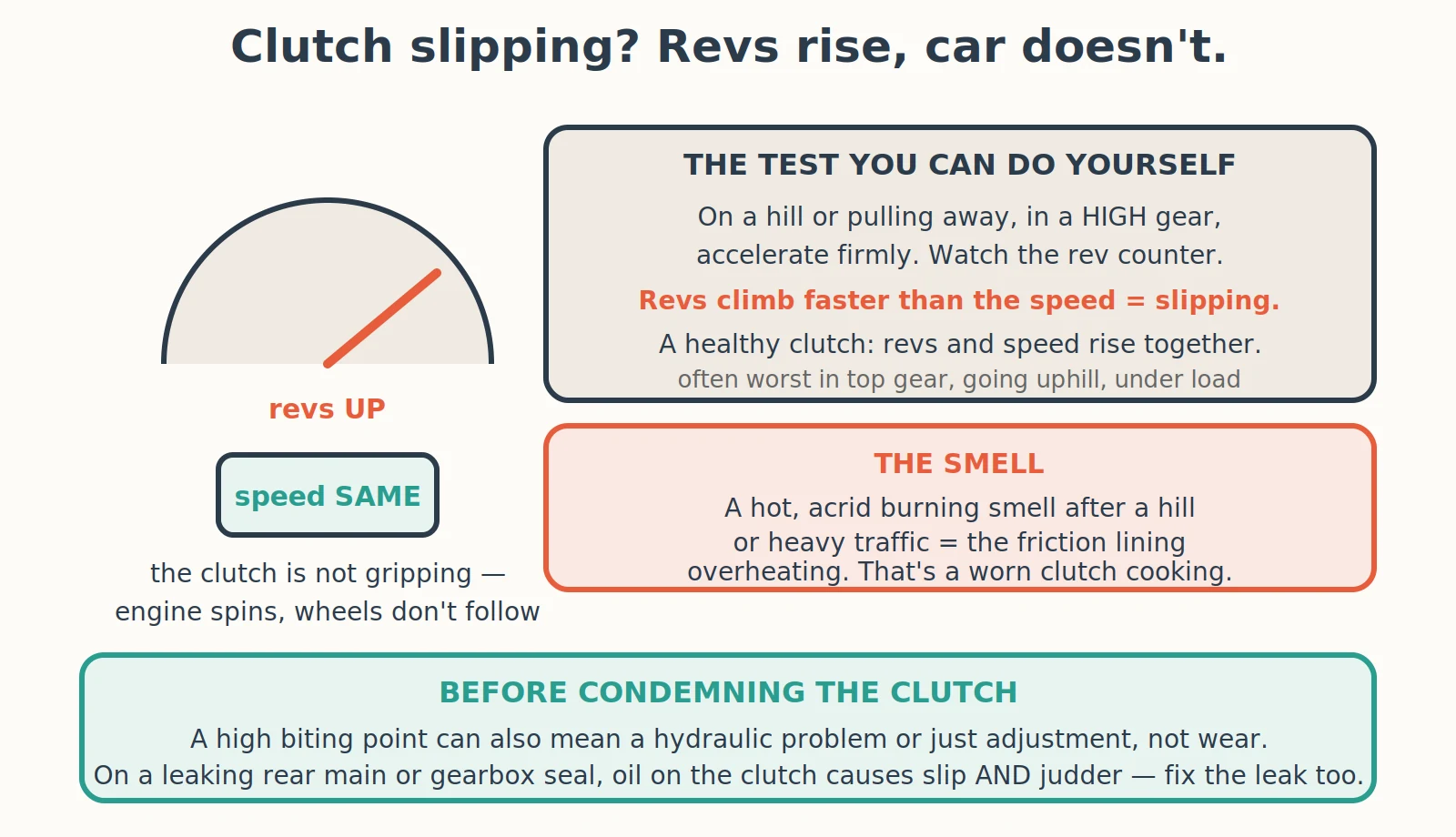
Revs rise, speed doesn't follow. The engine is spinning faster than the clutch can pass on to the wheels.
What does a slipping clutch actually feel like?
The clutch connects the engine to the gearbox by clamping a friction plate. When it is healthy, that grip is total, so engine speed and road speed rise together. When the friction material wears down or is contaminated, the plate can no longer hold, and it slips under load.
What you feel is a disconnect. You press the accelerator, the engine revs climb, but the car does not surge forward the way the revs suggest it should. In a manual car this is unmistakable once you know it, because the engine is clearly working harder than the car is moving.
It is worst under load, which means the higher gears, going uphill, carrying weight or accelerating hard. In first gear on the flat it may not show at all, because the demand on the clutch is lower. That is why the test uses a high gear and a hill.
How do I test for clutch slip myself?
Find a hill or a situation where the engine is under load. Put the car in a higher gear than you normally would for that speed, so the engine is having to pull, then accelerate firmly and watch the rev counter against your speed.
On a healthy clutch the revs and the speed climb together. On a slipping clutch the revs shoot up while the speed lags behind, because the clutch is not passing all that extra engine power to the wheels. The bigger the gap between rising revs and rising speed, the worse the slip.
You can also often smell it. A clutch that is slipping badly overheats its friction lining, and that produces a distinctive hot, acrid burning smell, similar to burning brakes but with its own character. Smelling that after a hill or heavy stop-start traffic is a strong sign the lining is cooking.
What causes a clutch to slip?
Normal wear is the main one. The friction lining wears down over the life of the clutch, and eventually there is not enough material left to grip firmly. How long that takes depends enormously on driving style and conditions. Lots of stop-start traffic, hill starts, towing and riding the clutch all wear it faster.
Oil contamination is the other big cause, and it is important because it makes a clutch slip long before it is worn out. A leaking crankshaft rear main seal or a leaking gearbox input shaft seal drips oil onto the clutch, and oil on the friction surface destroys its grip. In that case the clutch slips and often judders too, and simply fitting a new clutch without fixing the leak just contaminates the new one.
A faulty pressure plate or a weak diaphragm spring can also fail to clamp the plate properly, causing slip even with friction material left.
What can be mistaken for a slipping clutch?
Before condemning the clutch, a few cheaper things are worth ruling out. On a hydraulic clutch, a problem in the release system or simply the adjustment can change the biting point and feel wrong without the clutch being worn. A high or vague biting point is not always a worn clutch.
It is worth separating slip from other clutch symptoms too. A clutch that judders as you pull away, rather than slipping under load, points more at contamination or a worn dual mass flywheel than at a worn friction plate. A clutch that is heavy or will not disengage cleanly points at the release mechanism. Slip specifically is revs rising without matching speed under load.
Because the gearbox has to come out to replace a clutch, and the labour is the main cost, it is worth confirming the diagnosis properly before committing, and checking for an oil leak at the same time so you are not fitting a new clutch into an oily bellhousing.
Can I keep driving with a slipping clutch?
A clutch that is just starting to slip under heavy load can be nursed for a while by driving gently and avoiding the situations that make it slip, but it will not recover, and it tends to get worse.
A badly slipping clutch is another matter. It generates a lot of heat as it slips, which can damage the flywheel and the pressure plate, turning a clutch job into a clutch plus flywheel job. And a clutch that is slipping severely can eventually leave you unable to drive up a hill or pull away properly. So while a mild slip is not an emergency, letting a bad one continue tends to increase the eventual bill.
Common questions
How long does a clutch last? Anywhere from well under a hundred thousand kilometres to far more, depending almost entirely on driving style and conditions. Traffic, hills, towing and riding the clutch all shorten it.
Does a burning smell always mean the clutch? A hot acrid smell under load in a manual car often means clutch slip, but overheated brakes smell similar, so check which. After a long descent it may be brakes; after a hard hill climb pulling away, more likely clutch.
Should the flywheel be replaced with the clutch? The flywheel should be inspected and, if worn or if it is a dual mass flywheel at high mileage, replaced at the same time. The labour is already paid for with the gearbox out, and a worn flywheel damages a new clutch.
Can oil on the clutch be cleaned off? Not reliably, and it misses the point, because the oil is coming from a leaking seal that will just contaminate it again. The seal has to be replaced and the clutch usually renewed.
Why does my new clutch already slip or judder? The most common reasons are an oil leak that was not fixed, so the new clutch is already contaminated, or a worn flywheel that was not replaced. Both should be addressed when the clutch is done.
Need clutch parts?
I supply clutch kits, pressure plates, release bearings, dual mass and solid flywheels and crankshaft seals out of China. Matched to your VIN, with warranty, and I can price the seal alongside so you fix the leak at the same time. Send me the VIN on WhatsApp and I will price the full kit the same day.