
Before anyone quotes you for a rebuilt gearbox, this is worth understanding, because the cheap causes and the expensive causes produce the same symptom.
What is the torque converter lock-up clutch?
A torque converter connects the engine to an automatic gearbox using fluid rather than a mechanical clutch. That is what lets the car sit in gear at a standstill without stalling. The downside is that a fluid coupling always slips a little, and slip wastes fuel.
So once the car is cruising and the slip is no longer needed, the car engages a lock-up clutch inside the converter that physically clamps the two halves together. Now the engine and gearbox are connected solid, with no slip and no waste.
That clutch is a friction surface, like any other clutch. It wears. And the pressure that applies it is controlled by the gearbox's hydraulic system, so anything wrong with fluid pressure affects how cleanly it engages.
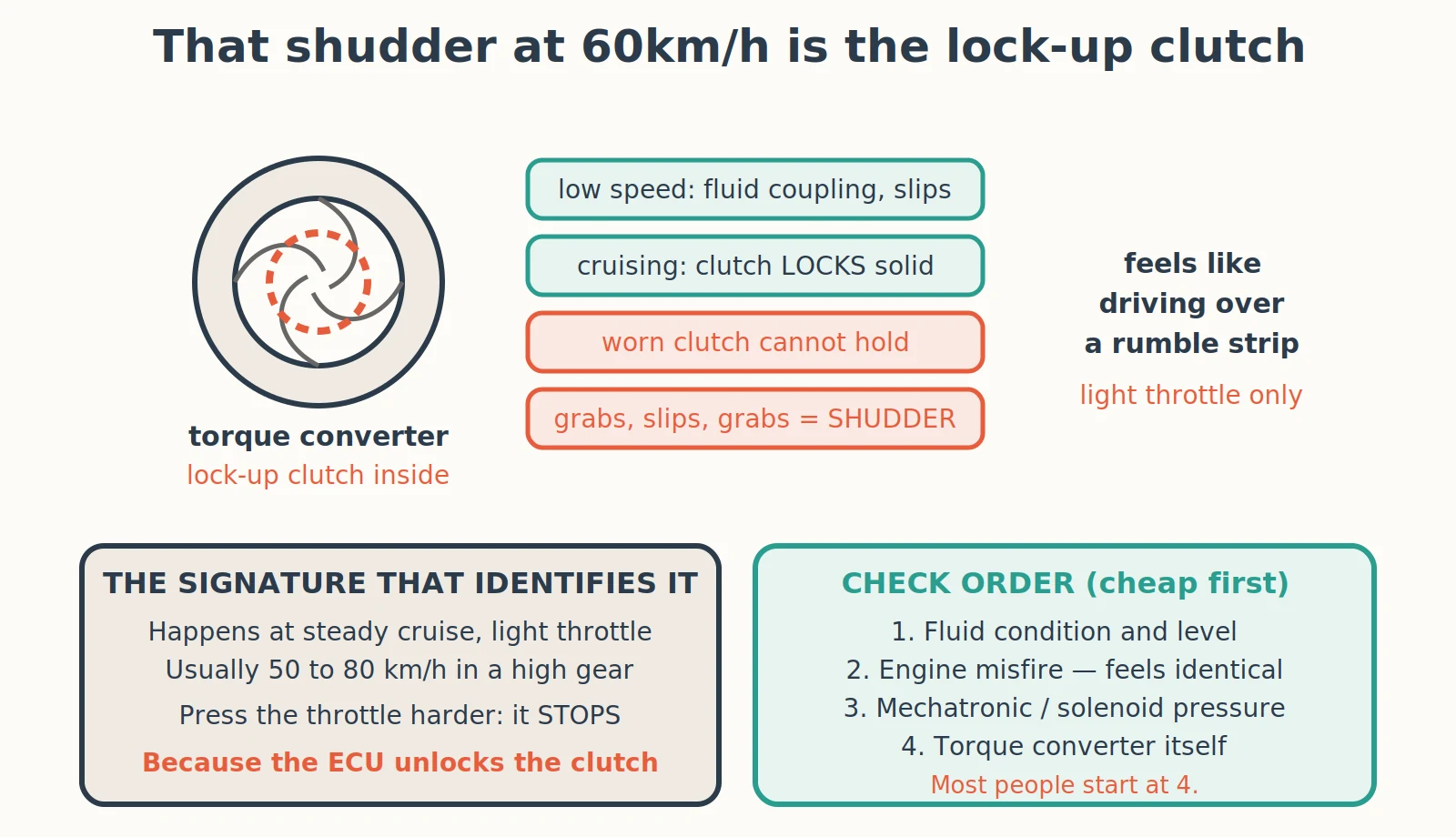
Lock-up engages at cruise. A worn clutch cannot hold, so it grabs and slips repeatedly — that is the shudder.
Why does the shudder stop when I accelerate?
Because the car unlocks the clutch. When you ask for more power, the control unit releases lock-up so the converter can multiply torque again. With the clutch released there is nothing to slip, so the shudder vanishes instantly.
That behaviour is the single most useful diagnostic clue you have. A shudder that appears only at light throttle at cruising speed, and clears under harder acceleration, points at lock-up. A vibration that gets worse under acceleration is usually something else entirely, such as a driveshaft, a wheel balance issue or an engine misfire.
Can dirty transmission fluid cause the shudder?
Yes, and this is the cause most worth ruling out first because it is by far the cheapest.
The lock-up clutch is applied hydraulically, and its friction material runs in the transmission fluid. As the fluid ages it loses its frictional properties, and it accumulates clutch material and metal particles. Degraded fluid means the clutch does not apply cleanly, so it chatters instead of clamping.
On a car where the fluid has never been changed at high mileage, a proper fluid and filter service sometimes reduces or removes the shudder completely. It is not guaranteed, and it will not restore a clutch that is already worn out, but it costs a fraction of the alternatives.
One honest caution: on a badly neglected gearbox with a lot of internal wear, a fluid change occasionally makes shifting worse rather than better, because the old degraded fluid had been compensating for wear through friction that fresh fluid does not have. That risk is real, but it is usually overstated. The bigger risk is leaving the wrong fluid in there for another fifty thousand kilometres.
Could it actually be an engine misfire instead?
This catches people constantly, and it is the reason plenty of perfectly good gearboxes get rebuilt.
A misfire under light load at cruising speed feels remarkably similar to a lock-up shudder. Same speed range, same light throttle, same rhythmic vibration. And when the lock-up clutch is engaged there is no fluid coupling left to absorb engine roughness, so a misfire that would otherwise be barely noticeable is transmitted straight through to the cabin.
So a mild misfire can present as a gearbox problem, and the car may not even show a fault light if it is not bad enough to trigger one. Before condemning a gearbox, check ignition coils, spark plugs, injectors and for vacuum leaks. That is a far cheaper investigation than a transmission.
What else causes an automatic gearbox to judder?
Worn internal clutch packs, which usually give judder during gear changes rather than at steady cruise. Failing solenoids or a worn mechatronic unit, which affect the pressure that applies both the clutches and the lock-up. A failing torque converter, where the clutch material has broken down completely. Or in some cases engine mounts, which allow the whole driveline to move more than it should.
The pattern of when the judder occurs is what separates them. Only at steady cruise under light throttle points at lock-up. During shifts points at clutch packs or pressure control. Under all conditions points at something mechanical.
Is it safe to keep driving with a shuddering gearbox?
Driving on it does further damage. Every time the lock-up clutch slips it sheds friction material into the fluid, and that material circulates through the valve body, the solenoids and the rest of the gearbox.
So a fault that starts as a worn lock-up clutch gradually contaminates everything else. What might have been a fluid service or a converter replacement becomes a full rebuild. This is one of those faults where the delay is what makes it expensive, not the fault itself.
Common questions
At what speed does torque converter shudder usually happen? Typically somewhere between about fifty and eighty kilometres per hour in a high gear at light throttle, though it varies by vehicle and gearing. What matters is the pattern, not the exact number.
Will a transmission fluid change fix converter shudder? Sometimes, if the fluid is the cause and the clutch is not badly worn. It is the correct first step because it is cheap and it may be the whole answer.
Can you replace just the torque converter? Yes, and it is far cheaper than a full rebuild. Whether it is the right repair depends on how much contamination has already spread through the gearbox.
Does shudder always throw a fault code? No. Mechanical slip often produces no code at all until it becomes severe, which is why so many people are told nothing is wrong.
Is torque converter shudder the same as transmission slipping? No. Slipping means the engine revs rise without the car accelerating properly. Shudder is a vibration at a steady speed. They point at different problems.
Need transmission parts?
I supply torque converters, mechatronic units, valve bodies, oil pan kits with integrated filters and transmission parts out of China. Matched to your VIN, variant confirmed, coding requirements confirmed before shipping, with warranty. Send me the VIN on WhatsApp and I will price it the same day.