
Before replacing anything, work out which of these three situations you are in, because they lead to completely different places.
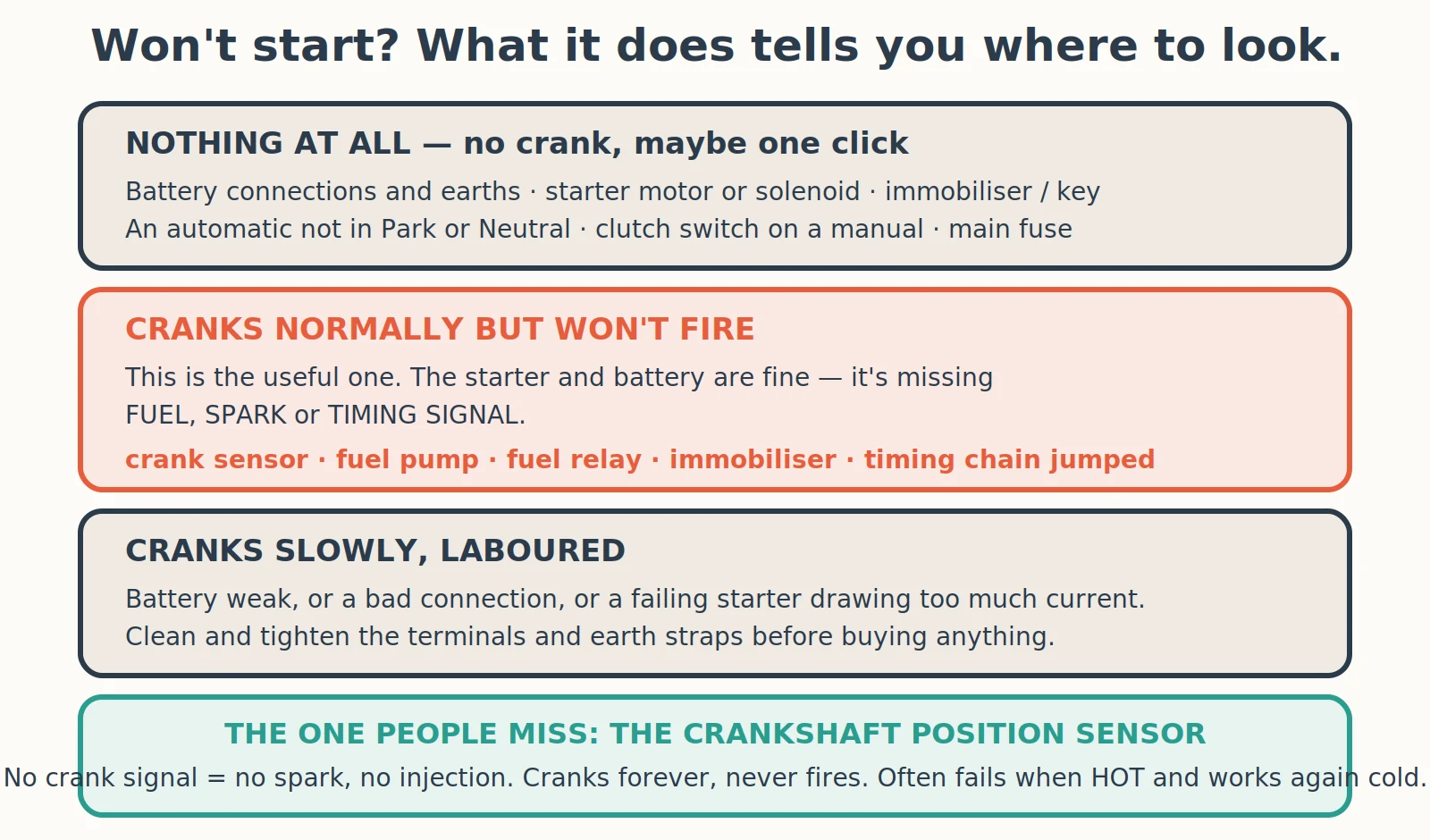
Nothing, cranks but won't fire, or cranks slowly — three different symptoms pointing at three different areas.
What does it mean if nothing happens at all?
No cranking, and perhaps a single click or nothing, points at the starting circuit rather than the engine.
Start with the battery connections and the earth straps, because a battery can test perfectly and still not deliver current through a corroded terminal or a loose earth. A single loud click usually means the starter solenoid is engaging but the motor is not turning, which points at the starter itself or the supply to it.
The immobiliser is worth considering, especially if the dashboard shows a security symbol. A key that is not being recognised will prevent starting entirely, and a spare key is a quick way to test that theory.
There are also simple interlocks that catch people out. An automatic will not crank unless it is properly in Park or Neutral, and sometimes moving the selector firmly into Neutral makes it start when Park does not, which points at a worn selector switch. A manual with a clutch switch will not crank unless the pedal is fully down.
What if it cranks normally but will not fire?
This is the most informative symptom, because it rules out the battery and starter completely. The engine is turning at normal speed but not running, so it is missing one of the three things it needs: fuel, spark, or the timing signal that tells the computer when to deliver them.
The crankshaft position sensor is the one people miss most often. It tells the computer the exact position and speed of the crankshaft, and without that signal the computer does not know when to fire the injectors or the spark, so the engine cranks forever and never starts. It is a small, inexpensive sensor with a large effect.
A characteristic of a failing crank sensor is that it often fails when hot and works again once cold. That produces a car that will not start after a run but starts fine the next morning, which is a very recognisable pattern and one that gets misdiagnosed as a fuel problem repeatedly.
Fuel delivery is the other main branch. A failed fuel pump, a fuel pump relay, or a blocked filter all give a car that cranks but does not fire. With the ignition turned on you can often hear the pump prime for a couple of seconds; silence there is a strong clue.
The immobiliser can also allow cranking while blocking fuel or spark, so a security light on the dash during cranking is worth noticing.
What does slow, laboured cranking mean?
It points at the electrical supply rather than the engine, even if a battery test said the battery was fine.
The most common cause is a poor connection rather than a bad battery. Corroded terminals, a loose clamp, or a corroded earth strap between the engine and the body all add resistance, and the starter draws a very large current, so a small amount of resistance makes a big difference. Cleaning and tightening the connections costs nothing and fixes a surprising number of slow-crank problems.
A failing starter motor drawing excessive current gives the same laboured cranking, as does a battery that tests acceptable at rest but collapses under the heavy load of starting. A proper load test on the battery, and a voltage-drop check across the connections while cranking, separate the two.
Why does it start when cold but not when hot, or the reverse?
Temperature-dependent no-starts are common and they narrow things down usefully.
Will not start when hot, but fine when cold, is the classic crankshaft position sensor pattern, since these sensors often break down as they heat up. It can also be a fuel pump that is weakening and struggles when hot, or a hot-soaked ignition component.
Will not start when cold, but fine once warm, points more at cold-start enrichment, a coolant temperature sensor reporting the wrong value so the computer supplies the wrong mixture, weak battery performance in cold weather, or on a diesel, failed glow plugs.
On a diesel specifically, hard starting when cold with white smoke and clearing once warm is a strong glow plug indication rather than anything more serious.
Can a bad earth cause a no-start?
Yes, and it is one of the most underestimated faults on any vehicle. Everything electrical returns through the earth straps, and the starter's return path carries an enormous current.
A corroded or loose engine-to-body earth strap can produce a car that cranks slowly, clicks, will not crank at all, or behaves strangely with lights dimming and odd dashboard behaviour when you turn the key. The symptoms look electrical and confusing, and the fix is often just cleaning and tightening a strap.
Because earth faults produce such varied symptoms, checking and cleaning the main earth connections is always worth doing early. It is free, and it eliminates a cause that otherwise sends people replacing expensive parts.
Common questions
Can a car with a good battery still have a starting problem? Certainly. A good battery with a corroded terminal, a bad earth, a failed starter or a dead crank sensor will not start. Battery condition is only one part of the picture.
Why does my car click once and not start? Usually the solenoid engaging without the motor turning, which points at the starter, or a supply and connection problem preventing enough current reaching it.
How do I know if the fuel pump has failed? With the ignition on, listen for a brief priming hum from the tank area. Silence is a strong clue, though it needs confirming with a fuel pressure test rather than assumed.
Can a timing chain cause a no-start? If the chain has jumped, valve timing is lost and the engine will not run, and it may crank unusually easily because compression is reduced. That is a serious situation and usually follows a rattle or a warning that was ignored.
Does an immobiliser fault always show a light? Usually there is a security or key symbol on the dash. Trying a spare key is a quick and free way to test whether the key or the immobiliser is involved.
Need starting and ignition parts?
I supply starters, crankshaft and camshaft position sensors, fuel pumps, relays, glow plugs and ignition parts out of China. Matched to your VIN, tested, with warranty. Tell me on WhatsApp exactly what the car does when you turn the key, and I will help narrow it down before you buy anything.