
Replacing the battery when the real fault is a drain or a charging problem is one of the most common wasted repairs. Here is how to tell them apart before spending anything.
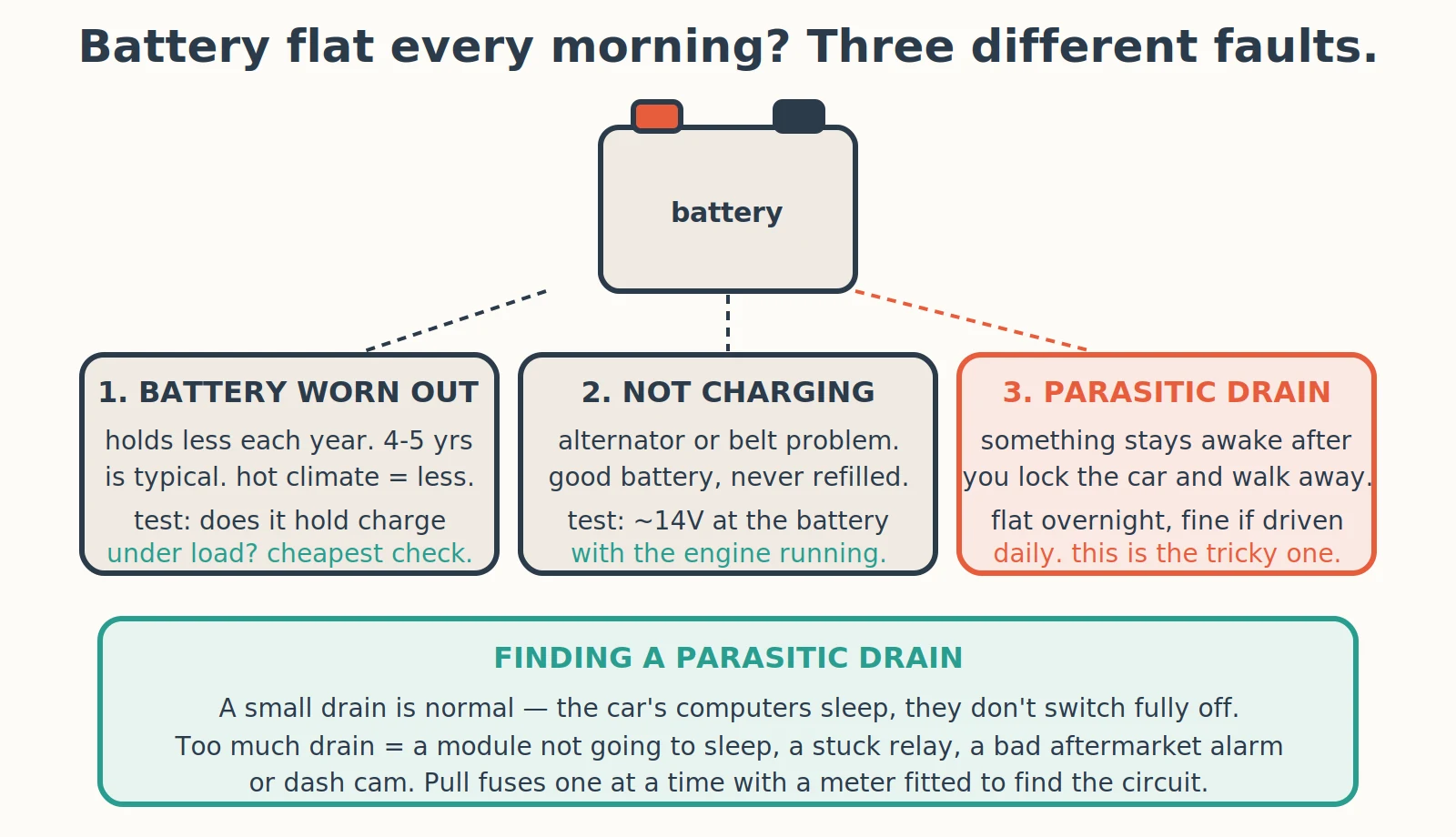
Worn battery, not charging, or something staying awake after you walk away. The pattern separates them.
How do I know if it is the battery or something else?
Start with the pattern, because it points you straight at the cause before any tools come out.
If the battery goes flat overnight or over a day or two of sitting, but is fine as long as you drive the car every day, that is a parasitic drain. Something is staying awake and using power while the car is parked.
If the battery goes flat over a few days regardless of whether you drive it, and the car cranks slowly or the lights are dim even after a run, that points at a worn battery or a charging fault. The battery either cannot hold charge, or it is not being refilled.
If the battery is more than four or five years old, and especially in a hot climate, it is a prime suspect on age alone. Heat is very hard on batteries, and a battery that lasts six years in a cool climate may last three in a hot one.
How do you test the battery and the charging system?
The battery test that matters is whether it holds voltage under load, not just its resting voltage. A tired battery can show a normal resting voltage and then collapse the moment it has to deliver current. Most workshops have a load tester or a conductance tester that gives a proper answer in a minute.
The charging test is to measure the voltage at the battery with the engine running. It should be somewhere in the region of fourteen volts on most vehicles. Much lower and the alternator is not charging properly, or the belt is slipping, or there is a wiring or earth problem. Much higher and the voltage regulator has failed, which overcharges and cooks the battery.
On many modern cars the charging is managed intelligently and the voltage varies deliberately, so the reading has to be interpreted for that vehicle rather than against a fixed number. But a battery sitting well below fourteen volts with the engine running is a clear sign something is wrong on the charging side.
What is a parasitic drain?
When you lock a modern car and walk away, it does not switch fully off. Dozens of control modules go into a sleep mode, drawing a tiny amount of current so they can wake up when needed. That small draw is completely normal, and it is why a car left for several weeks can still go flat even with nothing wrong.
A parasitic drain is when something draws far more than it should. A module that never goes to sleep, a stuck relay, a boot or glovebox light that stays on, or an aftermarket accessory wired in badly are the usual culprits.
Aftermarket alarms, dash cams, stereos and tracking devices are extremely common causes. Anything added to the car after it left the factory, wired to a permanent live feed, is the first place to look. A dash cam in parking mode will flatten a battery over a weekend.
How do you find a parasitic drain?
A meter is connected in the battery circuit to measure the current drawn with everything switched off and the car locked and asleep. This has to be done carefully, because the car needs time to go into sleep mode, which can take many minutes, and opening a door wakes everything up again.
Once the car is asleep and the parked draw is higher than it should be, the circuits are checked one at a time, usually by pulling fuses while watching the meter, until the draw drops. That identifies the circuit, and from there the specific component.
It is a methodical job rather than a difficult one, but it takes patience because of the sleep timing. It is also exactly the job that gets skipped, which is why people end up buying two or three batteries for a car that has a drain.
Why did my battery die right after fitting a new one?
Because the new battery did not fix the underlying fault. If the real problem was a charging fault or a parasitic drain, a new battery just gives it something fresh to flatten.
There is also the registration issue on many modern European cars. If the car requires the new battery to be registered and it was not, the charging system may undercharge it, and it will struggle from the start. On those vehicles, fitting and registration go together.
Does short-trip driving flatten a battery?
It contributes, and it is an underrated cause. Starting the engine takes a large amount of energy, and the alternator needs running time to put that energy back. A pattern of only short trips, especially with lights, heater and other loads running, may never fully recharge the battery.
Add a cold climate, which reduces battery capacity, or a hot climate, which ages the battery faster, and a car used only for short journeys can sit permanently undercharged. That undercharged state then shortens the battery's life, so it wears out early and the cycle looks like a faulty battery.
Common questions
How long should a car battery last? Commonly four to six years, but a hot climate, lots of short trips, or a car that sits unused all shorten that considerably. Age alone makes an old battery a prime suspect.
Can a bad alternator kill a new battery? Yes, both ways. Undercharging leaves it flat and sulphated, overcharging cooks it. Check the charging voltage before blaming the battery.
Will a dash cam or alarm drain my battery? A dash cam in parking mode certainly can over a weekend, and badly wired accessories are one of the most common causes of parasitic drain. Check anything added after the factory first.
Is it normal for a car to go flat if left for weeks? Some drain is normal from the sleeping modules, so a car left for a long time can go flat with nothing wrong. A car that goes flat overnight has a real drain.
Should I disconnect the battery if the car sits? It prevents the normal sleep drain from flattening it, but on modern cars it also means losing stored settings and sometimes needing re-learns. A battery maintainer is usually the better answer.
Need batteries sensors or charging parts?
I supply alternators, starters, IBS battery sensors and charging system parts out of China. Tested, matched to your VIN, with warranty. Small or mixed orders welcome and the small parts fly fast. Send me the part number or the VIN on WhatsApp and I will price it the same day.