
The type of noise tells you a lot, so it is worth being precise about what you are hearing.
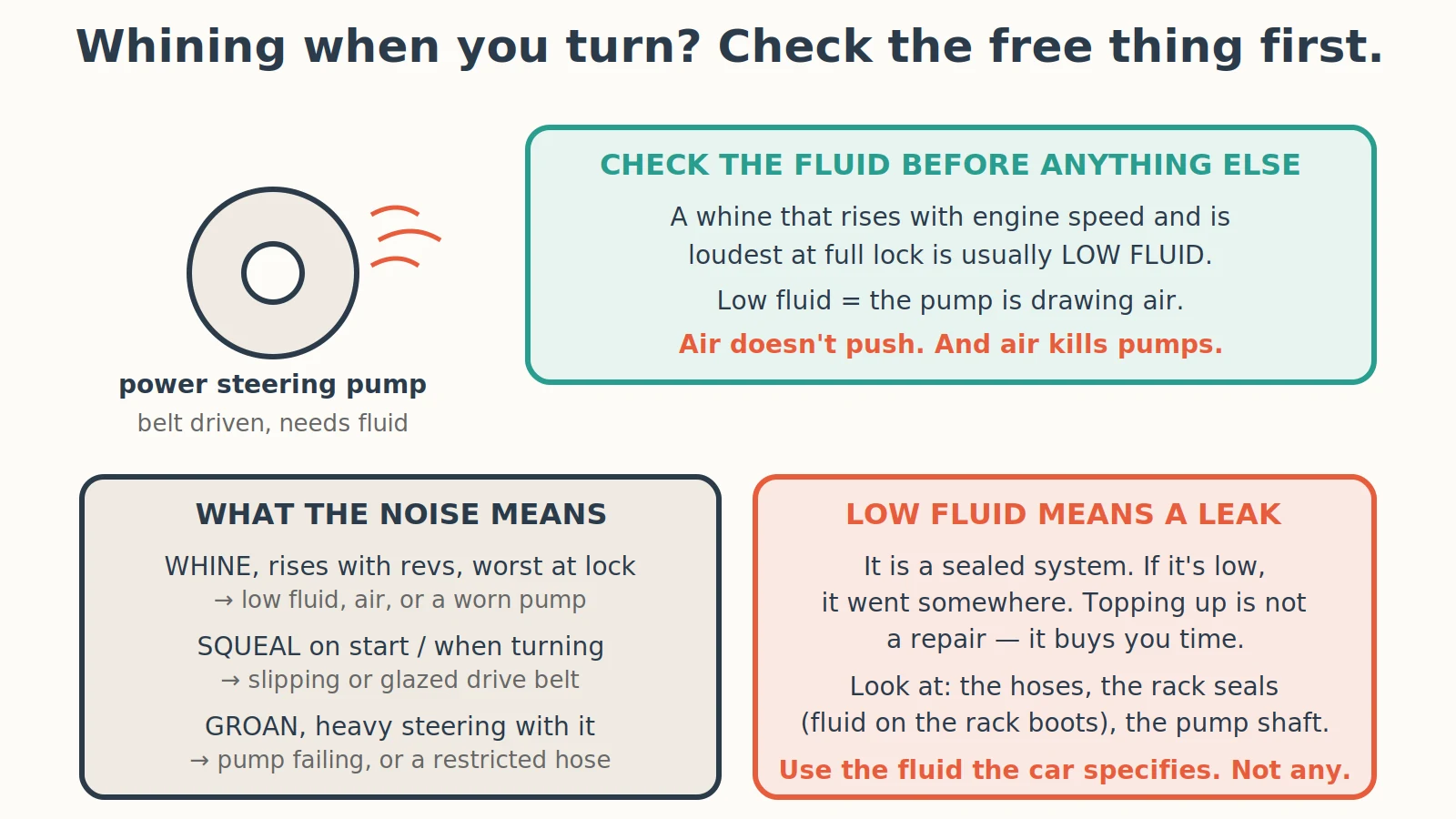
Whine rising with revs and worst at full lock is the classic low-fluid signature. Check that before anything else.
Why does low fluid make the pump whine?
Hydraulic power steering works by a belt-driven pump pressurising fluid, which then assists the steering rack. The system relies on moving liquid, and liquid does not compress.
When the fluid level drops, the pump starts drawing in air along with the fluid. Air does compress, so instead of building smooth pressure the pump is churning a foamy mixture. That churning is what you hear as a whine, and it gets louder as the pump works harder, which is why it peaks at full lock when demand is highest.
It also does real damage. A pump running with air in it is not properly lubricated and cavitates internally, which wears it out. So a whine from low fluid, left alone, eventually becomes a genuinely failed pump. Catching it early is the difference between a hose and a pump.
Where does the fluid go?
Power steering is a sealed system, so it does not consume fluid the way an engine consumes oil. If the level is low, it leaked, and the leak needs finding.
The usual places are the hoses, especially where they crimp onto fittings and where they run near heat; the steering rack seals, which often shows as fluid soaking the rubber boots at each end of the rack; and the pump shaft seal, which usually leaves fluid running down the front of the pump.
Because the fluid is often thin and gets blown around by airflow, the leak point is not always where the drips land. Cleaning everything and then looking again after a drive is a more reliable way to find the source than looking at where the puddle is.
What if it squeals rather than whines?
A squeal, especially on start-up, when turning hard, or when the engine is cold, usually points at the drive belt rather than the pump. A belt that is loose, glazed or perished slips on the pulley when the pump loads up, and the noise is the belt slipping rather than the pump complaining.
This is worth distinguishing because the fix is completely different and much cheaper. Check the belt condition and tension, and look at the tensioner if the vehicle has an automatic one. A glazed shiny belt surface or visible cracking tells you a lot.
On many engines the same belt drives the alternator and water pump, so a slipping belt can come with charging or cooling symptoms too, which is a useful confirming clue.
What does a groan with heavy steering mean?
A groaning or grinding noise combined with steering that has become genuinely heavy usually means the pump is failing to build pressure, or something is restricting flow.
A worn pump that can no longer generate pressure is the obvious one. A restricted or collapsing hose, where the inner lining has broken down and is blocking flow, is a less obvious cause that produces similar symptoms and is much cheaper to fix. Contaminated fluid, thick with debris from a worn pump, can also restrict the system.
Because heavy steering with noise can point at several things, it is worth checking fluid condition as well as level. Fluid that is dark, gritty or smells burnt tells you the system has been suffering for a while and that a simple top-up will not be the end of it.
Does the type of fluid matter?
Yes, more than people expect. Different vehicles specify different power steering fluids, and some use a specific hydraulic fluid while others use an automatic transmission fluid. They are not interchangeable.
Using the wrong fluid can attack the seals in the system, causing leaks that were not there before, and can affect how the system performs when hot or cold. On a system that already has a leak, adding the wrong fluid makes things worse rather than buying time.
So when topping up, use what the vehicle specifies rather than whatever bottle is nearest. It is a small detail that causes expensive problems.
Common questions
Can I keep driving with a whining power steering pump? For a short time, but it is damaging the pump and the fluid is low for a reason. Top it up correctly, find the leak, and get it sorted before the pump fails completely.
Why is the noise worse at full lock? Full lock is maximum demand on the pump, so any weakness, low fluid, air, wear or a slipping belt, shows up there first and loudest.
Does electric power steering whine too? Electric systems have a motor rather than a pump, and they can make a light electrical whirr under load which is normal. A loud whine that rises with engine speed is a hydraulic pump symptom, not an electric one.
Should I use a stop-leak additive? They can swell seals temporarily but they do not repair a failed seal or a split hose, and they can cause problems elsewhere in the system. Finding the leak is the real fix.
Can low power steering fluid damage the rack? A system running low and aerated is hard on both the pump and the rack seals, so a long-neglected leak can turn into a much bigger repair than the original hose would have been.
Need steering parts?
I supply power steering pumps, hoses, steering racks, drive belts and tensioners out of China. Matched to your VIN, with the correct fluid specification confirmed, with warranty. Send me the VIN on WhatsApp and I will price the pump and hoses together so the leak gets fixed properly.