
Shocks wear so gradually that most drivers adapt without noticing, which is why they are one of the most commonly overlooked worn parts on a car.
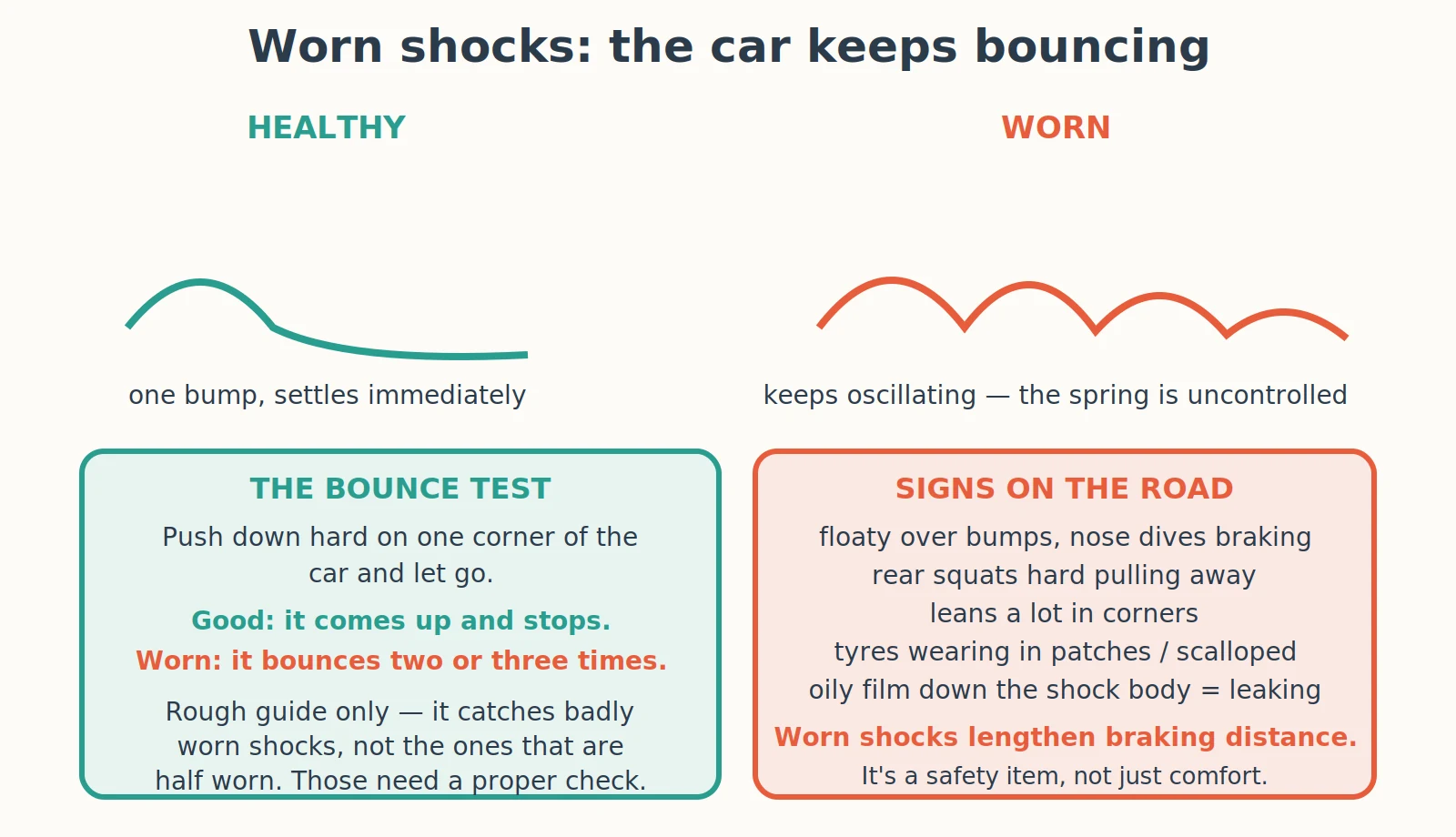
A healthy shock settles the car after one bump. A worn one lets the spring keep oscillating.
What does a shock absorber actually do?
The springs hold the car up and absorb bumps. The shock absorbers, or dampers, control what the springs do afterwards. Without damping, a spring that is compressed by a bump would keep bouncing up and down for a long time, because a spring stores energy and gives it back.
The shock converts that energy into heat by forcing oil through small valves inside it, so the movement is damped out. That is why the correct name is damper: it damps the spring's oscillation.
This matters for safety, not just comfort. A wheel that is bouncing is not in firm contact with the road, and a tyre that is not in contact cannot brake or steer. That is why worn shocks lengthen braking distances and reduce grip, particularly on rough surfaces.
How do I test shock absorbers myself?
The bounce test is the simple one. Push down hard on one corner of the car, get it moving as much as you can, then let go and watch. A healthy corner will come back up and settle almost immediately. A worn one will bounce two or three times before settling.
It is worth being honest about its limits. The bounce test reliably catches badly worn shocks, but a shock can lose a great deal of its damping performance and still pass it, so a car that passes the bounce test does not necessarily have healthy shocks. It is a useful quick check, not a definitive one.
A visual inspection often tells you more. Look down the body of each shock for an oily film or wet streaks. A shock is full of oil, and once the seal fails and the oil leaks out, the damping goes with it. Visible leakage means the shock is finished, regardless of how the car feels.
Proper testing on a suspension tester at a workshop measures damping performance properly and catches the partially worn ones the bounce test misses.
What are the signs while driving?
A floaty or wallowy feeling over undulating roads, where the car takes a moment to settle after a dip or a crest, is the classic one.
Excessive nose dive under braking, and the rear squatting noticeably when you accelerate away, both indicate the shocks are not controlling weight transfer.
More body lean in corners than the car used to have, and a general feeling of vagueness or instability at speed, particularly in crosswinds or on rough surfaces.
A knocking noise over bumps can come from worn top mounts or a shock that has failed internally, though noises over bumps have many possible causes, so that one needs proper checking rather than assuming.
The reason these get missed is that they arrive slowly over years, and drivers adjust their driving without realising. It is common for people to be genuinely surprised at how different the car feels after new shocks.
What does tyre wear tell you?
Worn shocks produce a distinctive pattern sometimes called cupping or scalloping, where the tyre wears in patches around its circumference rather than evenly across it.
It happens because the wheel is bouncing rather than being held down, so the tyre is loaded and unloaded repeatedly as it rolls, wearing more where it is pressed hardest. If you run your hand around the tread and feel high and low patches, that pattern points at damping.
This is worth knowing because it means worn shocks cost money in tyres as well as in safety, which usually changes how people weigh up the repair.
Should shocks be replaced in pairs?
Yes, in axle pairs, and this is one case where the advice is genuinely worth following.
If one front shock is worn and the other is replaced with a new one, the two sides of that axle now behave differently. The car brakes and corners unevenly, because one side controls its wheel better than the other. That imbalance can be worse than having two equally worn shocks.
So replace both fronts together, or both rears together. Whether you need to do all four at once depends on their condition, and the fronts often wear faster because they carry more weight and take more braking load.
It is also worth checking the top mounts and bump stops while the shock is out, since they wear in the same conditions and the labour is already being spent.
Common questions
How long do shock absorbers last? There is no fixed figure, because it depends heavily on road conditions and loads. On rough or unsealed roads they wear far faster than on smooth highways. They should be inspected periodically rather than replaced on a schedule.
Are shock absorbers and struts the same thing? Related but not identical. A strut is a structural suspension component that includes a damper, so on a strut suspension the damper is part of the assembly. The damping function is the same.
Do worn shocks affect braking distance? Yes. A bouncing wheel has reduced contact with the road, so braking and grip suffer, particularly on uneven surfaces. This is why they are treated as a safety item.
Is a leaking shock absorber always bad? Visible oil leakage means the seal has failed and the damping is compromised or gone. A slight misting can be borderline, but wet streaks running down the body mean it needs replacing.
Will new shocks fix a bouncy ride completely? If the shocks were the cause, yes. But tyre pressures, worn springs, worn bushes and top mounts all affect ride too, so it is worth checking the whole corner rather than assuming the shock is the only worn part.
Need suspension parts?
I supply shock absorbers, struts, top mounts, springs, control arms and bushes out of China, including air suspension components for Range Rover, Land Cruiser, Patrol and German SUVs. Matched to your VIN, supplied in axle pairs, with warranty. Send me the VIN on WhatsApp and I will price a full axle set the same day.