
Why a petrol engine gets vacuum for free
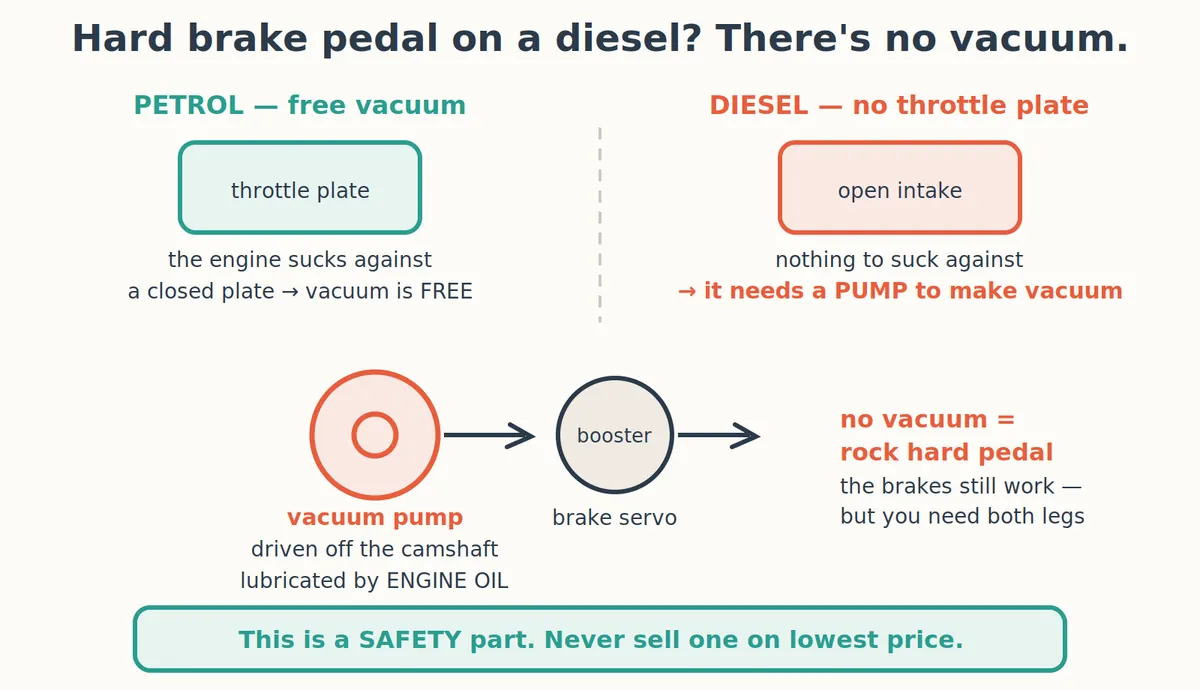
Because it's got a throttle plate. At part throttle the engine's trying to breathe through a nearly shut door, so the intake is under vacuum all the time. The brake booster just taps into that. Free of charge.
I confirm the engine, pump mounting and drive, vacuum specification, oil-feed arrangement and seal kit. Because this affects brake assistance, I require the workshop to inspect the hose, booster and service information before fitting.
OE / VIN · FITMENT · TEST · WARRANTYA diesel's got no throttle plate, so there's no natural vacuum. It has to make its own with a pump.
So why does a diesel need a pump
Because a diesel has no throttle plate — it breathes freely and controls power with fuel, not air. No shut door means no vacuum. So the car has to manufacture vacuum with a mechanical pump, usually driven off the end of a camshaft.
Plenty of modern turbo petrol engines need one too, for the same reason: under boost the intake's at positive pressure, not vacuum. So it's not a diesel-only part anymore.
Why they fail
Here's the important bit: the vacuum pump is lubricated by engine oil, fed through a little passage. Two failures come straight out of that.
One: oil quality and level. Sludge blocks the feed, the pump runs dry, the vanes wear. Stretched-out oil changes kill vacuum pumps — same story as the VANOS solenoid, different symptom.
Two: the seal. When it hardens, the pump leaks oil — often down the back of the engine, and people waste hours hunting a rear main seal leak that isn't there. And in a bad case oil gets sucked into the brake booster through the vacuum line, which wrecks the booster too. Now a vacuum-pump failure has turned into a brake job.
What you must say when you quote it
Two things. First: this is a safety part. Loss of vacuum assistance can greatly increase pedal effort and stopping risk. Treat a hard brake pedal as a safety fault: stop using the vehicle and have the complete braking and vacuum system inspected by a qualified technician. This is not one to buy from an unverified source, and I'd honestly rather lose the sale than send someone a low-grade unit.
Second: check the oil feed and the oil condition. If the pump died because the oil was filthy, the new one dies too — and this time it's your part on a brake system. Not a comeback you want.
What to order
Engine-specific, and the mounting and drive change even within one engine family. Send the VIN. Quote the gasket or O-ring with it — it seals against engine oil, and a reused seal leaks.
And check the vacuum line while you're there. A perished line gives you the exact same hard pedal as a dead pump, and it costs next to nothing. Check the hose and other simpler causes as part of the complete diagnosis.
What I check before shipment
I confirm the engine, pump mounting and drive, vacuum specification, oil-feed arrangement and seal kit. Because this affects brake assistance, I require the workshop to inspect the hose, booster and service information before fitting.
Diagnosis and safety note
This guide describes common failure patterns, not a final diagnosis. Confirm fault codes, live data, wiring, fitment and the vehicle-specific service information before ordering or fitting a part. Safety-critical, refrigerant, high-pressure and drivetrain work should be handled by a qualified technician using the correct procedures.
Frequently asked questions
Pedal's only hard on the first stop after starting — is that the pump? Often, yes. A weak pump takes too long to build vacuum. It's an early warning, not a minor niggle.
There's oil in the brake booster line — what does that mean? The pump seal's failed and it's pumping oil into the booster. Replace the pump, and check the booster, because oil destroys the diaphragm inside it.
Can you drive with a failed vacuum pump? I would not advise it. A hard pedal or loss of brake assistance is a safety fault; stop using the vehicle and arrange qualified inspection or recovery.
Need vacuum pumps and brake parts?
I supply brake vacuum pumps, boosters, seals and engine parts for Mercedes, BMW, Land Rover and Toyota diesels out of China — tested, matched to your VIN, with warranty. Small or mixed orders welcome. Send me the VIN on WhatsApp and I will confirm fitment, testing, warranty and shipping options before you order.