
The test
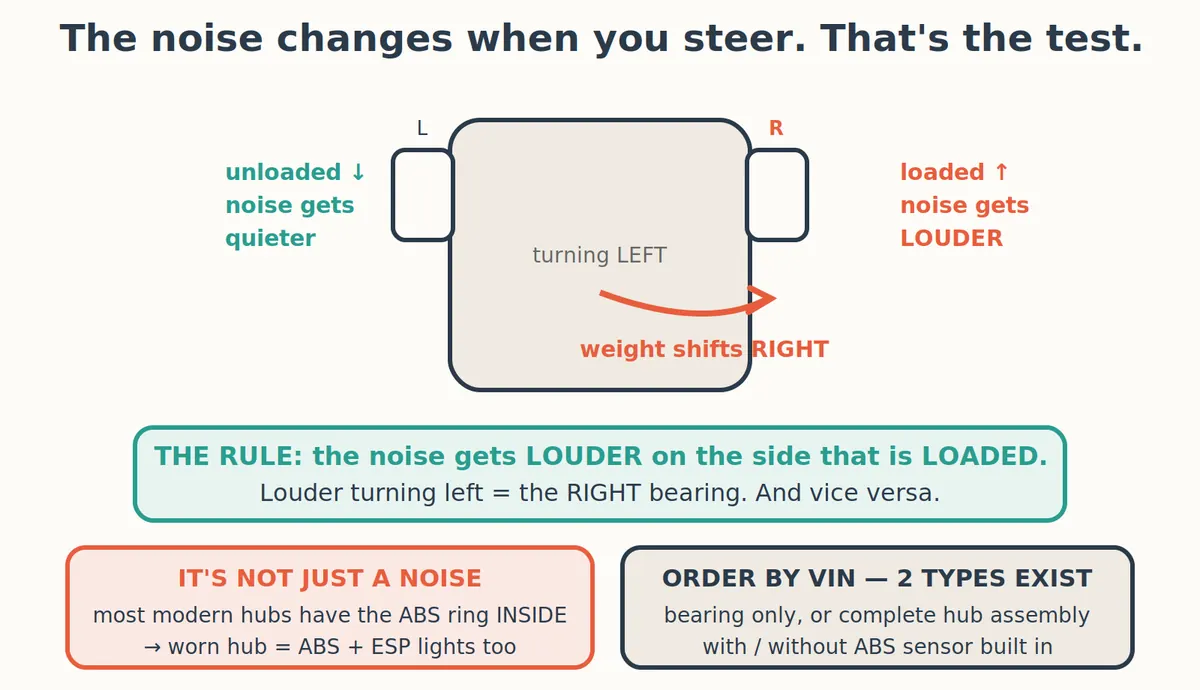
A qualified technician may compare noise under gentle, controlled steering load only where road, traffic and legal conditions allow. Workshop inspection or chassis-ear testing is safer and more repeatable. Noise often changes as the suspect side is loaded, but tyre, differential and CV-joint noise can overlap.
When you turn left, the weight shifts onto the right side of the car. So if the noise swells up turning left, it's the right bearing. Turn right, weight goes left — louder means the left one. Simple, and it costs nothing.
I match the VIN, axle and side, bolt pattern, bearing or complete-hub format and ABS encoder design. I also confirm whether the sensor or magnetic ring is integrated before shipment.
OE / VIN · FITMENT · TEST · WARRANTYTurning loads up the outside wheel. Whichever bearing gets louder under that load is the one that's gone.
Why they fail, and why faster in some places
A wheel bearing carries the whole weight of that corner plus every pothole hit, spinning the entire time. What kills it is water and dirt getting past the seal, and shock loading off bad roads. On rough roads, in sand, in floods, they go much faster — this is a steady seller across Africa, the Middle East, and anywhere with real off-road use.
Heavy vehicles cop it worst. A Land Cruiser or a Range Rover puts serious weight through each bearing, and the ones that tow or carry loads are on a shorter clock.
Why it's not just an annoying noise
Two reasons, and both matter for your quote.
First, safety. A bearing that's been growling for a year has play in it. Play means the wheel isn't sitting exactly where the geometry wants it, and in a bad case a bearing can seize or the hub can let go. This isn't a noise to nurse along for another six months.
Second, the ABS ring. On most modern hubs the ABS tone ring is built right into the bearing or the hub. So a worn hub throws ABS and stability lights too — and somebody starts chasing the ABS sensor, replaces it, and the light stays on. The sensor was fine. The ring inside the hub is wrecked.
That's a handy thing to say out loud: if a customer's got ABS lights and a humming noise at the same time, stop staring at the sensor and look at the hub.
What to order
Two types, and they're not the same order: a bare bearing that has to be pressed into the hub carrier, or a complete hub assembly that just bolts on. The assembly costs more but saves hours of labour and a press. Ask the workshop which they want.
And confirm whether the ABS sensor or tone ring is built in, because that changes the part number. Send the VIN, and say front or rear — they're different, and on some cars left and right differ too.
One note on freight: hubs are heavy for their size, so this is usually a sea freight item unless there's a job waiting on it.
What I check before shipment
I match the VIN, axle and side, bolt pattern, bearing or complete-hub format and ABS encoder design. I also confirm whether the sensor or magnetic ring is integrated before shipment.
Diagnosis and safety note
This guide describes common failure patterns, not a final diagnosis. Confirm fault codes, live data, wiring, fitment and the vehicle-specific service information before ordering or fitting a part. Safety-critical, refrigerant, high-pressure and drivetrain work should be handled by a qualified technician using the correct procedures.
Frequently asked questions
Can you do just one side? Yes — unlike air springs, bearings fail one at a time, usually from a specific pothole or a failed seal. No need to sell the pair.
How do you confirm it on the lift? Jack the wheel up, grab it at twelve and six o'clock, and rock it. Play means bearing or ball joint. Spin the wheel and listen for roughness. Combine those observations with workshop inspection and service information before confirming the part.
New hub, ABS light's still on? Check the wiring and the sensor, and make sure the right part went on — some cars have a magnetic ring on the hub seal that's easy to wreck during fitting.
Need hubs and chassis parts?
I supply hub assemblies, bearings, control arms and chassis parts for Land Cruiser, Range Rover, Mercedes and BMW out of China — matched to your VIN, ABS type confirmed, with warranty. Small or mixed orders welcome. Send me the VIN on WhatsApp and I will confirm fitment, testing, warranty and shipping options before you order.