
And here's the annoying bit, the reason I'm writing this one at all: it's the kind of fault that makes a good workshop look stupid. Fit the part, light's still on, customer thinks you don't know what you're doing. So let me save you that.
One wheel, five systems
The sensor does one simple thing. It sits at the wheel and counts how fast that wheel is spinning. That's it.
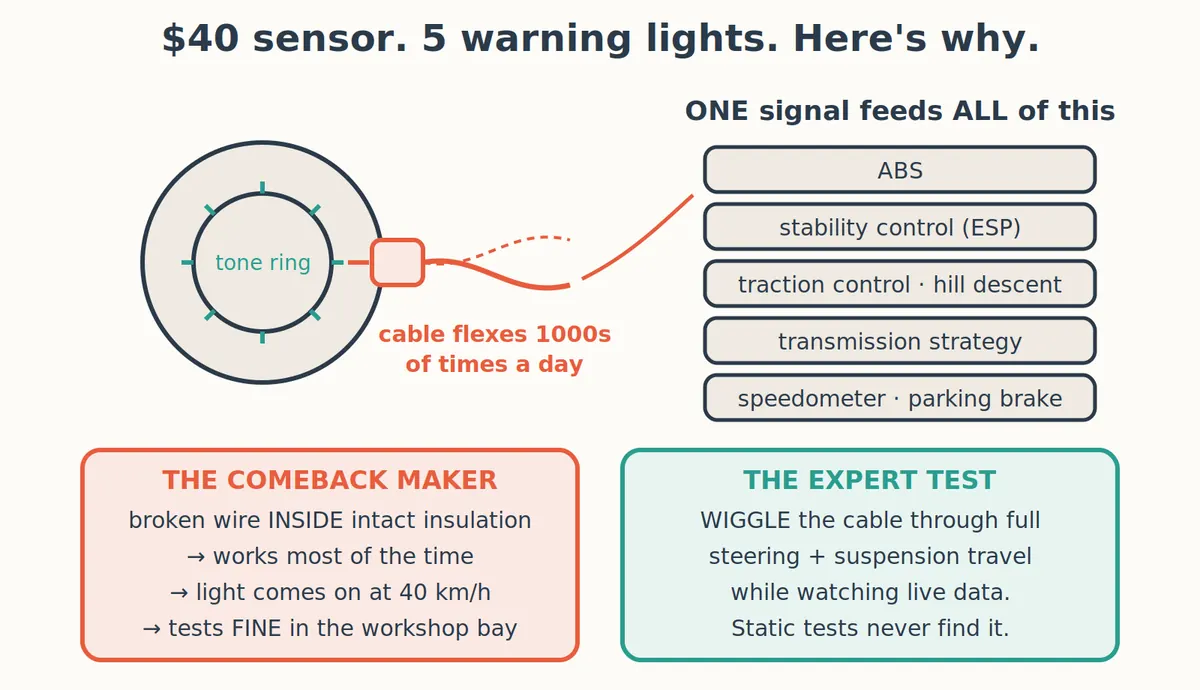
But that little number doesn't just go to the ABS. It goes to traction control, stability control, hill descent if the car has it, the gearbox, sometimes the electric handbrake, and on a lot of cars the speedo runs off it too. So when one sensor stops talking, half the car panics at once. Five lights. Looks catastrophic. It's one quiet sensor at one corner.
I confirm the VIN, axle and corner, connector shape, cable length, mounting and whether the vehicle uses an active or passive wheel-speed sensor. I also ask the buyer to check the tone ring or magnetic encoder before a sensor is approved.
OE / VIN · FITMENT · TEST · WARRANTYOne little signal feeds five systems. That's why one small sensor lights up the whole dash.
Why they die — and why yours die faster
Think about where this thing lives. Bolted next to the wheel, down in the water, the salt, the mud, the sand, the brake heat, shaking every second the car moves. It's a hard life. In dusty places and anywhere people go off-road, they go quicker — grit gets into the toothed ring it reads, or the tip gets caked.
The sensor, cable, connector and encoder can all fail. An intermittent break inside the cable is especially easy to miss. That wire flexes every time the wheel steers and every time the suspension moves — thousands of times a day, for years — until one strand cracks inside the insulation. From the outside the cable looks perfect. That's the one that comes back to bite you.
Why it passes every test in the workshop
This is the part that catches people. A cracked wire still works most of the time. So the car sits in the bay, wheels straight, engine idling, and the tech tests the sensor. Passes. Reads perfect. "Sensor's fine."
It isn't fine. It just isn't being bent. The fault only shows up at fifty on a bumpy road when the cable flexes and that cracked strand pulls apart for half a second. Light comes on, then clears next time the car starts. You can chase that for a week if you test it standing still.
The test that actually finds it
A static resistance check can miss an intermittent wiring fault. A trained technician can compare wheel-speed live data while the harness and steering move through the manufacturer-approved inspection range. A dropout is useful evidence, but it should be confirmed against the wiring, connector, encoder and service information.
One more thing before you sell anyone a sensor: look at the toothed ring it reads. If that ring is cracked or packed solid with dirt you get the exact same symptoms — and if the customer fits your brand new sensor and the light stays on, whose part do you think gets the blame? Inspect the tone ring or magnetic encoder before condemning the sensor.
Getting the right one
Good news: it's small and light so it is easy to consolidate into a mixed shipment. Bad news: there are a hundred versions. The plug, the cable length, the mounting — all change between models, and often the front is different from the rear on the same car. So don't guess. Send me the VIN and tell me which corner.
And get a tested one. An untested copy that works intermittently just recreates the whole nightmare, except now your name's on it. Not worth the small saving.
What I check before shipment
I confirm the VIN, axle and corner, connector shape, cable length, mounting and whether the vehicle uses an active or passive wheel-speed sensor. I also ask the buyer to check the tone ring or magnetic encoder before a sensor is approved.
Diagnosis and safety note
This guide describes common failure patterns, not a final diagnosis. Confirm fault codes, live data, wiring, fitment and the vehicle-specific service information before ordering or fitting a part. Safety-critical, refrigerant, high-pressure and drivetrain work should be handled by a qualified technician using the correct procedures.
Frequently asked questions
Can you still drive with the ABS light on? Do not assume normal braking performance from the warning lamp alone. Base braking may remain, but ABS, stability control or related assistance can be reduced. Follow the vehicle manual and have a qualified workshop diagnose the fault promptly.
Why did five lights come on from one little sensor? Because all five systems share that one wheel-speed number. It looks like a disaster and it's a sensor-related repair. Saying that to a worried customer, calmly, buys you a lot of trust.
Fitted a new one and the light is still on — now what? Recheck the tone ring or magnetic encoder, wiring, connector, wheel-bearing play, exact corner and part number. Then follow the vehicle procedure for fault-code clearing and calibration.
Need ABS or engine sensors?
I supply ABS wheel sensors, crank and cam sensors, MAF and NOx sensors out of China — tested, matched to your VIN, with warranty. Happy to do small or mixed orders, and they are easy to consolidate with a mixed order. Send me the part number or the VIN on WhatsApp and I will confirm fitment, testing, warranty and shipping options before you order.