
What each one tells the engine
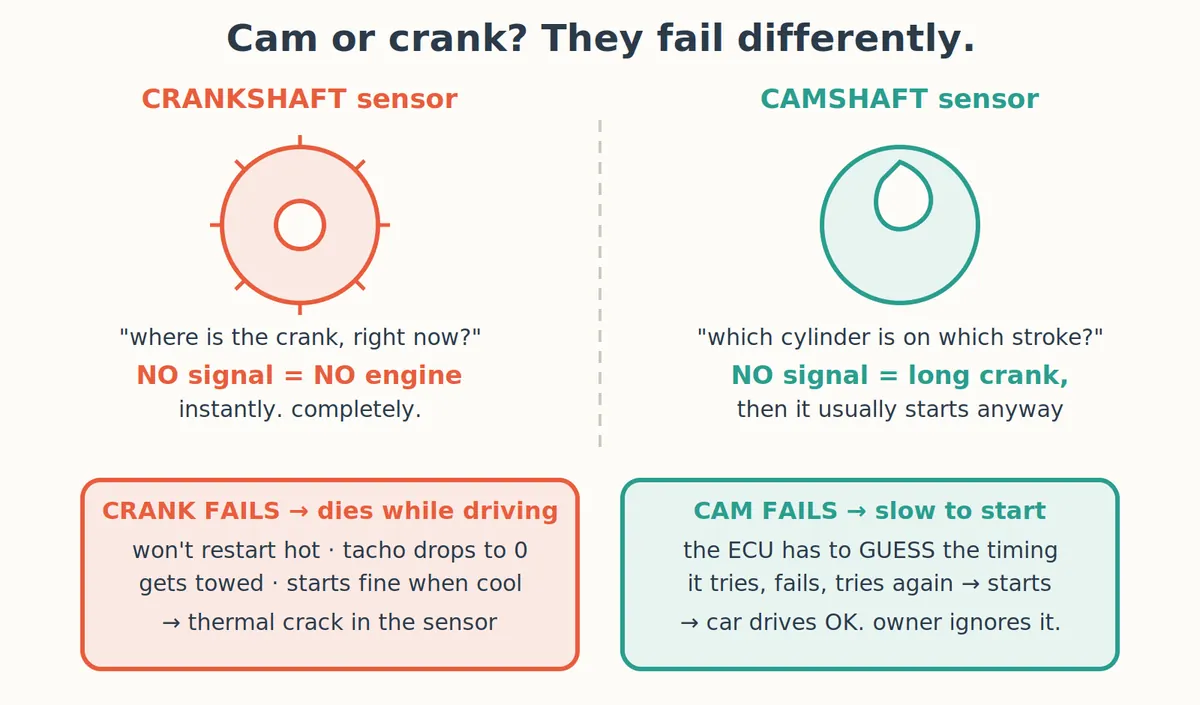
The crank sensor answers one question: where's the crankshaft right now, and how fast is it spinning. Without it, the computer has no idea when to fire anything. No signal, no engine — instantly, completely.
The cam sensor answers a different question: which cylinder is on which stroke. The crank spins twice for every one turn of the cam, so from the crank alone the computer can't tell whether a cylinder's on compression or exhaust. The cam sensor sorts that out.
I confirm whether the request is cam or crank, the exact bank or position, connector, cable and OE number. On engines with several cam sensors, I do not approve an order from a generic model description alone.
OE / VIN · FITMENT · TEST · WARRANTYThe crank sensor is life support. The cam sensor is more of a shortcut — and the engine can limp along without it.
Why the symptoms are so different
Here's the key. A lot of engines will still start with a dead cam sensor. The computer just guesses which stroke it's on, tries, gets it wrong, tries again — and that takes a few seconds. So the customer tells you the car takes ages to start, and then it starts and drives fine.
A dead crank sensor is a totally different story: the car cuts out while driving, won't restart when it's hot, and the rev counter drops to zero. That's not a slow start. That's an engine that stopped existing for a moment.
Long cranking can point toward a cam-signal problem, while an intermittent stall can point toward a crank-signal problem, but the symptoms overlap with wiring, timing, fuel and other faults. Use codes, signal data and service information before ordering.
What else a bad cam sensor does
Because the variable valve timing needs to know exactly where the cam is, a failing cam sensor also gives you rough running, lost power, bad economy, and VVT or VANOS codes. On a BMW, that's exactly the point where somebody starts quoting VANOS units and timing chains — for a sensor that costs next to nothing.
So the honest order is: read the codes, check the cam sensor and its wiring, and only then start talking about the expensive stuff behind it.
Why they fail
Heat and oil. The cam sensor sits up high on the engine, right in the hot zone, and on a lot of engines it seals against oil pressure with an O-ring. Two things follow: the electronics cook over time, and the O-ring hardens and leaks. An oil-soaked connector is a really common cause of a flaky cam signal — and people swap the sensor without swapping the O-ring, so the new one drowns too. Replace the specified seal with the sensor.
What to order
Small, light, is easy to consolidate into a mixed shipment, and very engine-specific. A lot of engines have two or more cam sensors — intake side and exhaust side, or bank one and bank two — with different part numbers. So I do not approve an order that only says "cam sensor." Ask which one, or ask for the VIN. And quote the O-ring with it — it's a few cents, and leaving it off is how a good part fails in six months.
What I check before shipment
I confirm whether the request is cam or crank, the exact bank or position, connector, cable and OE number. On engines with several cam sensors, I do not approve an order from a generic model description alone.
Diagnosis and safety note
This guide describes common failure patterns, not a final diagnosis. Confirm fault codes, live data, wiring, fitment and the vehicle-specific service information before ordering or fitting a part. Safety-critical, refrigerant, high-pressure and drivetrain work should be handled by a qualified technician using the correct procedures.
Frequently asked questions
Can you drive with a bad cam sensor? Usually yes, badly — slow to start, rough, thirsty. Which is exactly why it gets ignored for a year.
New sensor, code came back — why? Check the connector for oil, check the wiring, make sure you did the right bank. And check the timing chain — a stretched chain shifts the cam relative to the crank and throws a correlation code that no sensor will ever fix.
Cam correlation code — is that the sensor? Not necessarily. That code means the cam and crank positions don't agree, which can be a stretched chain. Don't sell a sensor as a cure for a chain.
Need engine position sensors?
I supply cam and crank sensors, VANOS solenoids and engine electronics out of China — tested, matched to your VIN and the right bank, with the seals, with warranty. Small or mixed orders welcome and they are easy to consolidate with a mixed order. Send me the part number or the VIN on WhatsApp and I will confirm fitment, testing, warranty and shipping options before you order.