
What the computer does with this one number
Almost everything. How much extra fuel to add while warming up. When to start trusting the oxygen sensors. When to run the cooling fan. When to let a diesel burn its DPF. When to let the gearbox lock up the torque converter. All of it hangs off one number from one small sensor.
And notice the theme running through this whole subject: the computer can't feel the engine. It just believes the sensor.
I confirm which temperature circuit the sensor serves, its thread, connector, sealing method and OE number. On engines with several similar sensors, I use the VIN and location rather than appearance alone.
OE / VIN · FITMENT · TEST · WARRANTYAn engine that is reported as colder than it really is may enrich fueling, alter fan strategy and delay DPF regeneration.
When it reads too cold
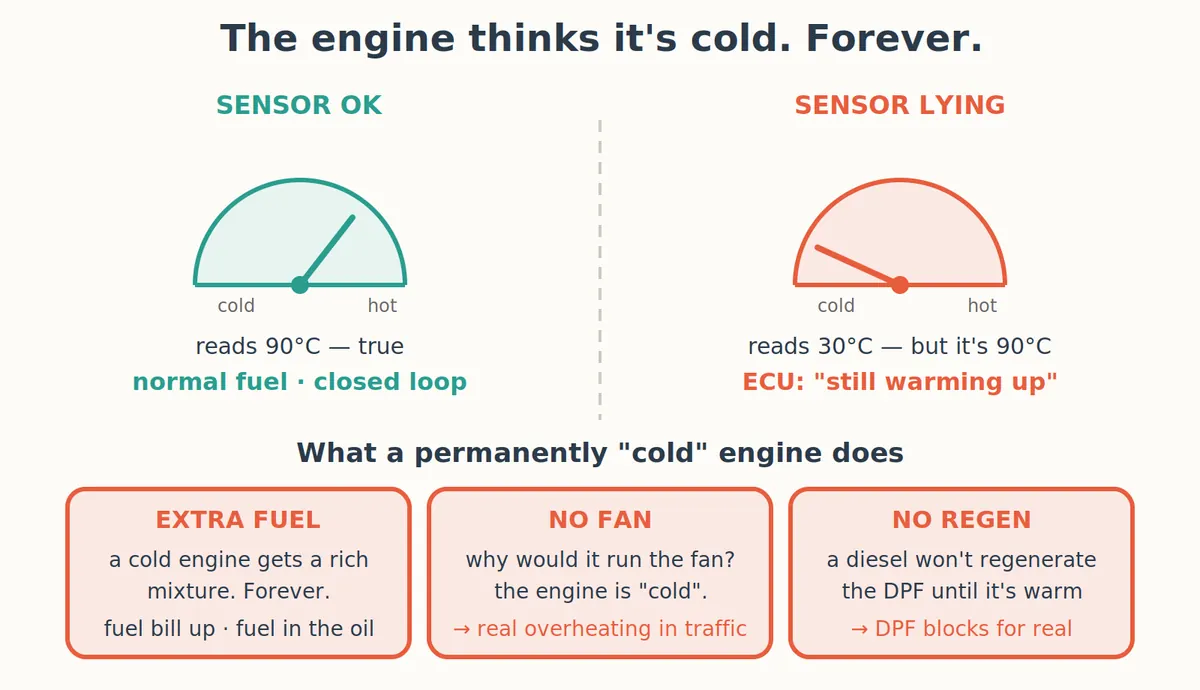
Three things happen, all bad, none of them obvious.
Extra fuel. A cold engine gets a deliberately rich mix. If the sensor says thirty degrees when it's really ninety, the engine gets that rich mix forever. Fuel climbs, unburnt fuel washes the bores and thins the oil, and it fails the emissions test.
No fan. Why would the computer run the fan on a "cold" engine? So on a hot day in traffic the thing genuinely overheats — and everyone starts staring at the fan clutch, the radiator, the water pump. All of them fine.
No regen. A diesel won't burn its DPF until the engine's up to temperature. If the required temperature is not reached or reported, regeneration may be delayed and soot loading can increase. Same story as the EGT sensor, just a different starting point.
Why it reads wrong instead of just dying
Because it's a thermistor — a resistor that changes value with temperature. As it ages, that relationship drifts. It still spits out a number, and the number looks believable, so there's no fault code — unless it drifts so far the computer decides it's flat-out impossible.
That believable-but-wrong zone is where the money quietly leaks away, and it can go on for years.
How to catch it in one minute
Cold engine, first thing in the morning. Read the coolant temp on a scan tool. It should match the outside air. If the car sat all night at twenty-five degrees and the sensor says forty, it's lying — and you just proved it with no tools.
Then compare: a lot of cars have more than one temperature sensor — one for the computer, one for the gauge, sometimes one at the radiator. If they disagree when cold, one of them's wrong.
What to order
Tiny, light, is easy to consolidate into a mixed shipment — and worth checking which one, because some engines have two or three that look identical with different part numbers and different plugs. Send the VIN. And quote the O-ring with it: it seals against pressurised coolant, and a reused hardened seal just gives you a leak.
What I check before shipment
I confirm which temperature circuit the sensor serves, its thread, connector, sealing method and OE number. On engines with several similar sensors, I use the VIN and location rather than appearance alone.
Diagnosis and safety note
This guide describes common failure patterns, not a final diagnosis. Confirm fault codes, live data, wiring, fitment and the vehicle-specific service information before ordering or fitting a part. Safety-critical, refrigerant, high-pressure and drivetrain work should be handled by a qualified technician using the correct procedures.
Frequently asked questions
The gauge reads normal, so the sensor must be fine? Not necessarily. The gauge sensor and the computer's sensor are often two different parts. The gauge can be perfect while the computer's being fed lies.
No fault code — can it still be this? Yes. That's the normal case. A drifted thermistor looks plausible, and plausible doesn't set codes.
New sensor, still running rich — why? Check the thermostat. A thermostat stuck open means the engine really is running cold, and the sensor's telling the truth. Same symptoms, different part.
Need temperature sensors and cooling parts?
I supply coolant temp sensors, thermostats, water pumps and engine sensors out of China — tested, matched to your VIN, with the seals, with warranty. Small or mixed orders welcome and they are easy to consolidate with a mixed order. Send me the VIN on WhatsApp and I will confirm fitment, testing, warranty and shipping options before you order.