
Head gasket gets diagnosed far more often than it actually fails, so it is worth knowing what genuinely points to it and what does not.
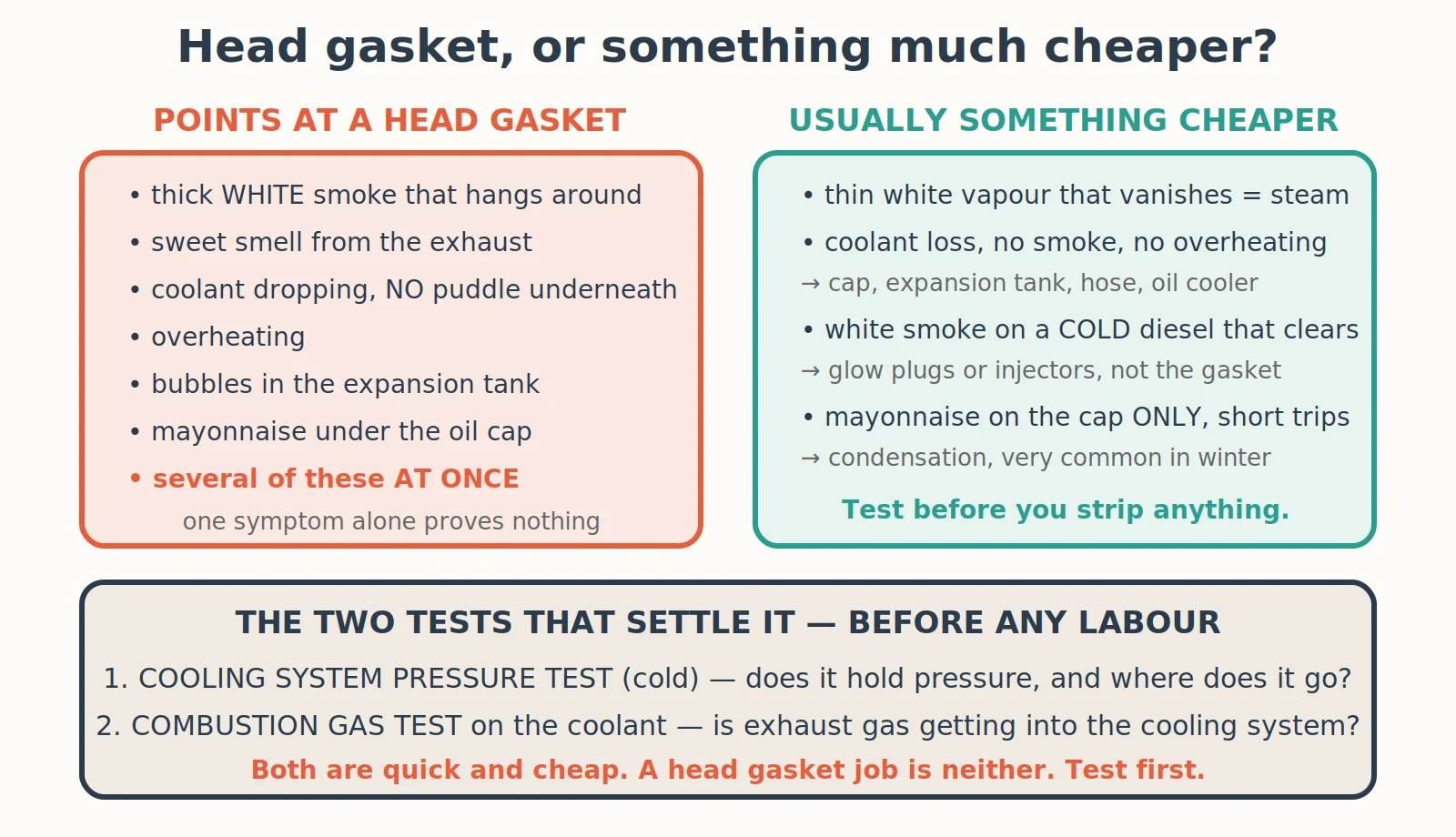
A real head gasket failure gives several symptoms together. One symptom alone usually has a cheaper cause.
What does a head gasket do?
The head gasket seals the joint between the cylinder head and the engine block. It has to contain the extreme pressure of combustion in each cylinder, while at the same time keeping the oil passages and the coolant passages sealed and separate as they pass across that same joint.
When it fails, those things that should be separate start mixing. Combustion pressure can get into the cooling system, coolant can get into a cylinder and be burned, coolant and oil can mix, or pressure can escape externally. Which of those happens depends on where the gasket failed, which is why the symptoms vary.
What are the real signs of head gasket failure?
Thick white smoke from the exhaust that hangs in the air and does not disperse quickly, often with a slightly sweet smell, is coolant being burned in a cylinder. This is different from the thin white vapour that appears on a cold morning and vanishes, which is just condensation and completely normal.
Coolant level dropping steadily with no visible leak anywhere and no puddle under the car. The coolant is going somewhere, and if it is not on the ground it may be going into the engine.
Overheating, particularly overheating that has got worse over time, and especially where the cooling system seems otherwise healthy.
Bubbles or pressure in the expansion tank, which can indicate combustion gases being forced into the cooling system. In a worse case the tank overflows or the top hose becomes very hard soon after starting.
A creamy, mayonnaise-like emulsion where oil and coolant have mixed, which can appear on the dipstick or under the oil filler cap. This one comes with a caution, explained below.
The important pattern is that a genuine failure usually produces several of these together. A single symptom in isolation is far more likely to have another cause.
What gets misdiagnosed as a head gasket?
Coolant loss with no smoke and no overheating is usually something much simpler: a failing pressure cap, a cracked expansion tank, a weeping hose or housing gasket, a leaking oil cooler, or on some engines a leaking EGR cooler. All far cheaper than a head gasket, and all commonly missed because the head gasket is assumed first.
White smoke on a cold diesel that clears as the engine warms is usually unburnt fuel, pointing at glow plugs, injectors or compression, rather than coolant. Cold, white, and clears with heat is a diesel starting issue far more often than a head gasket.
Mayonnaise under the oil filler cap alone, on a car doing short trips in cold weather, is very often just condensation. Moisture collects in the engine when it never gets fully hot, and it emulsifies with oil in the coolest part of the engine, which is the filler cap area. If the dipstick oil is clean, the coolant level is stable and there is no overheating, this is usually harmless and a few longer runs at temperature clear it. Plenty of good engines have been condemned on the strength of a bit of mayonnaise on a cap.
What tests confirm it properly?
A cooling system pressure test is done with the engine cold, pressurising the system and watching whether it holds. If pressure drops without any external leak visible, the coolant is going somewhere internal. This also finds the cheap external leaks that mimic a head gasket, which is exactly why it is worth doing first.
A combustion gas test, sometimes called a block test, checks the coolant or the gas above it for the presence of exhaust gases using a chemical that changes colour. If combustion gases are getting into the cooling system, the gasket or the head is letting them through. It is a direct test of the actual failure mode.
Between them, these two tests give a solid answer quickly and cheaply. Compared with the cost of stripping an engine down on a guess, they are trivial. Anyone quoting for a head gasket without having done tests like these is guessing, and it is entirely reasonable to ask what testing was done.
Is a failed head gasket worth repairing?
It depends on the vehicle's value, the engine, and how much damage has already been done. The job itself is labour intensive, and once the head is off, the head usually needs checking for flatness and possible skimming, because overheating often warps it.
The other consideration is what caused the failure. Head gaskets often fail as a result of overheating, so if the real cause was a failed thermostat, a blocked radiator or a dead cooling fan, that has to be fixed too or the new gasket suffers the same fate.
Sealant products marketed as head gasket repairs are worth being honest about. They can sometimes slow a very small leak temporarily, but they are not a repair, and they carry a real risk of blocking the radiator, the heater core or narrow coolant passages, which creates a second problem. As a way to limp a low-value car a short distance they exist; as a fix, they do not.
Common questions
Can you drive with a blown head gasket? It risks severe overheating and further engine damage, including a warped head or hydrolocking a cylinder with coolant. It is not something to drive on.
Does mayonnaise on the oil cap always mean head gasket? No, and this is one of the most common false alarms. On short-trip cars in cold weather it is usually condensation. Check the dipstick, the coolant level and for overheating before worrying.
Can a head gasket fail without white smoke? Yes. If it fails between a cylinder and a coolant passage you get smoke, but a failure into the oil galleries or externally gives different symptoms. That is why the tests matter more than any single symptom.
What causes a head gasket to fail? Overheating is the most common cause, along with age, poor coolant condition, and in some engines a known design weakness. Fixing the cause matters as much as fixing the gasket.
Should the cylinder head be skimmed when the gasket is replaced? The head should at least be checked for flatness, because overheating commonly warps it. Fitting a new gasket to a warped head means doing the job twice.
Need gaskets and cooling parts?
I supply head gasket sets, head bolts, thermostats, water pumps, radiators, expansion tanks and cooling hoses out of China. Matched to your VIN, with warranty, and I can price the cooling parts alongside so the cause gets fixed at the same time. Send me the VIN on WhatsApp and I will price it the same day.