
What an EGT sensor does
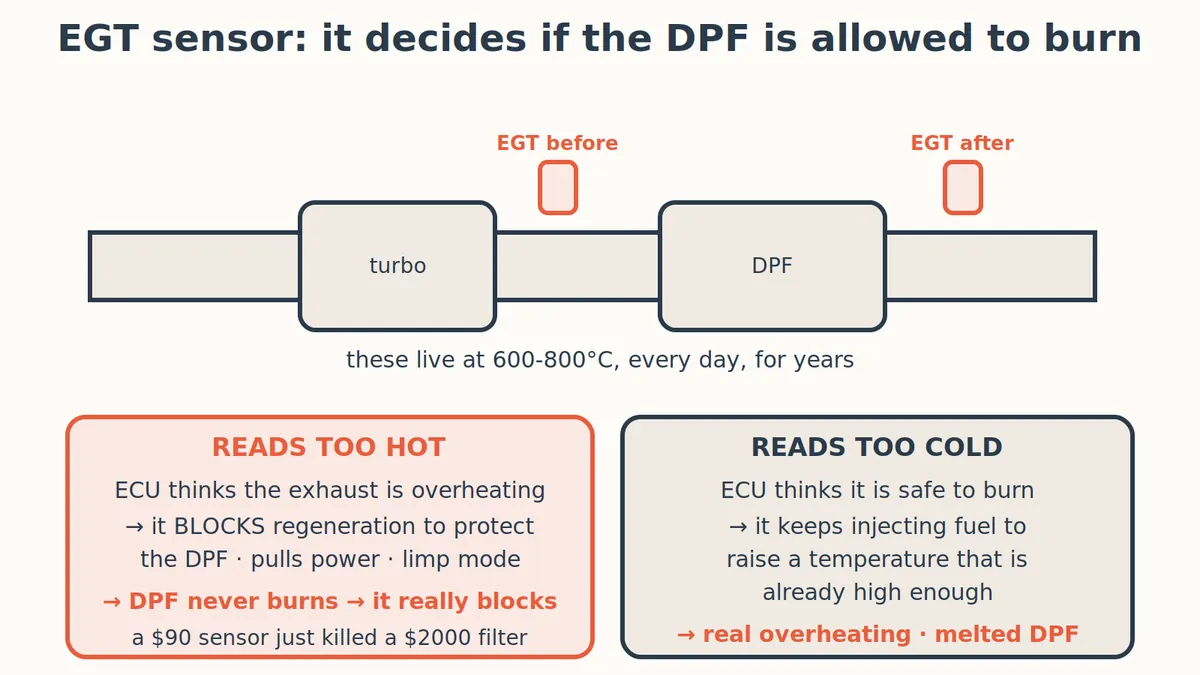
It measures exhaust temperature, and most diesels have a few — before the turbo, before the DPF, after the DPF. The computer uses those readings for two things: keeping the hardware from cooking, and working out when it's safe and worthwhile to burn the soot out of the filter.
That second job is the one that bites here. A regeneration means deliberately cranking the exhaust temperature up to burn the soot out — a controlled fire inside a part under the car. The computer won't start that fire, or will shut it down, unless the temperatures look right.
I confirm upstream or downstream position, cable length, connector, thread and temperature range. I also ask for cold and hot live-data readings because several EGT sensors can look alike on the same exhaust.
OE / VIN · FITMENT · TEST · WARRANTYThese sensors sit at six to eight hundred degrees, every day, for years — and then they start to drift.
When it reads too hot
The computer thinks the exhaust is overheating, so it goes into protect-everything mode: blocks the regeneration, pulls power, maybe drops to limp mode. Now the DPF never gets to burn its soot off — and it slowly, genuinely clogs. An incorrect temperature signal can contribute to a much larger DPF problem if the underlying fault is not diagnosed.
When it reads too cold
The opposite, and it's worse. The computer thinks the exhaust is cooler than it really is, so it keeps dumping in extra fuel to raise a temperature that's already high enough. Now you've got real overheating — a melted DPF, a cooked turbo, actual damage, not theory.
Why they fail
Look where they live. Six to eight hundred degrees, thermal shock every start and stop, vibration, exhaust gas washing over them. Nothing lasts forever in that. And they don't usually die cleanly — they drift. A drifting sensor throws no code, because the reading it gives still looks believable.
The other one's the cable and connector. They run along a scorching exhaust, and a broken wire inside good-looking insulation gives you an on-again-off-again fault that only shows up when the vehicle's moving.
The diagnostic worth knowing
Put the sensors side by side on live data with the engine stone cold. They should all read roughly the outside air temperature. If one says forty and the rest say twenty, that one's lying — and you found it in thirty seconds with no tools at all.
Say that to a customer staring down a DPF quote: before you buy a filter, look at the EGT sensors cold and check they agree. simplest test in the whole diesel game.
What to order
Position and cable length. There's usually several EGT sensors per vehicle, they look nearly identical, and often the only difference is the cable length and the thread. Wrong length and it won't reach, or it ends up routed against something hot and dies in months. Send the VIN and say which position.
What I check before shipment
I confirm upstream or downstream position, cable length, connector, thread and temperature range. I also ask for cold and hot live-data readings because several EGT sensors can look alike on the same exhaust.
Diagnosis and safety note
This guide describes common failure patterns, not a final diagnosis. Confirm fault codes, live data, wiring, fitment and the vehicle-specific service information before ordering or fitting a part. Safety-critical, refrigerant, high-pressure and drivetrain work should be handled by a qualified technician using the correct procedures.
Frequently asked questions
Can you clean an EGT sensor? No. The sensing bit is inside and the drift isn't surface dirt. It's a replace-it part.
No code, but regeneration does not complete — could it be EGT? It is one possibility to compare with other temperatures, soot load, pressure data and the service procedure. A drifted sensor looks plausible, so it doesn't throw a code. It just quietly stops the regen from ever completing.
How many are there? Depends on the engine — often two to four. Check the VIN. Selling one when he needed a specific one of four is just wasted freight.
Need EGT and diesel sensors?
I supply EGT sensors, DPF pressure sensors, NOx sensors and diesel parts out of China — position and cable length confirmed, tested, matched to your VIN, with warranty. Small or mixed orders welcome and they are easy to consolidate with a mixed order. Send me the VIN on WhatsApp and I will confirm fitment, testing, warranty and shipping options before you order.