
This exact pattern, hot in traffic and cool on the move, is one of the most useful diagnostic clues in cooling, because it points almost straight at airflow.
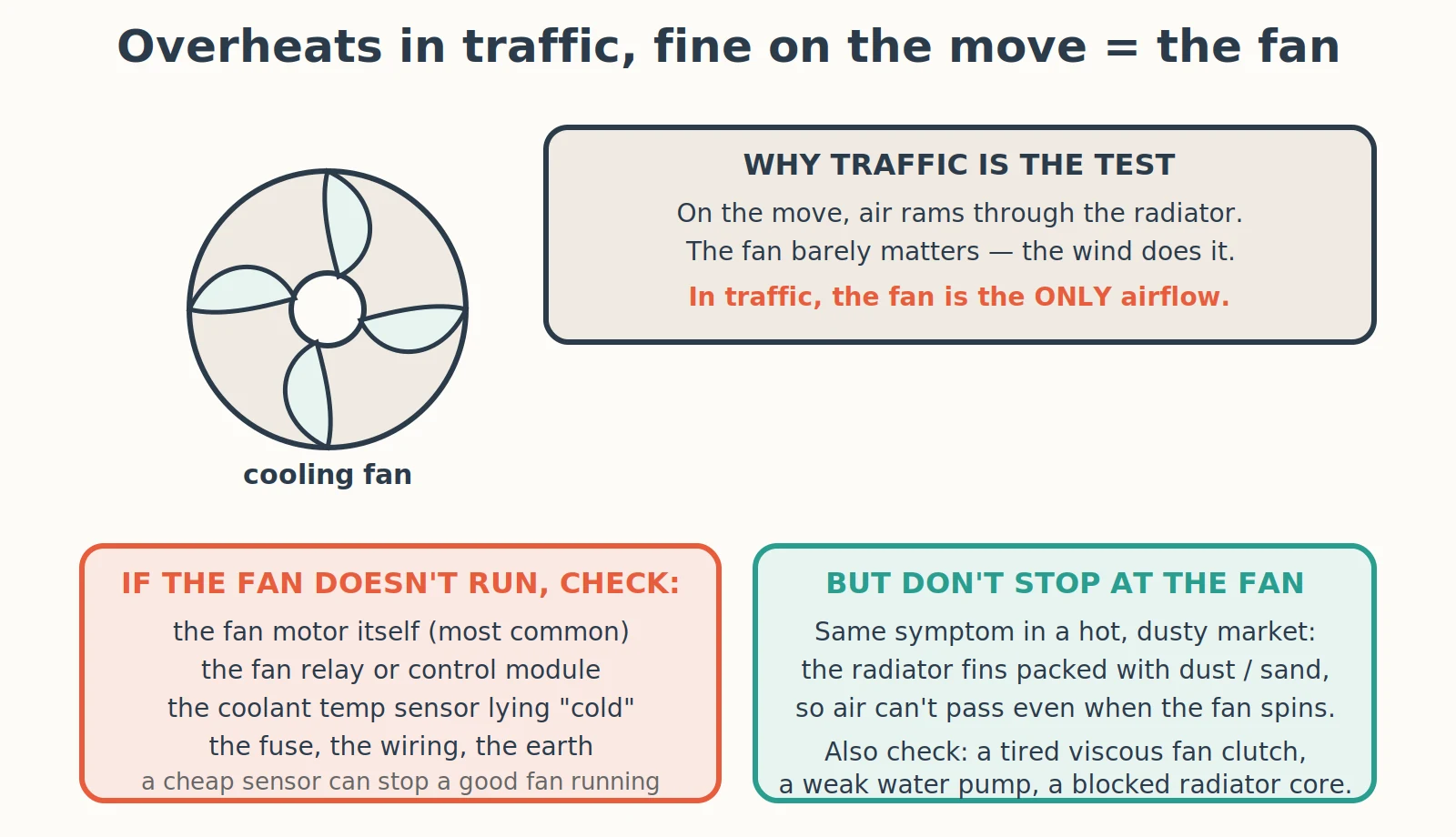
On the move the wind forces air through. In traffic the fan is the only airflow there is.
Why does speed make such a difference?
The radiator gets rid of the engine's heat by passing air through it. At road speed, the car's forward motion rams a large volume of air through the radiator whether the fan runs or not. There is so much natural airflow that a failed fan makes no difference at all, and the temperature stays normal.
The moment the car slows to a crawl or stops, that natural airflow disappears. Now the only way to get air through the radiator is the fan. If the fan is not working, heat builds with nothing to carry it away, and the temperature climbs. Get moving again and the airflow returns, and the temperature drops back down.
So a temperature gauge that climbs at every set of traffic lights and falls again once you are moving is describing a fan or airflow problem almost by definition.
What stops the cooling fan running?
The fan motor itself is the most common, especially on cars with an electric fan. Motors wear out, seize, or develop a fault after years of running in heat.
The relay or fan control module that switches the fan on can fail, so the motor is fine but never gets power.
The coolant temperature sensor is an underrated cause. The fan is often triggered by the engine computer based on the temperature sensor reading. If that sensor is lying and reporting the engine as cooler than it is, the computer never commands the fan to run. So a cheap sensor fault stops a perfectly good fan, and this catches people out.
And the basics: a blown fuse, corroded wiring, or a bad earth. On a hot-climate vehicle these are worth checking before condemning the motor.
What if the fan does run but the car still overheats in traffic?
Then the airflow is being blocked, or the cooling system cannot move or shed the heat, and there are several possibilities worth checking in order.
The radiator fins blocked from the front. In a hot, dusty or sandy climate, or after driving on unsealed roads, the radiator and the air conditioning condenser in front of it can pack solid with dust, sand, insects and debris. Air cannot pass through even with the fan spinning. Cleaning the fins out is cheap and is worth doing as routine maintenance in these conditions.
A viscous fan clutch that has gone lazy, on vehicles that use an engine-driven fan. The clutch is meant to lock up and drive the fan hard when hot, and as it ages it slips and the fan never pulls properly. This is common on older four-wheel drives and pickups.
A weak water pump that cannot circulate coolant fast enough, or a radiator whose internal passages are silted up and no longer flowing well. Both reduce the system's ability to move heat, and both show up worst when the demand is highest, in slow traffic on a hot day.
Can a coolant sensor really stop the fan?
Yes, and it is worth understanding because it is cheap to fix and easy to miss. On most modern cars the engine computer decides when to run the fan, and it makes that decision largely on the coolant temperature sensor reading.
If that sensor has drifted and is reporting a lower temperature than the real one, the computer believes the engine is cooler than it is. So it never reaches the threshold to command the fan, and the engine overheats while the gauge or the computer thinks everything is fine. On some cars the dashboard gauge runs off a different sensor, which is why the gauge can show hot while the fan still refuses to run.
So on a car that overheats in traffic with a fan that never runs, checking the coolant temperature sensor is a cheap early step before assuming the fan motor is dead.
Is it safe to keep driving if it only overheats in traffic?
Overheating damages engines, and it does so quickly once the temperature goes past a certain point. A warped cylinder head or a failed head gasket from overheating is a very expensive repair, far more than the fan or sensor that caused it.
So while the car may seem fine as long as you keep moving, relying on that is risky, because one bad traffic jam on a hot day can cause real damage. Treat overheating as urgent, and in the meantime, running the heater on full dumps some engine heat into the cabin and can buy time in traffic, unpleasant as it is in a hot climate.
Common questions
Why does turning the heater on help when overheating? The heater core is a small radiator, so running it hot pulls heat out of the engine and into the cabin. It is a get-me-home measure, not a fix.
How do I know if my cooling fan is working? With the engine at operating temperature and idling, or with the air conditioning on, the fan should audibly run. If it never comes on as the engine gets hot, that is your answer.
Can low coolant cause overheating in traffic? Yes. Low coolant, often from a leak, reduces the system's capacity and shows up worst when demand is highest. Check the level, and if it is low, find the leak rather than just topping up.
Why is my radiator fan always running at full speed? The opposite fault, often a temperature sensor reading high, a fan control module fault, or the system running the fan as a protective default. Worth diagnosing, as it points at the same sensors and controls.
Does a blocked radiator cause overheating only in traffic? Often it shows up in traffic first, because that is when the cooling system has the least help. As it worsens it can overheat on the move too.
Need cooling system parts?
I supply cooling fans, fan clutches, radiators, water pumps, thermostats and coolant temperature sensors out of China. Matched to your VIN, tested, with warranty. This is core stock for hot climates and I move a lot of it. Send me the VIN on WhatsApp and I will price it the same day.