
This is the one dashboard light where the difference between reacting immediately and driving a few more kilometres can be the difference between a small repair and a new engine.
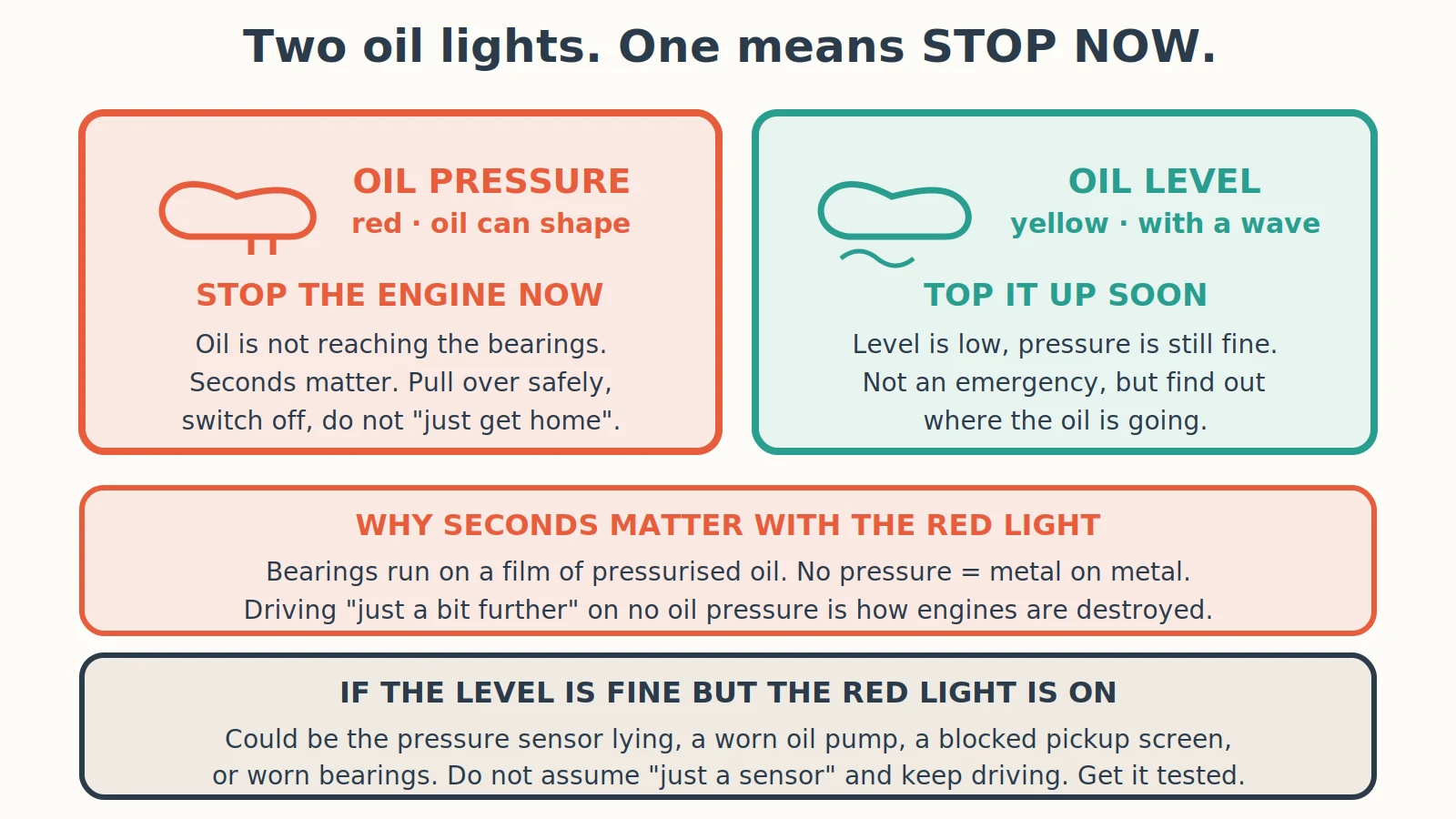
Red oil can: stop now. Yellow oil can with a wave: top up soon. They are not the same warning.
Why is the red oil pressure light so serious?
The engine's crankshaft and camshafts do not run on ball bearings. They run on plain bearings, riding on a thin film of oil held under pressure. That film is the only thing keeping metal off metal at high speed and high load.
When oil pressure is lost, that film collapses almost immediately. The bearing surfaces touch, generate enormous heat, and the damage begins within seconds. This is why the advice is to stop the engine rather than to drive carefully to a workshop.
Drivers often reason that home is only ten minutes away, and it feels reasonable. But an engine running without oil pressure can be destroyed in far less time than that, and a spun bearing usually means an engine rebuild or replacement. The cost difference between stopping and continuing is enormous.
What should I actually do when the red light comes on?
Pull over safely as soon as you can and switch the engine off. Safety on the road comes first, so do not stop somewhere dangerous, but get off the road promptly and do not keep driving.
Once stopped, let the engine sit for a minute, then check the oil level on the dipstick. If it is very low, that is very likely the cause, and adding the correct oil to bring it to the right level may restore pressure. If the level comes back to normal and the light goes out on restart, the immediate crisis is over, but the oil went somewhere, so the leak or consumption still needs finding.
If the oil level is normal and the red light is still on, do not restart and drive. That combination points at a pressure fault rather than a level fault, and it needs investigating before the engine runs again. Getting the car recovered is far cheaper than the alternative.
What if the level is fine but the light stays on?
There are several possibilities, and they range from cheap to very expensive, which is why guessing is a bad idea.
It may be the oil pressure sensor or switch itself failing and reporting a false low pressure. This is common enough that people jump to it, and sometimes it is the answer. But it is a diagnosis to confirm, not to assume.
It may be a genuinely low pressure caused by a worn oil pump, a blocked oil pickup screen, or an oil that is far too thin or degraded to hold pressure. Sludge from extended oil changes blocking the pickup is a classic cause.
Or it may be worn bearings, where the clearances have opened up so much that the pump can no longer maintain pressure. That is the expensive answer, and it is the reason no one should drive on a red oil light hoping it is just a sensor.
The proper check is to measure actual oil pressure with a mechanical gauge, which tells you whether the pressure is genuinely low or the sensor is lying. It is a straightforward test and it settles the question before any money is spent.
What does the yellow oil level warning mean?
It means the oil level has dropped below the level the car wants to see, but the pressure is still adequate. It is a maintenance prompt, not an emergency.
Top up with the correct specification oil to the right level, taking care not to overfill, since too much oil causes its own problems. Then work out where the oil went, because a healthy engine should not need frequent topping up.
The oil is either leaking out, which leaves marks under the car and on the engine, or being burned, which does not. If neither is obvious and the level keeps dropping, that is worth investigating properly rather than just topping up every month.
Does the light ever come on for a moment when cornering or braking?
A brief flicker of the oil pressure light during hard cornering, braking or acceleration usually means the oil level is low enough that the oil is sloshing away from the pump pickup momentarily. The pump briefly draws air instead of oil.
That is a genuine warning even though it is brief. Check and correct the level. If the level is correct and the light still flickers under those conditions, it points at a pressure or pickup issue and needs looking at.
A flicker at idle when hot, on an older engine, can indicate that pressure is marginal at low speed, which often means wear. It is a sign to get the pressure measured rather than ignored.
Common questions
Can I drive a short distance with the red oil light on? The safe answer is no. Damage can occur in seconds, and a short distance is a common way engines are ruined. Stop and check the level, and get it recovered if the level is fine.
Is the oil light the same as the service light? No. A service or maintenance reminder is a scheduling prompt. The red oil pressure light is a live warning that the engine is at immediate risk.
Can the wrong oil cause low pressure? Oil that is too thin for the engine, or oil that has degraded badly, can fail to hold pressure, especially when hot. Using the correct specification matters.
Why did the light come on right after an oil change? Possible causes include the wrong oil grade, an incorrect or faulty filter, underfilling, or air in the system that should clear quickly. If it does not clear immediately, switch off and check rather than driving.
How often should I check the oil level? Regularly, and especially on any engine known to consume oil. Modern service intervals are long, and a car can lose a lot of oil between them without anyone noticing.
Need engine and lubrication parts?
I supply oil pumps, oil pressure sensors and switches, sumps, pickup pipes, filters and gaskets out of China. Matched to your VIN, with warranty. Send me the VIN on WhatsApp and I will price it the same day.