
What it does, and what wears out
The starter is a strong little electric motor that spins your engine fast enough to fire up. It's got a solenoid on it that does two jobs at once: it shoves a small gear out to meet the engine's ring gear, and it throws the heavy electrical switch that feeds the motor.
What wears? The brushes inside wear down. The solenoid contacts burn. The little gear that jumps out gets chewed. And heat cooks it — which is why hot climates and big engines eat starters faster than anywhere else.
I match the old-unit number or VIN, tooth count, rotation, mounting, voltage and power rating. For a new-unit order I also confirm the test record and whether the application is 12 V or 24 V.
OE / VIN · FITMENT · TEST · WARRANTYThe noise tells you where the fault is — and three quick checks decide whether the new one even fits.
Reading the noises
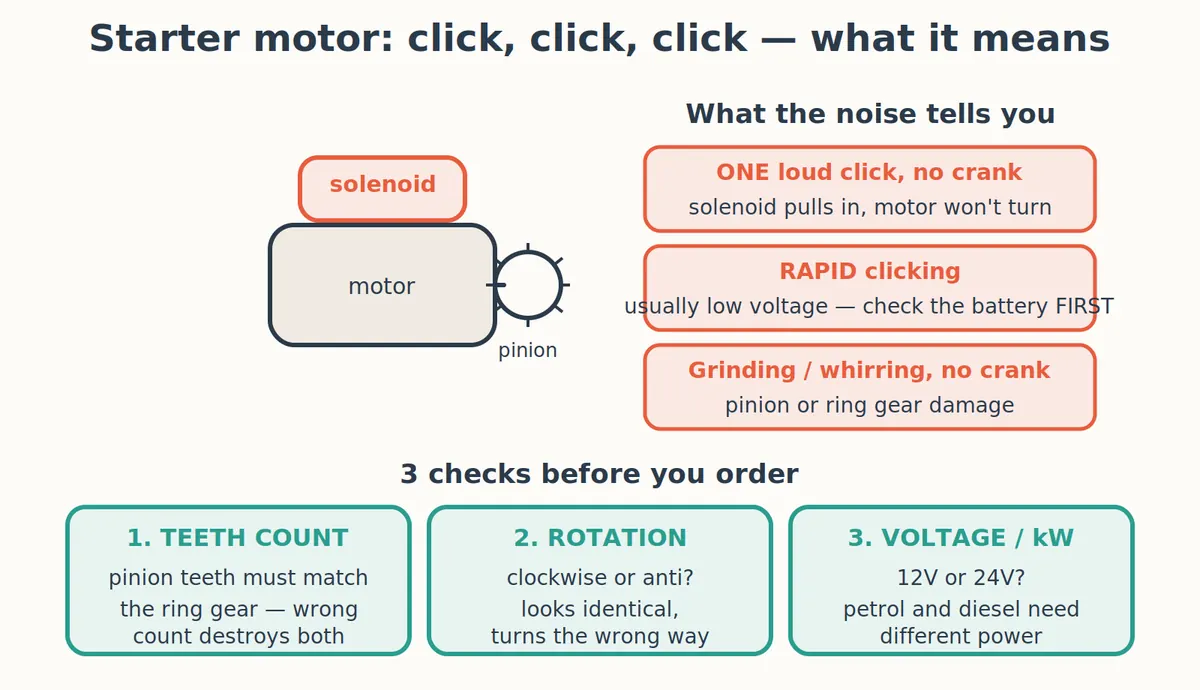
One loud clunk and nothing turns: the solenoid pulled in but the motor didn't spin. Usually worn brushes or burnt contacts inside. The starter's had it.
Fast clicking, like a stutter, often points to low available voltage or excessive voltage drop. The solenoid grabs, the voltage collapses, it lets go, grabs again — over and over. A weak battery, poor terminal or cable connection should be checked before the starter is condemned. Check that before you sell anyone a starter, or you'll be replacing a good part.
Grinding or whirring with no crank: the gear isn't meeting the ring gear properly, or the ring gear teeth are damaged. Get underneath and look at those teeth before you blame the starter.
The three checks before you order
One: count the teeth on the gear. It has to match the ring gear — wrong count and it grinds itself and the engine to bits. Two: which way it spins. Three: where the mounting bolts go and which way the solenoid points, because the same engine can have two or three different starters depending on the year.
The habit that kills all three problems at once: send me the number off the old unit, or the VIN. Ten seconds, and it's the simplest fitment safeguard in this trade.
Telling a good one from junk
Pick it up — weight's a fair first guess, because the copper inside is the first thing the low-grade manufacturers cut, and copper is heavy. Then look at the windings and the solenoid: clean, tidy, properly finished. A rebuilt unit dressed up as new is a real thing in this business, so buy from someone who tests them.
What I check before shipment
I match the old-unit number or VIN, tooth count, rotation, mounting, voltage and power rating. For a new-unit order I also confirm the test record and whether the application is 12 V or 24 V.
Diagnosis and safety note
This guide describes common failure patterns, not a final diagnosis. Confirm fault codes, live data, wiring, fitment and the vehicle-specific service information before ordering or fitting a part. Safety-critical, refrigerant, high-pressure and drivetrain work should be handled by a qualified technician using the correct procedures.
Frequently asked questions
The car starts if you whack the starter with a hammer — why? Worn brushes or a sticking solenoid. The knock jolts them into contact one more time. It's a dying starter telling you it's nearly done. Get it changed before it leaves him stranded somewhere bad.
Is it the battery or the starter? Fast clicking with dim lights, look at the battery and the connections first. A single clunk with strong bright lights points at the starter. The lights tell you a lot.
New starter, still grinding — why? Inspect ring-gear condition, tooth count, alignment, mounting and engagement before blaming either part. Look at the ring gear before you blame the new part.
Need starters and alternators?
I supply starters and alternators out of China — Hilux, Land Cruiser, Patrol, all the pickups, 12V and 24V. Bench-tested, matched to your VIN or the old part number, with warranty. Send me the number or a photo of the old one's label on WhatsApp and I will confirm fitment, testing, warranty and shipping options before you order.