
What a decoupler pulley is
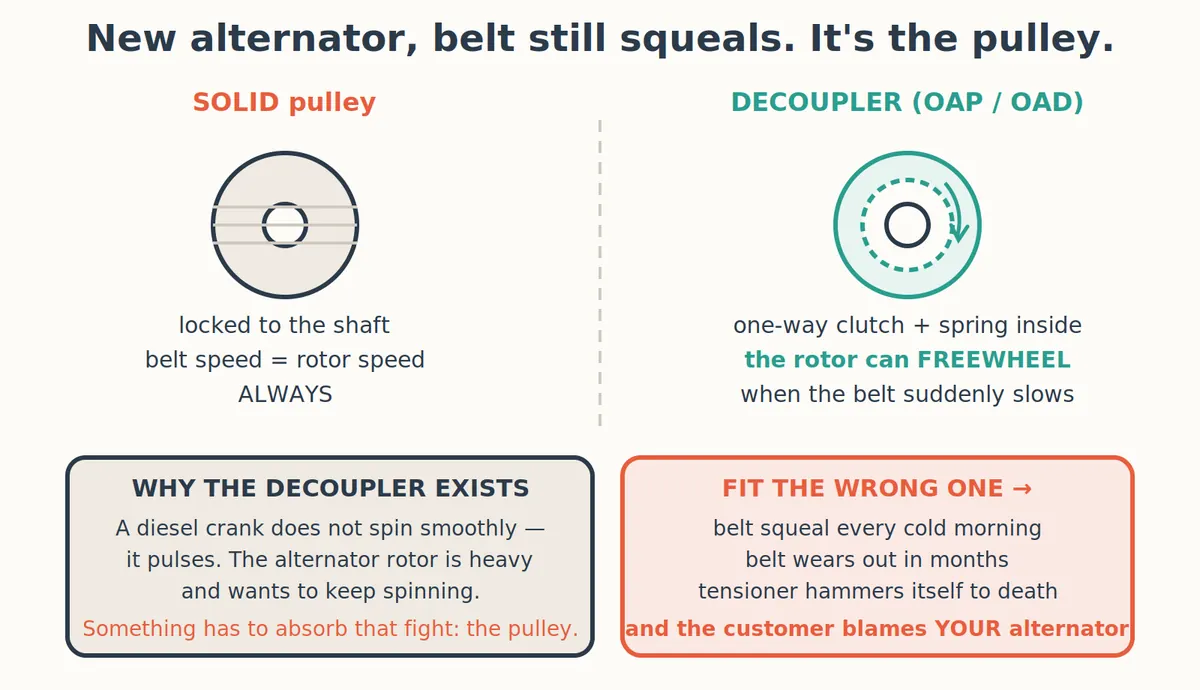
On a lot of modern engines the alternator doesn't have a solid pulley. It's got a one-way clutch pulley — you'll hear it called an OAP (overrunning alternator pulley) or an OAD (overrunning alternator decoupler, which also has a spring inside). From two feet away it looks identical to a plain solid pulley.
I match the alternator OE number, pulley type, groove count, rotation, voltage and application. I also confirm whether the pulley is supplied separately and whether the installer has the correct tool.
OE / VIN · FITMENT · TEST · WARRANTYA solid pulley is locked to the shaft. A decoupler lets the alternator freewheel when the belt suddenly slows down.
Why it exists — this bit's worth getting
A crankshaft doesn't spin smoothly. It pulses — every firing stroke gives it a little kick, and between kicks it eases off. On a diesel those pulses are strong. Meanwhile the alternator's got a heavy rotor spinning fast, and heavy spinning things want to keep going at a steady speed.
So every time the crank pulses, the belt tries to slow the rotor and the rotor fights back. Something has to soak up that fight. Without a decoupler, it's the belt, the tensioner and everything else on the accessory drive that takes it — which is why you get squeal, chewed-up belts, and tensioners that hammer themselves to bits.
The decoupler lets the rotor freewheel through those pulses. The fight just disappears.
Fit the wrong one and…
Put a solid pulley where a decoupler belongs and everything on that belt starts getting beaten up. Squeal on cold mornings. Belts lasting months instead of years. Tensioner failure. Sometimes a noise that sounds just like a bearing. All from a part that bolted straight on and charged perfectly.
And who gets the blame? The alternator. Your alternator.
How they fail on their own
Decouplers wear out — there's a clutch and often a spring in there, and both age. The sign is a rattle or growl at idle that changes when the AC or the electrical load kicks in, or a squeal on start-up. Handy test: engine off, belt off, a good OAD should turn freely one way and lock the other, with a slight springy feel. If it spins free both ways or feels rough, it's done.
Worth knowing — on some cars this pulley is sold separately from the alternator, which turns a whole alternator sale into a small repair. Tell the customer that. Costs you a sale today and buys you a customer for ten years.
What to order
Three things, same list as ordering the alternator itself: the type (solid, OAP or OAD), the thread and size, and whether it needs a special tool to fit — because a lot of them do, an internal spline tool most general workshops don't own. Tell the customer that before he starts, not after the belt's already off.
Send the number off the old alternator, or the VIN. Model and year isn't enough here, because the same car can have different accessory drives.
What I check before shipment
I match the alternator OE number, pulley type, groove count, rotation, voltage and application. I also confirm whether the pulley is supplied separately and whether the installer has the correct tool.
Diagnosis and safety note
This guide describes common failure patterns, not a final diagnosis. Confirm fault codes, live data, wiring, fitment and the vehicle-specific service information before ordering or fitting a part. Safety-critical, refrigerant, high-pressure and drivetrain work should be handled by a qualified technician using the correct procedures.
Frequently asked questions
Can you just fit a solid pulley to save money? Physically, often yes. It's a slow way to destroy the belt, the tensioner and your reputation.
Do new alternators come with the pulley? Sometimes, sometimes not, and sometimes with the wrong type. Confirm before it ships — this is one of the most common wrong-part complaints in the whole alternator game.
Belt squeals only when cold — is that the pulley? Often, yes. A worn decoupler is at its worst when the grease inside is cold and stiff. It's a real symptom, not the customer imagining things.
Need alternators, starters and pulleys?
I supply alternators, starters and decoupler pulleys out of China — Toyota, Nissan, BMW, Mercedes, 12V and 24V. Bench-tested, matched to your VIN, pulley type confirmed before it ships, with warranty. Small or mixed orders welcome. Send me the old part number or a photo of the label on WhatsApp and I will confirm fitment, testing, warranty and shipping options before you order.