
The type of noise, and where you feel it, narrows it down a long way before anything is taken apart. Here is how to read it.
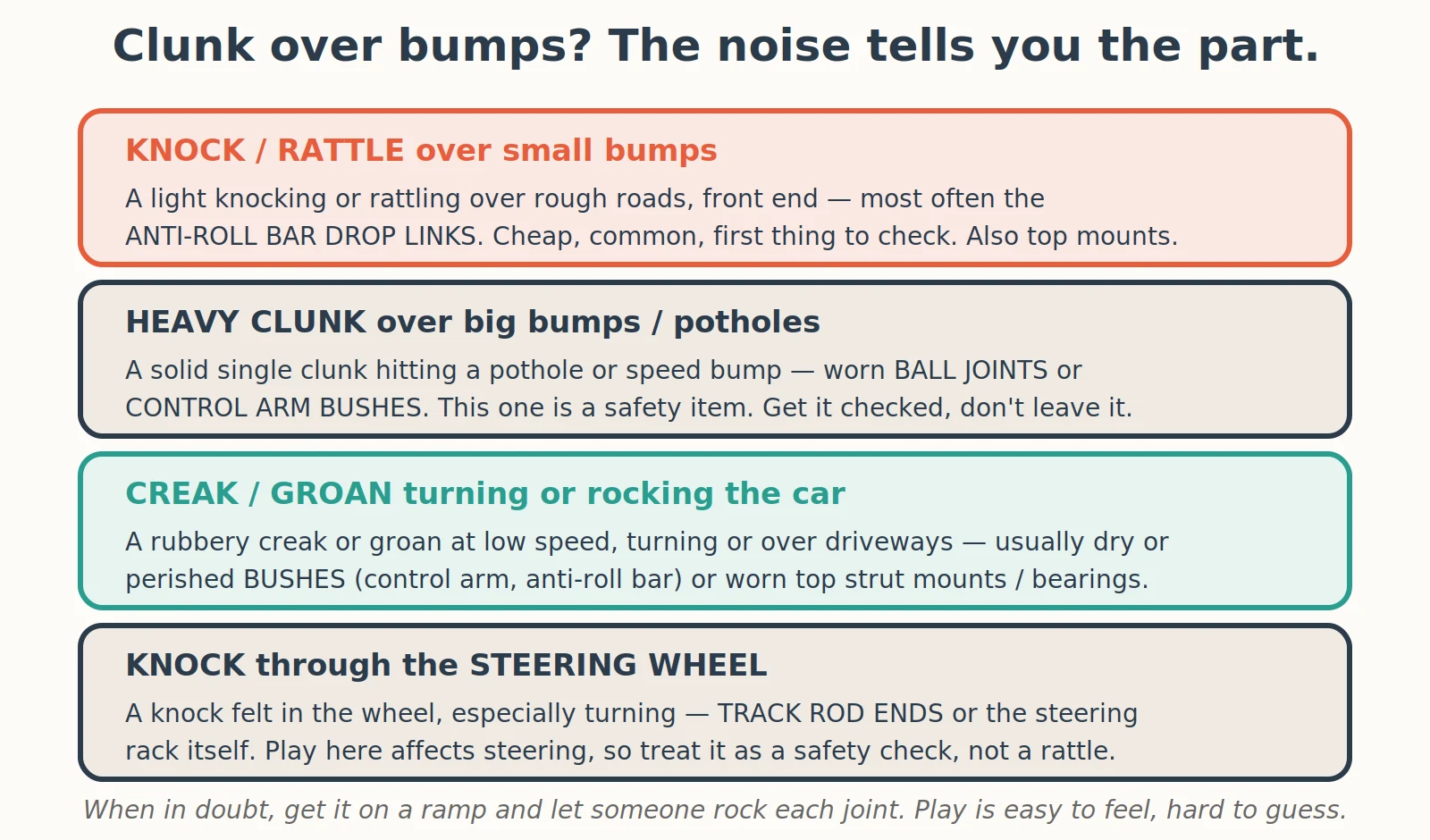
Light rattle, heavy clunk, rubbery creak, or a knock in the steering — each points at a different part.
What are anti-roll bar drop links and why do they knock?
The anti-roll bar links the left and right sides of the suspension so the car leans less in corners. It connects to the suspension through small parts called drop links, which have little ball joints or bushes at each end.
Those drop links are among the most worked and most exposed parts of the suspension, so they wear out often. When they do, they knock and rattle, and the noise is most obvious over small, sharp bumps and rough surfaces, especially at the front. It is usually a light knocking or rattling rather than a heavy thud.
The good news is that drop links are cheap and quick to replace, which is why they are the sensible first thing to check on a knocking front end. A lot of suspension knocks turn out to be nothing more than a worn set of links.
How do I tell drop links from ball joints or bushes?
By the character of the noise and when it happens. Drop links give a lighter, rattlier knock over small bumps. Worn ball joints and control arm bushes give a heavier, more solid clunk, the kind you hear and feel hitting a pothole or a speed bump, because there is real play in a load-bearing joint.
Bushes that are dry or perished, rather than worn loose, tend to creak or groan rather than knock. That rubbery creak shows up at low speed when turning, going over a driveway lip, or when the car is rocked, because it is the sound of a stiff rubber bush being twisted.
The reason this distinction matters is that drop links are a cheap wear item, while ball joints and worn bushes in load-bearing arms are more of a safety concern. So identifying which you have tells you both the likely cost and the urgency.
Which suspension noises are a safety concern?
Ball joints are the main one. A ball joint carries the weight of the car and locates the wheel, and if one fails completely the wheel can lose its location, which is dangerous. A heavy clunk from a worn ball joint should be checked promptly, not driven on for months.
Anything in the steering is also a safety item. A knock felt through the steering wheel, particularly when turning or over bumps, can be worn track rod ends or play in the steering rack. Because it directly affects steering, it needs checking rather than ignoring.
Control arm bushes that are badly worn allow the wheel to move out of position under braking and acceleration, which affects handling and tyre wear as well as making noise. Drop links and simple creaky bushes are less urgent, but the heavier clunks and any steering play should be treated as things to sort soon.
Why does the noise change in different weather?
Rubber bushes and mounts stiffen in cold weather and soften in heat, so a creak or knock from a perishing bush can be worse cold and quieter once everything has warmed up, or the other way round. A noise that is loud on the first drive of a cold morning and fades is often a bush or a top mount.
Damp can make dry bushes creak more, as the water briefly changes the friction. None of this changes the underlying fault, but it explains why a suspension noise can seem to come and go, which sometimes makes people doubt there is a real problem when there is.
How is the fault confirmed?
The reliable way is to get the car on a ramp and physically check each joint for play. A worn ball joint, track rod end or drop link can be felt by levering or rocking the component, and a perished bush can be seen. This is far more certain than guessing from the noise alone, because several parts can make similar sounds.
Rocking the car, or pushing and pulling each wheel at different points, also reveals play. The noise narrows it down to a likely area, and the physical check confirms exactly which part. It is worth doing this properly rather than replacing parts on the strength of a noise, because suspension parts are not the cheapest things to fit on a guess.
Common questions
Are anti-roll bar links easy to replace? They are one of the simpler and cheaper suspension jobs, which is why they are the first thing to check on a light front-end knock.
Can I drive with a knocking suspension? A light drop-link rattle is not an emergency, but a heavy clunk from a ball joint or any play in the steering is a safety concern and should be checked promptly. When in doubt, get it looked at.
Why does my suspension creak when turning at low speed? Usually dry or perished bushes or worn top strut mounts. The creak is stiff rubber or a dry mount being twisted as the suspension moves.
Do worn bushes cause uneven tyre wear? Yes. Worn control arm bushes let the wheel move out of its correct position, which affects alignment and wears tyres unevenly, as well as causing noise.
Should suspension parts be replaced in pairs? For load-bearing parts like ball joints and control arms it is often sensible to do both sides, since if one has worn out the other is usually not far behind, and it keeps the handling even. Drop links are frequently done as a pair for the same reason.
Need suspension and steering parts?
I supply anti-roll bar links, ball joints, control arms, bushes, track rod ends and top mounts out of China. Matched to your VIN, with warranty. Small or mixed orders welcome, and doing both sides at once is easy to price. Send me the VIN on WhatsApp and I will price it the same day.