
Why the pressure cap matters so much
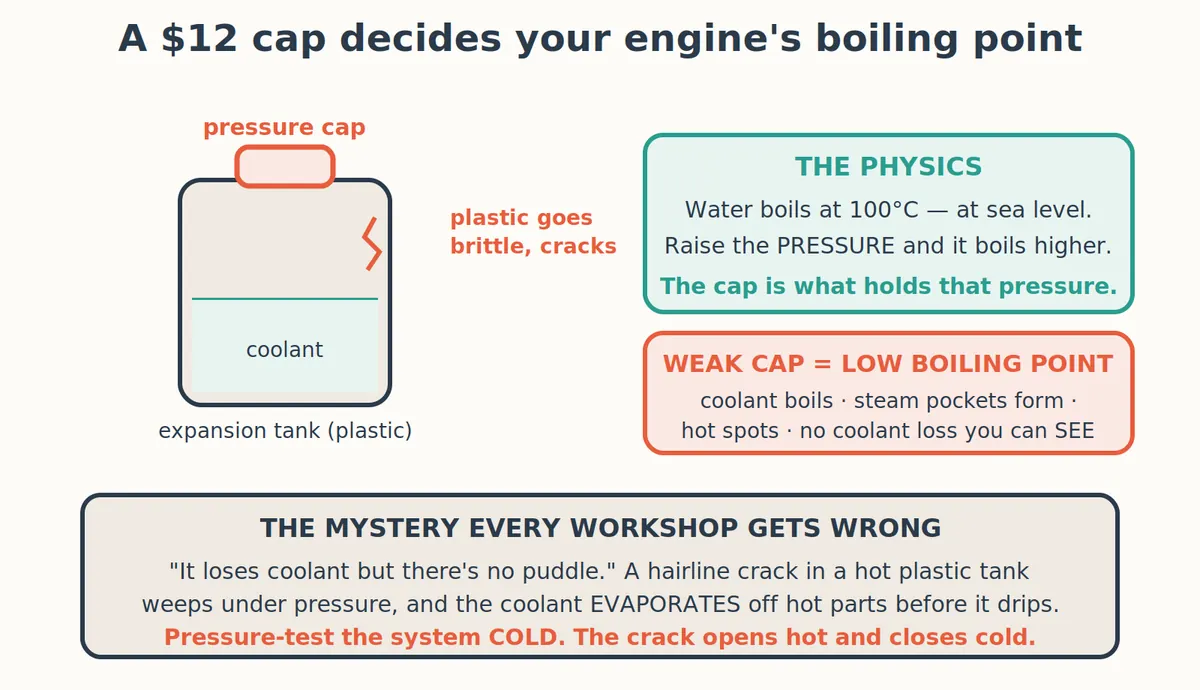
Physics. Water boils at a hundred degrees at sea level. Push the pressure up and it boils higher. That's the whole reason a cooling system is sealed and pressurised — so the coolant can safely run above a hundred without boiling.
And the cap is the thing holding that pressure. It's a spring and a rubber seal, rated for a specific pressure. That little cap is holding your engine's boiling point in its hand.
I match the VIN, cap pressure rating, neck or thread design, tank version and any integrated level sensor. The pressure rating is confirmed from the application, not from appearance alone.
OE / VIN · FITMENT · TEST · WARRANTYThe cap holds the pressure. The pressure sets the boiling point. A tired cap drops it.
What a weak cap does
The spring goes soft and the seal hardens, so the system holds less pressure. Down comes the boiling point with it. Now the coolant starts boiling at temperatures that used to be perfectly safe. Steam pockets form around the hottest spots — the cylinder head, the turbo — and steam doesn't shift heat the way liquid does. So you get local hot spots cooking away.
And here's the sneaky bit: the temperature gauge can look completely normal, because it's reading liquid coolant somewhere else while a steam pocket is quietly baking one specific area.
Why there's no puddle
Two reasons. A weak cap vents coolant as vapour once the pressure goes over its rating — so it leaves as steam, not as a puddle. And a hairline crack in a hot plastic tank weeps under pressure, and that little bit of coolant evaporates off the hot engine before it ever hits the ground.
The tank's plastic, cooking in engine bay heat for a decade. It goes brittle and cracks at the seams. In hot markets it happens a lot faster.
The test
Pressure test the system cold. This matters: the crack opens when the plastic's hot and closes when it cools, which is why a hot inspection misses it and why the leak seems to come and go. Test it cold and hold the pressure. And test the cap on its own — it's got its own rated pressure, and a tester will tell you in a minute whether it still holds it.
Say this to a customer staring at a head gasket quote: before you spend thousands, pressure test the system cold and test the cap. Coolant loss with no obvious puddle still needs a complete pressure, combustion-gas and leak diagnosis before the cause is confirmed.
What to order
The pressure rating. Caps all look identical and they're rated differently, and putting a low-rated cap on a system that wants a high one drops the boiling point of the whole engine. Confirm by VIN, not by whether it screws on.
Quote the cap with every tank — the old cap's the same age as the tank that just cracked. And quote the level sensor if the tank's got one built in.
What I check before shipment
I match the VIN, cap pressure rating, neck or thread design, tank version and any integrated level sensor. The pressure rating is confirmed from the application, not from appearance alone.
Diagnosis and safety note
This guide describes common failure patterns, not a final diagnosis. Confirm fault codes, live data, wiring, fitment and the vehicle-specific service information before ordering or fitting a part. Safety-critical, refrigerant, high-pressure and drivetrain work should be handled by a qualified technician using the correct procedures.
Frequently asked questions
Can you use any cap that fits? No. The rating is the whole product. A cap that fits but holds less pressure lowers the boiling point everywhere in the engine.
Gauge reads normal but it keeps losing coolant — how? Steam pockets. The gauge's reading liquid somewhere else. A normal gauge doesn't mean nothing's boiling.
Worth replacing the tank if it's only weeping a bit? Yes. Plastic that's brittle enough to weep is brittle enough to split — and it can split without much warning, on a hot day, miles from anywhere.
Need cooling system parts?
I supply expansion tanks, pressure caps, level sensors, thermostats and water pumps for BMW, Mercedes, Land Rover and Toyota out of China — pressure rating confirmed, matched to your VIN, with warranty. Small or mixed orders welcome. Send me the VIN on WhatsApp and I will confirm fitment, testing, warranty and shipping options before you order.