
What heat soak is
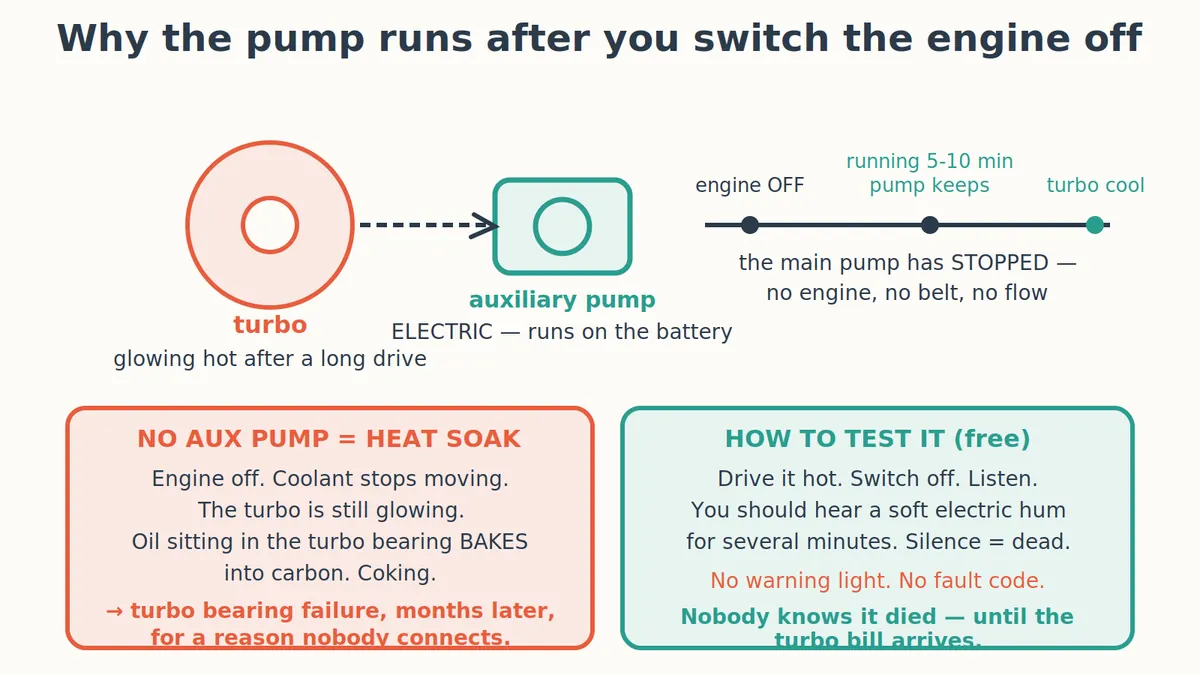
Here's the problem this pump exists to solve. You drive hard, the turbo's glowing hot, and you switch the engine off. Engine stops. Belt stops. Main water pump stops. Coolant stops moving — completely.
But the turbo's still red hot, and now there's nothing carrying that heat away. It soaks into everything around it, including the oil sitting still inside the turbo bearing. That oil bakes into carbon. In the trade they call it coking.
I confirm which coolant circuit the pump serves, connector, voltage, flow direction and OE number. I also check the vehicle's after-run control strategy because not every model commands the pump in the same conditions.
OE / VIN · FITMENT · TEST · WARRANTYEngine off, coolant stops moving — but the turbo's still glowing. The little electric pump keeps the flow going.
What the auxiliary pump does
It's a small electric pump. It runs off the battery, so it doesn't care whether the engine's running. When the computer sees a hot shutdown, it runs the pump for several minutes after you've pulled the key, pushing coolant through the turbo until it's cooled down safely.
The same kind of pump gets used on a lot of cars for cabin heating, for the intercooler on water-cooled setups, and for cooling other bits too. So a car might have more than one.
Why the failure is invisible
Because usually there's no warning light and no fault code. The pump just quietly stops. The car drives perfectly. The AC's fine. Everything's fine — except every hot shutdown is now cooking the turbo a little more.
Later on, the turbo fails, and it looks like a bad turbo. It wasn't. It was a small auxiliary pump that died in silence and nobody had a clue.
The free test
Drive it till it's properly hot. Switch off. Stand next to it and listen. You should hear a soft electric hum from the engine bay for a few minutes. Silence alone does not prove failure because control strategies vary. Confirm whether the pump was commanded, then check power, ground, flow and fault data.
Costs nothing, and it's worth telling any customer with a turbo: after a hot drive, listen for the pump. If you can't hear it anymore, that's a small component protecting an expensive one, and it's stopped.
One more thing to tell them
An honest habit that costs nothing: follow the vehicle manufacturer's shutdown guidance after sustained high load; after-run behaviour and recommended cool-down procedures vary by engine and turbo system. The old boys with turbo diesels have been doing this for decades, and they were right all along.
What to order
Which pump. A lot of cars have several auxiliary pumps for different circuits, and they look alike with different part numbers and flow rates. Send the VIN and say what it's for. Small, light, is easy to consolidate into a mixed shipment — an easy add-on to any air order.
And check the fuse or relay first. A dead fuse gives you the exact same silence as a dead pump, and it costs almost nothing.
What I check before shipment
I confirm which coolant circuit the pump serves, connector, voltage, flow direction and OE number. I also check the vehicle's after-run control strategy because not every model commands the pump in the same conditions.
Diagnosis and safety note
This guide describes common failure patterns, not a final diagnosis. Confirm fault codes, live data, wiring, fitment and the vehicle-specific service information before ordering or fitting a part. Safety-critical, refrigerant, high-pressure and drivetrain work should be handled by a qualified technician using the correct procedures.
Frequently asked questions
Is the humming after shutdown a problem? No — that's the system doing its job. Tell the customer to worry when it stops, not when it's happening.
No fault code — how do you prove the pump's dead? The listening test, then check for voltage at the plug during the run-on. If it's got power and won't run, it's the pump.
Does it affect the cabin heater? On some cars, yes — the same style of pump pushes coolant through the heater core. A weak heater at idle is sometimes an auxiliary pump, not a thermostat.
Need cooling and turbo parts?
I supply auxiliary water pumps, electric water pumps, thermostats, turbo actuators and cooling parts out of China — circuit confirmed, tested, matched to your VIN, with warranty. Small or mixed orders welcome and they are easy to consolidate with a mixed order. Send me the VIN on WhatsApp and I will confirm fitment, testing, warranty and shipping options before you order.