
What the drier actually does
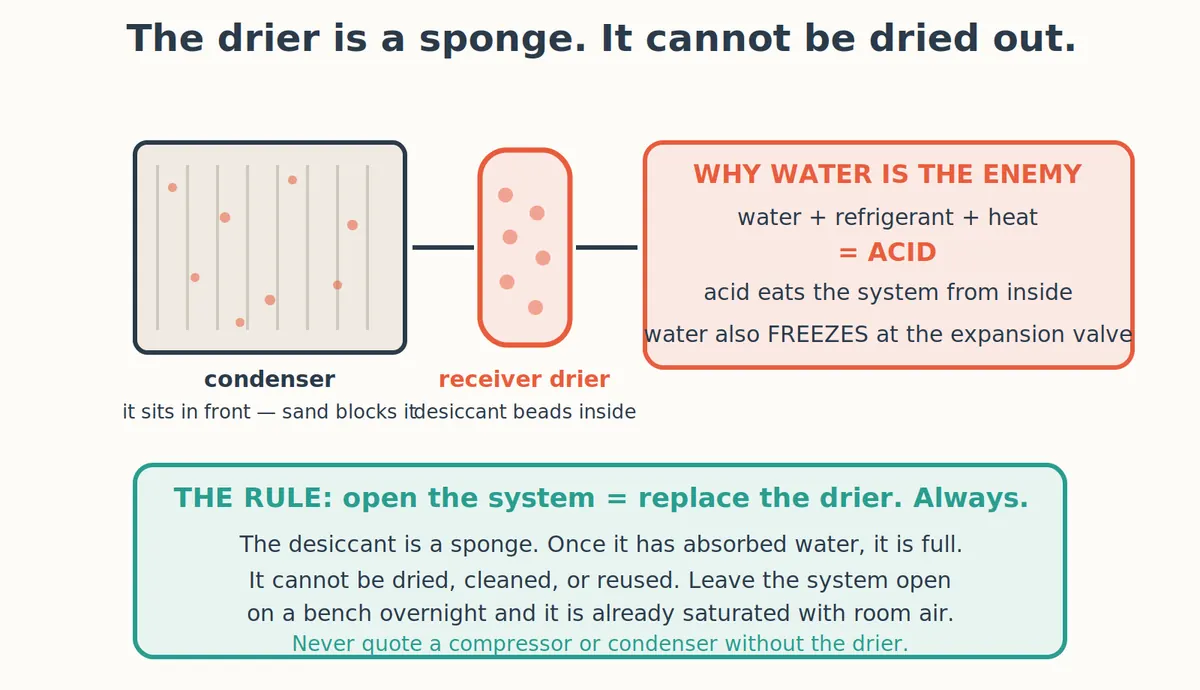
Inside it are little beads of desiccant that soak up water, keeping moisture out of the refrigerant circuit. It also works as a filter and a reservoir. And here's the fact that matters: it's a sponge. Once it's soaked up water, it's full. You can't dry it out, clean it, bake it, or reuse it.
Leave one sitting open on the bench overnight and it's already pulled moisture out of the room air. That's how thirsty the stuff is.
I confirm refrigerant type, separate or condenser-integrated drier design, compressor-oil requirement and seal kit. I also note that refrigerant recovery, evacuation and charging must follow local law and qualified service procedures.
OE / VIN · FITMENT · TEST · WARRANTYWater plus refrigerant plus heat makes acid. The drier is the only thing keeping water out of the system.
Why water is such a disaster
Two reasons, and both are chemistry, not opinion.
First: water plus refrigerant plus heat makes acid. That acid eats the system from the inside out — the compressor guts, the aluminium, the seals. Slow destruction, no outward sign, until something lets go.
Second: water freezes. At the expansion valve the refrigerant goes very cold, and any water in there turns to ice right at that spot and blocks the flow. Now you get cold air for ten minutes, then warm, then cold again — and that on-and-off cooling drives everyone up the wall. It's ice.
The rule
When the refrigerant circuit has been opened or contaminated, follow the vehicle and component manufacturer's replacement procedure for the receiver drier or desiccant element. If the system's been open to the air for any real length of time — a crash repair, a condenser swap, a compressor swap, a line change — the desiccant's already saturated. Reusing it means fitting a sponge full of water into a system that has to stay bone dry.
Say this to every customer buying a compressor or a condenser: the drier isn't optional, and neither is a proper vacuum. Costs you nothing to say, and it protects the expensive part you just sold him.
Why the condenser matters too, especially in hot markets
The condenser dumps the heat. It sits right at the front of the car, ahead of the radiator, catching every stone, bug and grain of sand. When the fins clog up, the system can't shed its heat, the pressure climbs, and the compressor ends up working way harder than it was built to — which is how a dirty condenser quietly murders a compressor.
So in any hot, dusty place: hose out the condenser fins as part of every AC job. Free, ten minutes, and it adds years to the part you sold.
What to order
Refrigerant type first — R134a and R1234yf systems use different parts and different oil, and mixing them is a genuine problem. Confirm by VIN. Condensers are bulky and easy to damage, so pack them well and expect sea freight; the drier's small and is easy to consolidate into a mixed shipment.
And confirm whether the drier's a separate bottle or built into the condenser, because on a lot of modern cars it's integrated — which changes the whole quote.
What I check before shipment
I confirm refrigerant type, separate or condenser-integrated drier design, compressor-oil requirement and seal kit. I also note that refrigerant recovery, evacuation and charging must follow local law and qualified service procedures.
Diagnosis and safety note
This guide describes common failure patterns, not a final diagnosis. Confirm fault codes, live data, wiring, fitment and the vehicle-specific service information before ordering or fitting a part. Safety-critical, refrigerant, high-pressure and drivetrain work should be handled by a qualified technician using the correct procedures.
Frequently asked questions
Can you reuse a drier after the system was opened? Follow the component and vehicle service procedure; exposure time, humidity, contamination and system design all matter. The desiccant is that greedy.
AC goes cold, then warm, then cold — is that the drier? Often it's ice at the expansion valve, from moisture, from a saturated or missing drier. Classic pattern.
How long should you evacuate the system? Use qualified equipment and follow the vehicle, refrigerant and local regulatory procedure. Time alone does not prove the system is dry or leak-free.
Need AC system parts?
I supply receiver driers, condensers, AC compressors, expansion valves and AC parts out of China — refrigerant type confirmed, matched to your VIN, with warranty. Small or mixed orders welcome. Send me the VIN on WhatsApp and I will confirm fitment, testing, warranty and shipping options before you order.