
Why do alternators fail?
Heat, dust, and age. The alternator works every second the engine runs, charging the battery and feeding every electrical system. Inside, the bearings wear, the brushes wear down, and the voltage regulator — the electronic brain — eventually gives up. In hot, dusty markets, alternators fail noticeably faster: heat cooks the electronics and dust attacks the bearings. On hard-working vehicles like the Hilux and Land Cruiser, an alternator is a wear item, not a lifetime part.
What are the symptoms of a failing alternator?
The battery warning light is the classic sign. Others: dim or flickering headlights at idle, a battery that keeps dying even after replacement, a whining or grinding noise from worn bearings, and electrical systems acting strangely. A very common story: the customer replaces the battery twice before anyone checks the alternator. The battery was never the problem — it was just never being charged.
Why is ordering an alternator so easy to get wrong?
Because one vehicle model can use several different alternators, and they all look nearly the same in a photo. A Hilux comes with different engines, and each engine version may take a different unit. Order by photo or by model name alone, and you are gambling. Three details decide whether the part fits — and all three must match.
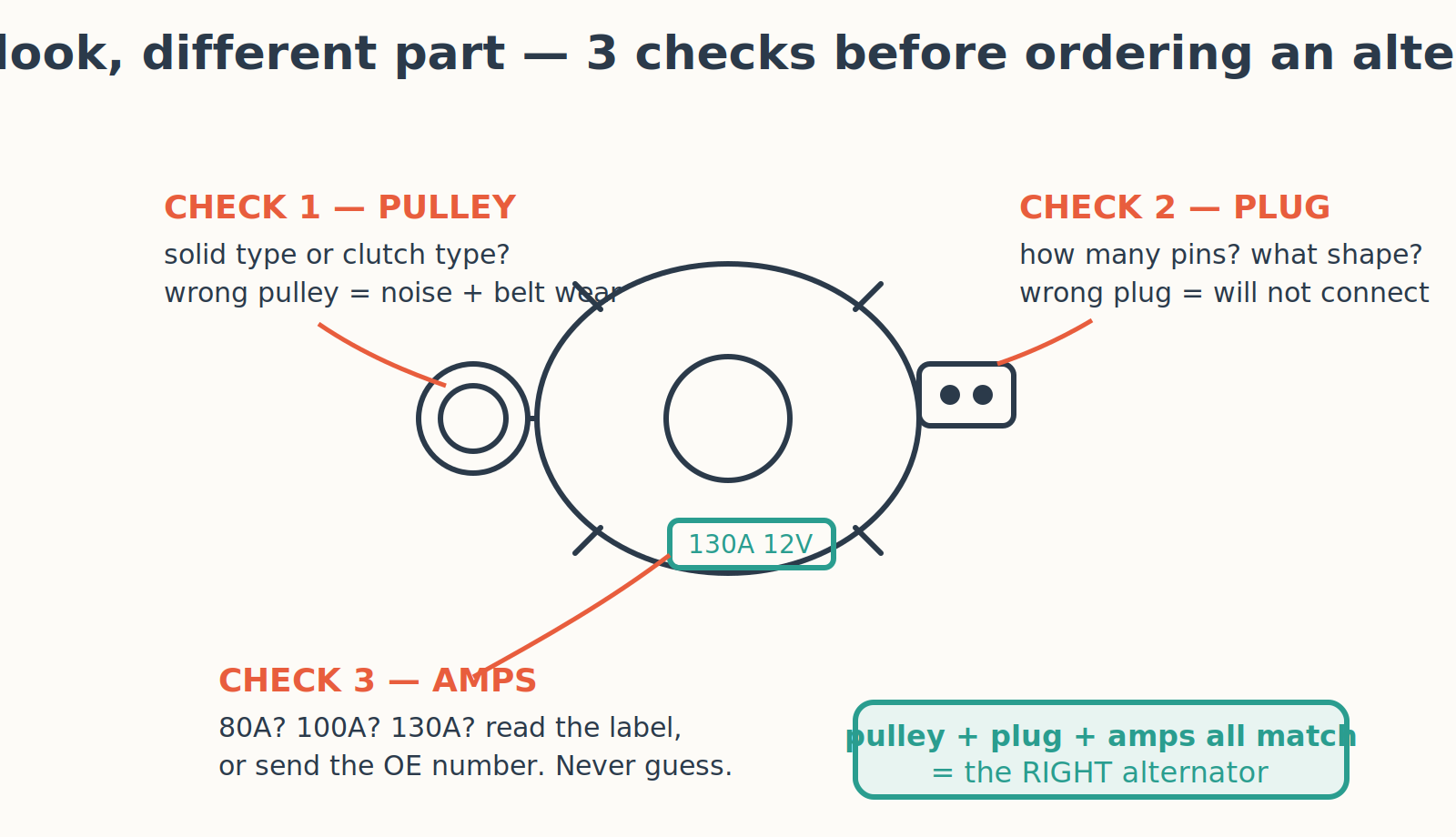
What are the three checks before ordering?
Check one: the amperage. An alternator is rated in amps — 80A, 100A, 130A. The rating is printed on the label of the old unit. A lower-amp unit on a vehicle that needs more will undercharge and kill batteries; the customer will blame the part.
Check two: the pulley. Some alternators use a simple solid pulley; many modern ones use a clutch-type pulley (an overrunning pulley) that smooths out belt vibration. They can look similar from a distance. The wrong pulley type causes belt noise and premature wear.
Check three: the plug. Count the pins and note the connector shape. Two pins, three pins, different sockets — if the plug does not match, the alternator cannot even be connected. The safest habit of all: send the OE number from the old unit, or the VIN. That removes all guessing at once.
How do you judge alternator quality?
Spin the pulley by hand: it should turn smoothly, with no rough spots or noise from the bearings. Look at the build: clean windings, solid casing, a properly made connector. And ask the supplier whether each unit is bench-tested for charging output before shipping — an untested alternator is a return waiting to happen. At 50 to 150 dollars per unit, testing and warranty are what separate a real supplier from a box-mover.
Frequently asked questions
Q: The customer replaced the battery but it keeps dying. Alternator? — Very likely. A healthy alternator should keep a healthy battery charged. Two dead batteries in a row means test the charging system, not buy a third battery.
Q: Are 24V truck alternators different? — Completely. Trucks and some heavy equipment run 24V systems with their own units. Always confirm voltage first on anything bigger than a pickup.
Q: New alternator, still not charging — why? — Check the belt tension and the wiring first. If those are good and the unit is silent, it may be a faulty or untested part. This is exactly why bench-testing before shipping matters.
Need alternators for Toyota, Nissan, or trucks?
We supply alternators and starter motors from China — for Toyota Hilux and Land Cruiser, Nissan Patrol, pickups, and 24V trucks. Bench-tested, OE-matched, with warranty. Small and mixed orders welcome. Send the OE number or a photo of the old unit's label on WhatsApp, and you will have a price the same day.