
Why do ignition coils fail so often on German cars?
The coil sits directly on top of the spark plug, inside the hottest part of the engine. Every drive cycle heats it up and cools it down. Over the years, that heat cycling breaks down the insulation inside the coil and hardens the rubber boot at the bottom. Turbo engines are even harder on coils, because they run hotter and demand a stronger spark. That is why a coil that is fine at 60,000 km can be dead at 100,000 km — heat simply wears it out.
What are the symptoms of a failed ignition coil?
A misfire is the classic sign: the engine shakes at idle, hesitates under acceleration, and the check engine light comes on — often blinking, which means unburned fuel is reaching the catalyst. Fuel consumption rises. On many cars the fault code tells you exactly which cylinder is misfiring, which points to one specific coil. And this is where most people make the expensive mistake.
Why is replacing only one coil usually a mistake?
Because all the coils on that engine are the same age. They were installed on the same day, they have lived through the same heat, the same vibrations, the same kilometres. When coil number one dies, coils two through six are not healthy — they are simply next in line. In practice, once the first coil fails, the others tend to follow one by one over the coming months.
Think about what that means for the car owner: three or four separate repair visits for the same basic problem. And for the workshop: an unhappy customer who starts to wonder if the shop knows what it is doing. Nobody wins — except the tow truck.
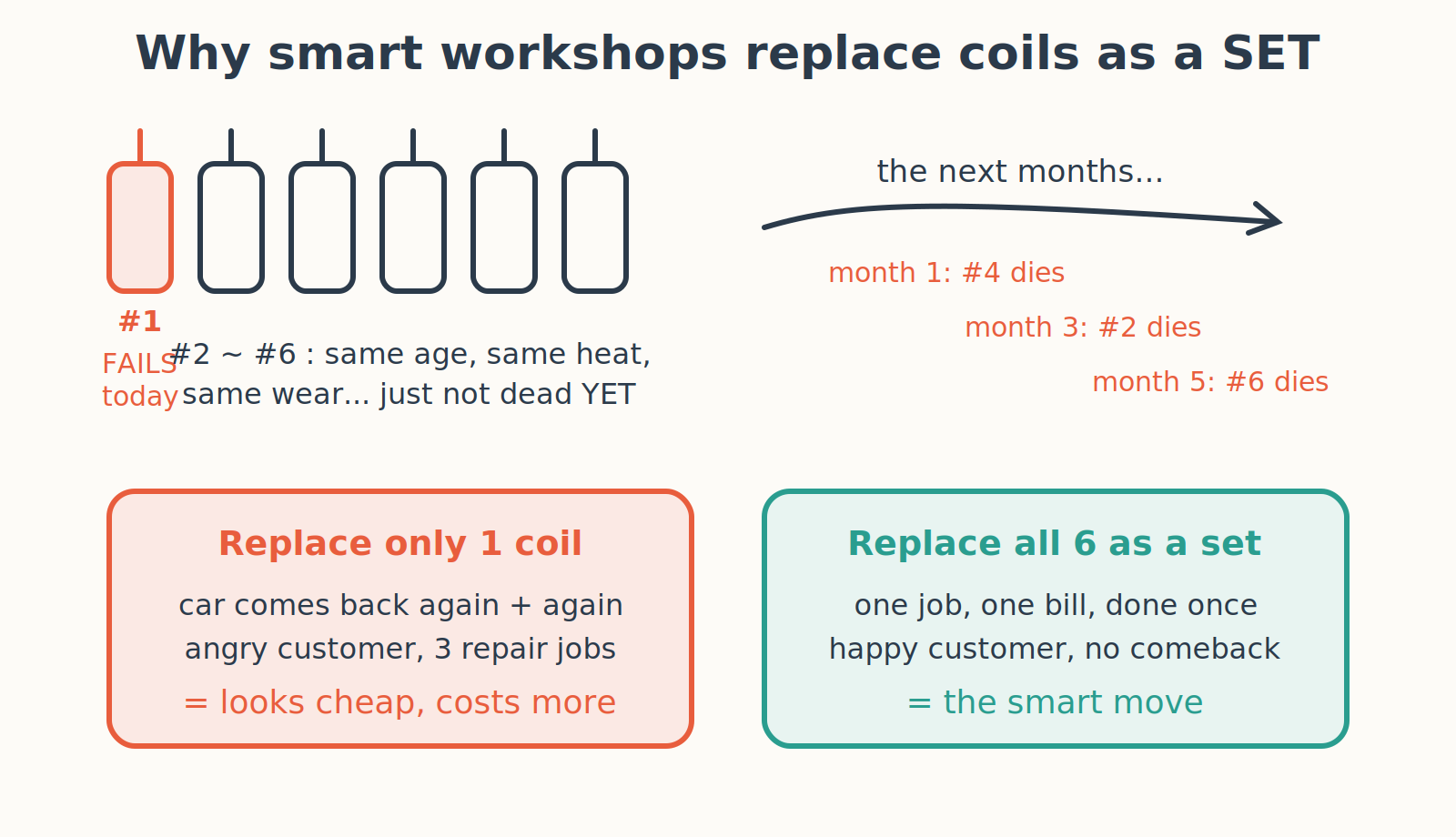
Why does replacing the full set make business sense?
For the workshop, it is one job instead of three: the engine cover is already off, the labour barely changes whether you swap one coil or six. For the car owner, it is one bill and no comebacks. And for the parts seller, it is a six-piece order instead of a one-piece order — from the same phone call. Many workshops also replace the spark plugs at the same time, since worn plugs overload coils and shorten their life. Coils and plugs together: that is the full, honest repair.
How do you spot a quality coil from a cheap copy?
Three checks. First, the rubber boot at the bottom: it should be soft, thick, and flexible, because it seals the coil against heat and moisture. A hard, thin boot cracks within months. Second, the connector: solid, precisely moulded plastic with a tight fit — rough plastic with play in the pins fails from vibration. Third, ask the supplier one question: are the coils spark-tested before shipping? A misfiring set of six untested coils is six returns at once. Testing is not optional at this price level.
Frequently asked questions
Q: Can a bad ignition coil damage the engine? — Indirectly, yes. A misfiring cylinder sends unburned fuel into the catalytic converter, which overheats it. Drive long enough with a blinking check engine light and the coil problem becomes a catalyst problem — ten times the cost.
Q: Do coils on turbo engines fail faster? — Generally yes. Higher heat and higher spark demand mean shorter coil life. On turbo German engines, treat coils as a wear item, like brake pads.
Q: Should spark plugs be changed with the coils? — In most cases, yes. Worn plugs force the coils to work harder. New coils on old plugs is half a repair.
Need ignition coils in full sets?
We supply ignition coils for BMW, Mercedes, Audi, and VW from China — sold in full sets, spark-tested before shipping, OE-matched, with warranty. Small and mixed orders welcome. Send the part number and the number of cylinders on WhatsApp, and you will have a set price the same day.