
What does the timing chain do, and why is the N20's a problem?
The timing chain connects the crankshaft to the camshafts and keeps every valve opening at exactly the right moment. It is supposed to last the life of the engine. On the N20, especially cars built before 2015, it often does not. The chain system has three weak points that wear together — and when they finally give up, the results can destroy the engine.
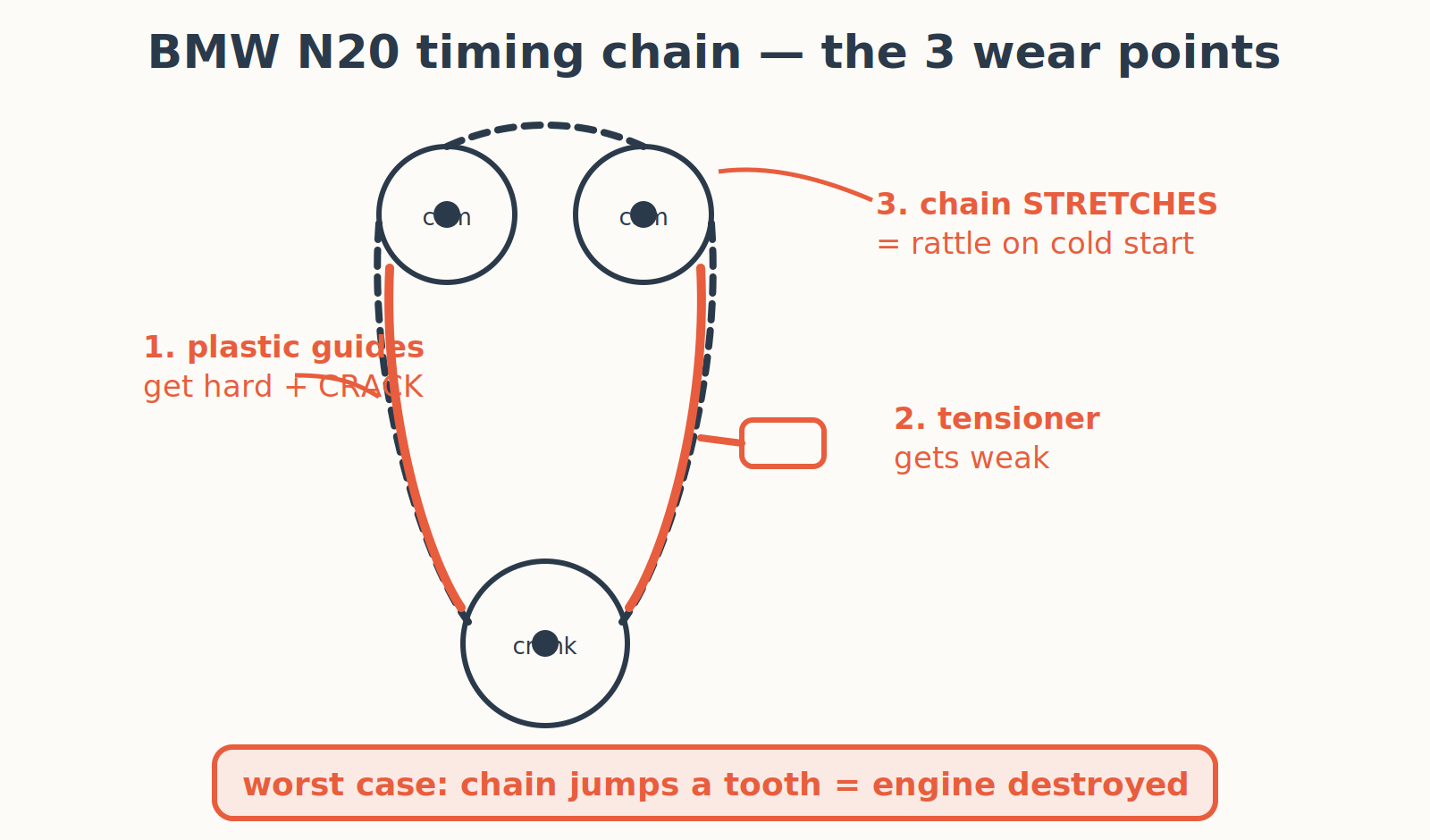
What are the three wear points?
One: the chain itself stretches. A stretched chain changes the engine timing slightly and gets noisy. Two: the chain guides — made of plastic — get hard and brittle with heat and age, then crack. Broken pieces of guide can end up in the oil pan, which is why finding plastic fragments during an oil change is a classic N20 warning sign. Three: the tensioner, which keeps the chain tight, gradually weakens. A loose chain on cracked guides is a countdown.
What are the warning signs?
The most famous one: a rattling noise from the engine for a second or two on cold start — that is the loose chain slapping before oil pressure builds. Other signs: a whining or ticking that rises with engine speed, timing-related fault codes, and plastic pieces in the oil. Any of these on an N20 means the chain system needs attention now, not next year.
What happens if it is ignored?
The worst case is simple and brutal: the chain jumps a tooth or breaks, the valves hit the pistons, and the engine is destroyed. What would have been a chain kit replacement becomes a full engine replacement — many times the cost. This is why experienced BMW workshops treat N20 chain noise as an emergency, and why many recommend preventive replacement around 100,000 km on pre-2015 cars, even without symptoms.
What should be replaced — and why always as a kit?
Never just the chain. The chain, the guides, the tensioner, and the related sprockets wear together and are replaced together as a timing chain kit. Putting a new chain on old cracked guides is asking for a comeback. The labour is significant — the front of the engine has to come apart — so doing the complete kit once is the only repair that makes sense. For parts sellers, this is good news: the N20 chain job is a kit sale, not a single-part sale.
How do you judge the quality of a chain kit?
The chain itself should feel heavy and precise, with smooth links and clean riveting — a light, rough chain stretches fast. The guides should be made of proper reinforced material, not brittle bargain plastic that repeats the original failure. And the tensioner must hold pressure correctly. As always at this value level: buy from a supplier who sources tested kits and stands behind them with a warranty, because a failed chain kit does not come back as a complaint — it comes back as a destroyed engine.
Frequently asked questions
Q: Which years are most affected? — Broadly, N20 engines built before 2015. BMW revised the chain components over time, and later engines hold up better. Pre-2015 cars with unknown history should be checked as a rule.
Q: Can you drive with cold-start rattle? — Every start is a risk. The rattle means the chain is loose. It might last months, or it might jump next week. The honest advice for any owner: stop gambling, book the repair.
Q: Is this only an N20 problem? — No. Several BMW engines of that era, including the N47 diesel, have well-known chain issues. But the N20 is the highest-volume case, which makes it the steadiest demand for workshops and parts sellers.
Need N20 timing chain kits?
We supply complete timing chain kits for the BMW N20 and other BMW engines from China — full kits with chain, guides, and tensioner, OE-matched, with warranty. Small and mixed orders welcome. Send the part number or VIN on WhatsApp for a same-day quote.